
 Search Articles


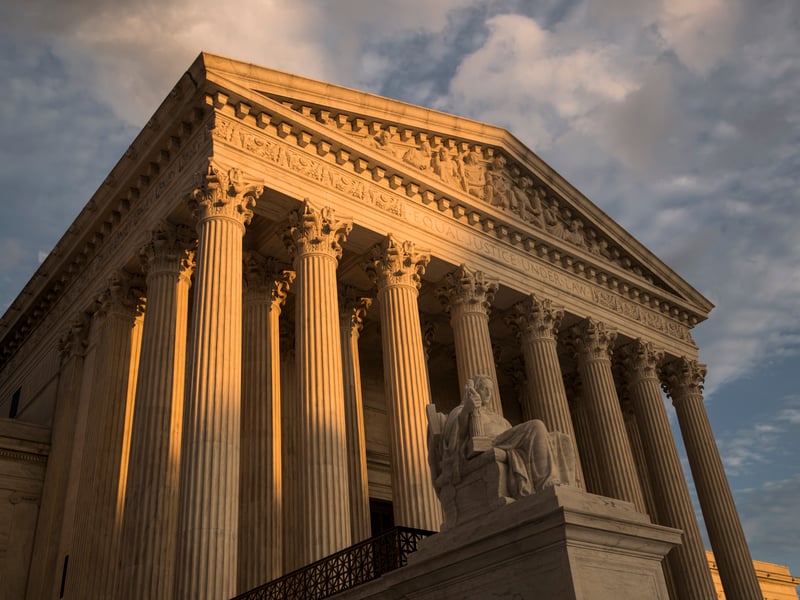
(CN) — The Supreme Court turned down a request Monday to pin down the meaning of an out-of-court “testimonial statement,” which justices previously found can’t be used as evidence at trial because of the Sixth Amendment guarantee that lets defendants confront their accusers.
Justice Samuel Alito and Justice Neil Gorsuch wrote separately, respecting the denial of certiorari but urging the court to reconsider its interpretation of the Constitution’s confrontation clause, which ensures the right to face witnesses in person and cross-examine them.
In a 2004 case, Crawford v. Washington , the high court found the clause barred the use of any “testimonial” statement made out of court by a person who could testify and hadn’t already been cross-examined by the defendant.
However, Alito wrote that this ruling has not produced predictable and consistent results.
“Despite repeated attempts to explain what Crawford meant by ’testimonial statements,’ our Confrontation Clause jurisprudence continues to confound courts, attorneys, and commentators,” the George W. Bush appointee wrote.
The rejected case comes from Cid Franklin, who was arrested in New York following a road rage incident in which he threatened nearby motorists with a gun.
Police searched the basement of Franklin’s home and found a gun in a closet containing items belonging to both Franklin and his stepmother, who lived at the house along with Franklin and his son. While Franklin awaited arraignment in Queens central booking, a Criminal Justice Agency employee interviewed him for a bail report, without a lawyer present, and recorded his address as the basement of his home.
This information was central to the prosecution’s case and Franklin’s weapon possession conviction, as there were no DNA or fingerprints discernable on the gun and there was no other direct proof that Franklin lived in the basement.
Franklin argued that this use of the bail report violated his Sixth Amendment right since he couldn’t cross-examine the report’s author at trial.
But the New York Court of Appeals disagreed, concluding that the bail report was not a barred “testimonial” statement because it was written primarily for “administrative” purposes and not for use at trial.
“It’s hard to fault the Court of Appeals for applying a ‘primary-purpose’ test in assessing Mr. Franklin’s Sixth Amendment claim,” Gorsuch wrote.
The Donald Trump appointee noted that such tests, where a court must objectively determine an out-of-court statement’s “primary purpose,” were endorsed by the justices just last year in Smith v. Arizona .
“But even if that judge-made test may have some useful role to play, it seems to me that treating it as a necessary condition to relief under the Confrontation Clause can pose problems too, risking results that sit uneasily with the Clause’s original meaning. It is a concern I raised in Smith —and one that, to my eyes, this case highlights,” Gorsuch wrote.
He expressed concerns with the challenges of determining the primary purpose of out-of-court statements, which can range drastically from eyewitnesses at crime scenes to expert forensic analyses. This process consequentially leads to different results from different judges in similar cases, the justice wrote.
Gorsuch said Franklin’s case “looks very similar to what the Confrontation Clause was adopted to prevent” — the use of ex parte examinations as evidence against the accused. Historically, he noted, the purpose of such examinations was to ensure that the defendant and key witnesses would appear at trial, not to generate admissible evidence.
“To my mind, all this suggests we may need to rethink our course sometime soon. The primary-purpose test came about accidentally. It has caused considerable confusion. This court has never sought to justify it on the basis of the Sixth Amendment’s text or original meaning. Nor, for that matter, is it easy to see how one might,” Gorsuch wrote.
He added that the original purpose of an out-of-court statement is not what matters under the Sixth Amendment. What matters is whether the government seeks to use a witness’ statement at trial against a defendant in lieu of live testimony.
“Now may not be the moment, I concede, for the court to take up these questions. The court issued its latest word on the Confrontation Clause in Smith less than a year ago. Before weighing in again, we may benefit from the insights and further experience of our lower court colleagues,” Gorsuch wrote. “Along the way, I hope only that they pause to consider the complications surrounding the primary-purpose test and address possible alternatives we might consider.”
 Follow @Megwiththenews
Subscribe to our free newsletters
Our weekly newsletter Closing Arguments offers the latest about ongoing trials, major litigation and rulings in courthouses around the U.S. and the world, while the monthly Under the Lights dishes the legal dirt from Hollywood, sports, Big Tech and the arts.