
 Search Articles


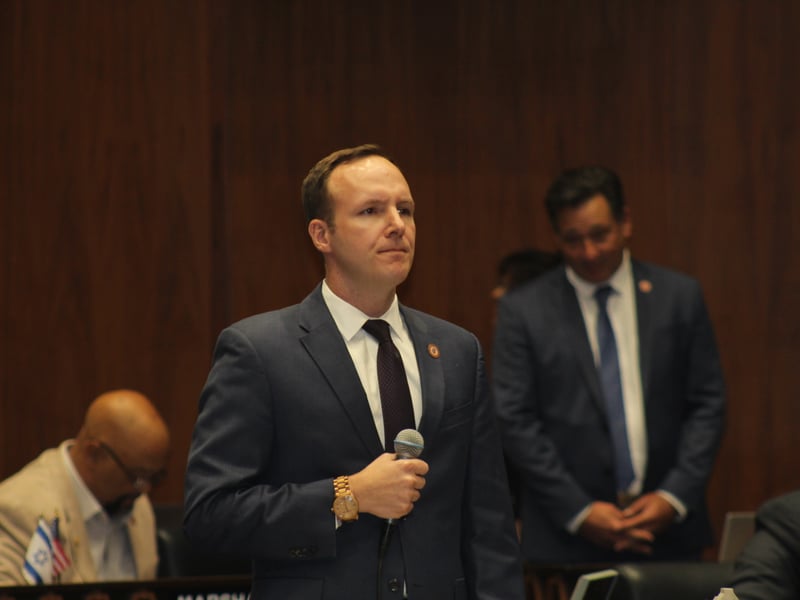
PHOENIX (CN) — Arizona Republicans shut down most of the governor’s budget proposals in the first Joint Appropriations Committee meeting of the legislative session.
The governor’s budget proposal for fiscal year 2026, first published Friday afternoon, includes $23 million for border security and combating fentanyl, more than $100 million in child care funding, and an estimated $150 million saved via guardrails to the universal school voucher program that committee chair David Livingston dismissed as dead on arrival.
Democratic Governor Katie Hobbs proposed $17.7 billion in total expenditures and estimated $16.9 billion returned in revenue, covering the balance with money from the state’s rainy day fund and other trusts to end fiscal year 2026 with $147 million remaining in the state’s pockets. But Hobbs’ proposed expenditures fall $846 million short of the Joint Legislative Budget Committee’s estimates, and her projected revenue eclipses the budget committee’s by $360 million.
Marge Zylla, director of legislative and fiscal affairs for the governor’s office, couldn’t explain why the governor’s projections stray so far from the Legislature’s.
State Representative Matt Gress, a Republican from Phoenix, warned that the remaining $147 million in the governor’s budget isn’t enough to carry over into expenditures the next two years.
“You’re submitting to us a deficit budget,” Gress said.
Zylla told the committee that “conversations are ongoing,” between the governor and the legislative budget committee.
Meanwhile, Livingston, a Republican from Peoria, warned the committee that the state needs an additional $340 million in supplemental expenses for state agencies over the next two years, $110 million of which is needed before April 1 or the state will run out of funding.
“This proposal you sent us does not add up,” Livingston said. “We’re not even close.”
Again, Zylla said the governor’s team is considering everything in its conversations with stakeholders.
The governor’s budget allocates $160 million to increasing child care subsidy payments, $7 million to “First Things First,” a program that funds day care and after school child care businesses, and $1 million to expand child care corporate tax credits for businesses that provide child care services to their employees.
But Gress pointed out that because the average child costs the program $12,000 annually and businesses can apply for up to $100,000 in funding, the million-dollar investment could serve no more than 83 children and as few as 10 businesses.
The budget also includes $3.8 million for schools to give free lunches to students currently on a “reduced” lunch plan. Zylla said eliminating the need to facilitate copays and differentiate between free and reduced lunch plans would reduce administrative spending.
Livingston and other Republicans pressed Zylla on whether students without legal citizenship status would receive the proposed benefits. Zylla assured them that citizenship is required to receive any state benefits.
“Will First Things First get assurances that the money is not being spent to subsidize the health care of illegal immigrants?" Fountain Hills Republican Representative John Kavanagh asked. “Is that gonna be part of their contract?”
Zylla said she’s sure those things will be worked out as negotiations continue.
The budget proposal also allocates $23 million toward local law enforcement and border security, including $10 million for on the ground border support in border communities and $5 million to the Department of Emergency and Military Affairs counter drug task force.
Republicans complained that $23 million isn’t enough.
“While you’re spending $23 million, the previous administration spent $600,000 on the border,” Gress commented. “So I think there’s a bit of an imbalance in resources.”
Hobbs has fought put guardrails on the state’s universal school choice voucher program since she took office in 2023, to no avail. This year, she proposed an income cap to refocus the program on its intended audience.
The program, which gives families the rough amount a public school would have spent on a given student for them to attend school anywhere they’d like, was originally intended to help low income families and students with special needs but has become a hotbed for fraud and abuse.
This year, Hobbs suggests that families who earn more than $200,000 should be ineligible to receive a voucher. Those who earn between $200,000 and $160,000 would receive only 25% of the voucher, those who earn between $160,000 and $130,000 would receive 50% and those who earn below $100,000 would remain eligible for an entire voucher.
That proposal would remove about 9,000 students from the voucher program and reduce the value of the vouchers of 12,000 more.
“I’m just telling you no now,” Livingston said. “We’re not gonna sacrifice 21,000 students to gain $150 million in revenue.”
Livingston suggested that the governor rank her priorities to help the budget committee better negotiate while ensuring she gets at least a few wins. Typically, budget negotiations last through July and are the last order of business the Legislature completes. But the government could sign a budget deal any time during the legislative session.
 Follow @JournalistJoeAZ
Subscribe to our free newsletters
Our weekly newsletter Closing Arguments offers the latest about ongoing trials, major litigation and rulings in courthouses around the U.S. and the world, while the monthly Under the Lights dishes the legal dirt from Hollywood, sports, Big Tech and the arts.