
 Search Articles


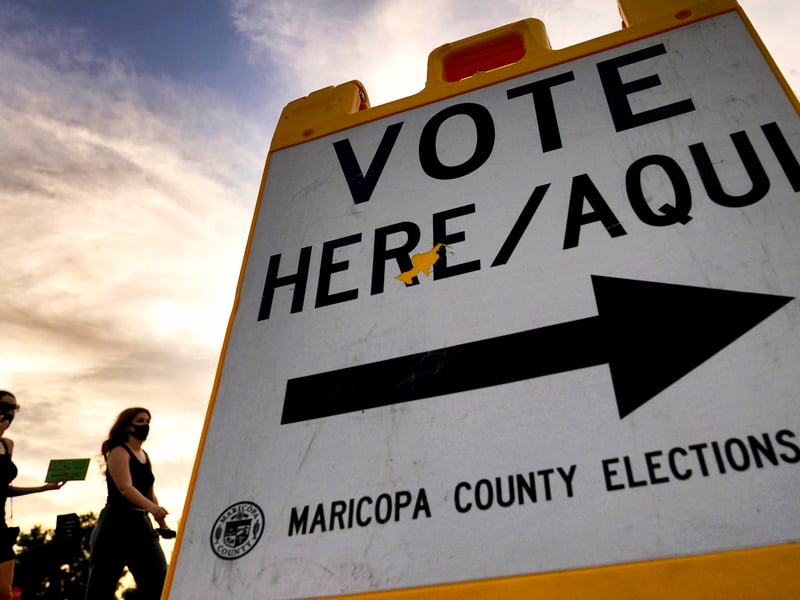
PHOENIX (CN) — Two conservative special-interest groups attacked two provisions of Arizona’s Elections Procedures Manual in federal court on Thursday, arguing the state’s updated election provisions infringe on free speech and the right to vote.
Those groups — American Encore and the American First Policy Institute — have asked a federal judge to enjoin those new provisions, enacted by officials in Arizona with the goal of ensuring free and fair elections.
In response to heightened tensions surrounding elections in Arizona and elsewhere, Democratic Secretary of State Adrian Fontes last year made two additions to the state Elections Procedures Manual — updated every odd year — regarding speech at polling places and vote canvassing by county supervisors.
The first addition, called the vote nullification provision, gives the secretary of state the authority to throw out all votes from a county during certification if the county board of supervisors fails to canvass its results by the required deadline.
That provision was a response to a controversy in Cochise County in 2022, in which two Republican supervisors pushed the final canvass past their deadline and nearly interfered with then-Secretary of State Katie Hobbs’ duty to certify statewide results.
The second addition, called the speech provision, expands the list of what constitutes voter intimidation in Arizona.
The new rules bar “aggressive behavior, such as raising one’s voice or taunting a voter or poll worker,” as well as “using threatening, insulting, or offensive language to a voter or poll worker.” In a lawsuit filed in July, the conservative groups zeroed in on that new language, arguing it violates the First Amendment.
Appearing in federal court in Phoenix on Thursday, Democratic Attorney General Kris Mayes defended these changes to state election law. She asked U.S. District Judge Michael T. Liburdi, a Donald Trump appointee, to dismiss the case.
Speaking about the first change in court, Karen Hartman-Tellez, an attorney with the firm Steptoe who is representing Fontes, told Liburdi that the plaintiffs don’t have standing because they haven’t shown an imminent threat of injury — only a hypothetical one.
Representing the conservative groups, attorney Drew Ensign of the firm Holtzman Vogel argued that the threat of disenfranchisement doesn’t need to be imminent if the threat is credible. Because the change was in response to a situation that nearly occurred in 2022, it’s not unreasonable to suggest that it could happen in the future, he argued.
“The possibility that the government could disenfranchise you, even if the likelihood is well under 1%, creates a cognizable injury,” he said.
Hartman-Tellez suggested that if the alternative to disenfranchising a county is disenfranchising the entire state, the first option was clearly preferable.
Ensign disagreed, arguing each option was equally problematic.
During arguments Thursday, Liburdi seemed more sympathetic to the conservative group’s arguments.
“If this is all hypothetical, why do we even need this?” Liburdi asked. “Mandamus is already a remedy for this.”
“It notifies the counties of the consequences of their failure to carry out their non-discretionary statutory duty,” Hartman-Tellez responded.
But Liburdi remained skeptical, calling the option a “nuclear bomb.”
“It seems totally unnecessary,” he said.
Then there’s the speech provision, which the groups argue infringes on free speech.
Mayes previously wrote the groups about the new provision, reassuring them that the change did not create any new criminal statutes. Instead, the new provisions are simply guidelines for poll workers to know what types of behaviors to look for and report.
“These are intended as examples for the lay election worker,” Nathan Arrowsmith with the Arizona attorney general’s office told Liburdi. “Nothing in this implies it regulates members of the public.”
Ensign again pushed back, arguing that because the provision refers to “any person,” it could be used to prosecute or otherwise remove voters from polling places. He added that the First Amendment doesn’t just protect against legal action.
“Their view is unless there’s criminal charges, it’s not enforcement,” he said. “Any application of coercive power triggers the First Amendment.”
To survive the defendants’ motion to dismiss, Ensign said the plaintiffs don’t yet have to prove the merits of their argument. Instead, they must only prove standing, which he argues they already have because “any person” on its face applies to all voters, not just election workers.
“It’s very clear that the text of the speech restriction doesn’t say what they say it says,” Ensign said.
Liburdi said he intends to have rulings on motions to dismiss and for a preliminary injunction within the next two weeks. Early voting in Arizona begins on Oct. 11, and the last day for county supervisors to canvass election results is Nov. 21, so the parties will need enough time before those dates to litigate appeals — though the window for that is closing.
 Follow @JournalistJoeAZ
Subscribe to our free newsletters
Our weekly newsletter Closing Arguments offers the latest about ongoing trials, major litigation and rulings in courthouses around the U.S. and the world, while the monthly Under the Lights dishes the legal dirt from Hollywood, sports, Big Tech and the arts.