
 Search Articles


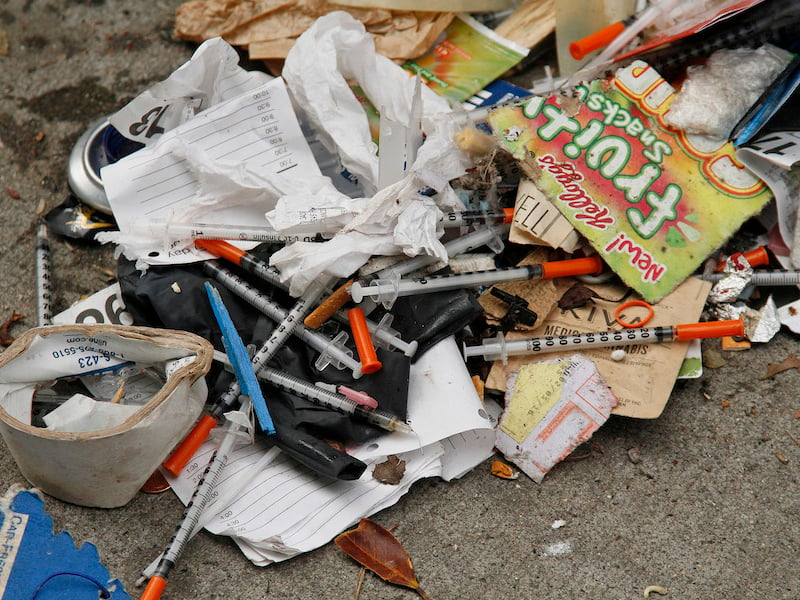
SAN FRANCISCO (CN) — A group of residents and businesses in San Francisco’s Tenderloin District failed Monday to stop the city’s drug paraphernalia program.
The group has argued city-allowed drug consumption sites and paraphernalia distribution lead to illegal drug use, property crime and dangerous and unsanitary behavior. It asked a federal judge to temporarily stop the program as a lawsuit proceeds, saying the city is violating the Americans with Disabilities Act and the Rehabilitation Act.
However, U.S. District Judge Jon Tigar determined the group has no standing and thus isn’t entitled to a preliminary injunction that would stop the drug consumption sites and paraphernalia.
“The city’s arguments are also persuasive on the merits,” the Barack Obama appointee wrote in his ruling. “Plaintiffs have not submitted evidence tying the city’s policies to an increase in drug use or the degradation of conditions in the Tenderloin. Thus, they have not shown the ‘certainly impending harm’ that is required for relief.”
The judge previously dismissed some the group’s claims in its 2024 suit, though others remain pending.
The group wanted the judge to stop contractors working with the city to furnish drug paraphernalia to people in the Tenderloin. It said the action drew drug users and gang-affiliated drug dealers to the district, which created a nuisance. It claims the city allowed the Tenderloin neighborhood to become a “containment zone for narcotic activities.”
San Francisco hinged its arguments on the group’s lack of standing — a point to which the group made no response, Tigar noted.
The group needed to show it would face future injury without a preliminary injunction. However, it didn’t show the paraphernalia policies increased drug use or social problems in the Tenderloin. It also failed to show that stopping the city policy would cause those ills to decrease, Tigar found.
“They note that plaintiffs have failed to respond to the city’s evidence that changes in its policies have actually improved conditions in the Tenderloin such that plaintiffs are no longer at risk of the harms they cited in their motion,” Tigar wrote, adding: “The city submitted photographic evidence of these improvements, as well as testimony from some plaintiffs conceding that conditions have improved such that they are no longer at risk of injury.”
That left the group with only one argument: the theoretical chance it might face future injury. The city argued such fears aren’t legally sufficient to support a preliminary injunction. Also, the group couldn’t prove that stopping the distribution of drug paraphernalia would solve crime, homelessness and drug-use problems. In fact, stopping the program could make those issues worse, as addicts would share or use unsafe paraphernalia.
Tigar noted the group didn’t rebut the arguments, which he called persuasive.
“Plaintiffs claim that the city has ‘presented a distorted visual record of the conditions by excluding images of nearby detrimental conditions,’” Tigar wrote. “But, with one exception, plaintiffs’ rebuttal evidence consists of photographs taken in November 2021. While plaintiffs make generalized contentions that conditions in the Tenderloin have not improved in the intervening time, they present no evidence demonstrating that any of the named plaintiffs can show they are suffering actual or imminent harm.”
The Tenderloin is comprised of some 50 city blocks known for homelessness, crime and open-air drug markets.
“The city has made great progress in reducing crime, disrupting open-air drug markets, getting people into treatment, and addressing homelessness in the Tenderloin and across the city,” said Jen Kwart, communications director with the City Attorney’s Office, in a statement to Courthouse News. “We firmly believe that lawsuits of this kind do not improve conditions on our streets, and we are pleased the court agreed that plaintiffs do not have standing to bring these claims.”
Attorneys for the group couldn’t be reached for comment.
Subscribe to our free newsletters
Our weekly newsletter Closing Arguments offers the latest about ongoing trials, major litigation and rulings in courthouses around the U.S. and the world, while the monthly Under the Lights dishes the legal dirt from Hollywood, sports, Big Tech and the arts.