
 Search Articles


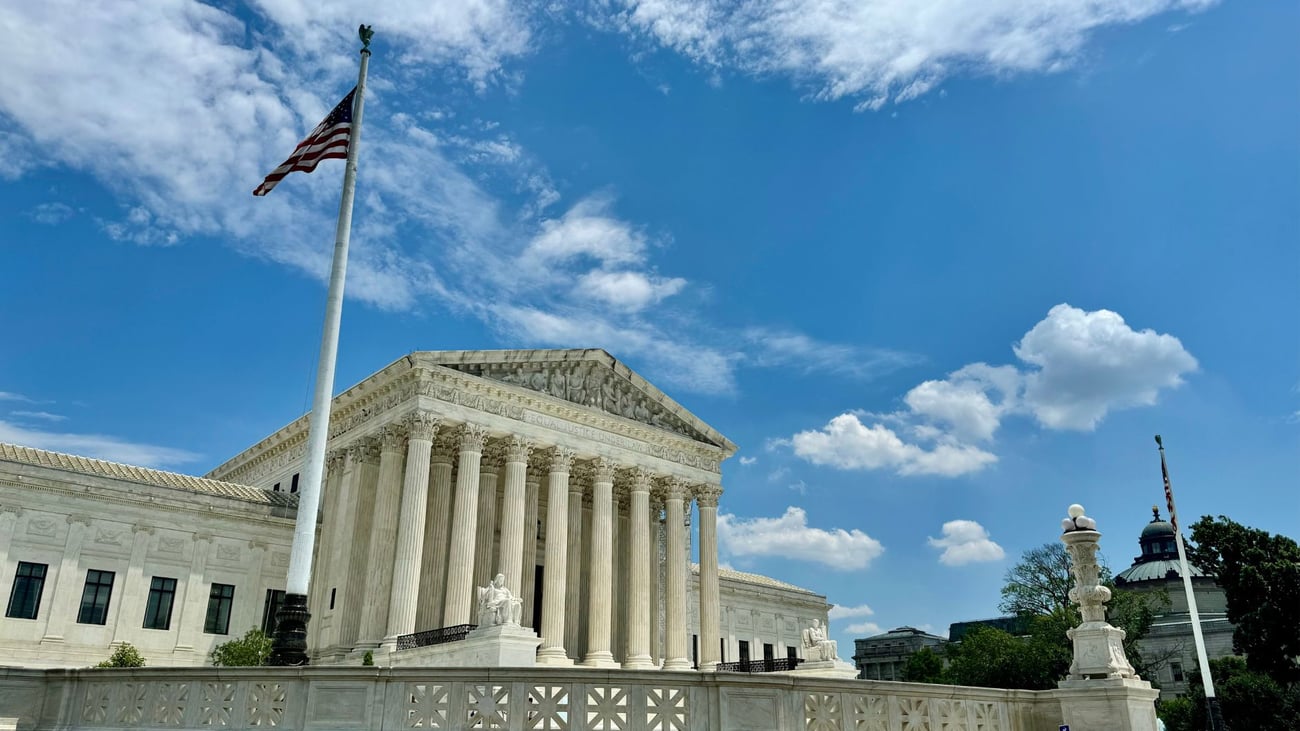
WASHINGTON (CN) — The Supreme Court split 5-4 Thursday over the scope of a decades-old jurisdictional rule, ruling against a Maryland woman who challenged conditions of her release from involuntary hospitalization.
The woman, identified in court papers as T.M., sought federal review of a case she originally brought in state court. The justices rejected her bid under the Rooker-Feldman doctrine, which bars lower federal courts from reviewing state court judgments.
Justice Sonia Sotomayor, writing for the majority, said T.M.’s case fit the “paradigm situation” for application of the doctrine.
“She does not like the result reached in state court and ‘repaired to federal court to undo the [state] judgment in [her] favor,’” the Barack Obama appointee wrote.
Justice Clarence Thomas, a George H.W. Bush appointee, Justice Samuel Alito, a George W. Bush appointee, Justice Brett Kavanaugh, a Donald Trump appointee, and Justice Ketanji Brown Jackson, a Joe Biden appointee, joined Sotomayor’s opinion.
T.M. has a condition she says causes episodes of psychosis after ingesting gluten. After she accidentally consumed gluten in March 2023, she was taken to an emergency room.
An administrative law judge later ordered her involuntarily commitment to a Baltimore hospital over her and her father’s objections. During a three-month stay, she was forcibly injected with antipsychotic medication.
T.M. and her parents sued the hospital seeking her release. In June 2023, the parties reached a settlement requiring T.M. to take medication, continue treatment and dismiss related lawsuits.
After her release, T.M. and her parents challenged the settlement in federal court, leading to the Supreme Court appeal.
At oral argument in April, the case drew veteran Supreme Court advocates, with former U.S. Solicitor General Elizabeth Prelogar representing T.M. and appellate litigator Lisa Blatt arguing for the hospital. Prelogar, now with Cooley, and Blatt, with Williams & Connolly, have collectively argued nearly 100 cases before the justices — with the latter holding the record for the most of any woman in U.S. history.
Blatt ultimately came out on top. Sotomayor wrote that the federal courts lacked jurisdiction because the suit effectively sought to overturn a state court judgment. Only the Supreme Court may review such decisions, she said.
“The court leaves the doctrine as it found it: narrowly confined to ‘cases brought by state-court losers complaining of injuries caused by state-court judgments rendered before the district court proceedings commenced and inviting district court review and rejection of those judgments,’” Sotomayor wrote.
Justice Amy Coney Barrett, a Trump appointee, Chief Justice John Roberts, a George W. Bush appointee, Justice Elena Kagan, an Obama appointee, and Justice Neil Gorsuch, another Trump appointee, disagreed.
Barrett, writing for the dissent, said the majority expanded the doctrine beyond its historical limits.
“Until today, this Court has applied the Rooker-Feldman doctrine ‘only twice,’” Barrett wrote. “That is no accident: Because Rooker-Feldman stands on shaky ground, we have consciously kept its footprint small."
She added that the ruling “muddied waters that were hardly clear to begin with,” arguing the Court should have instead adhered to federal statute governing the effect of state judgments.
Barrett said Rooker-Feldman should only apply when a state proceeding is still pending, warning that the majority’s approach risks confusion in lower courts.
“In the end, Rooker-Feldman has been given an inch — it should not be allowed to take a mile,” she wrote.
 Follow @KelseyReichmann
 Follow @kelseyreichmann.bsky.social
Subscribe to our free newsletters
Our weekly newsletter Closing Arguments offers the latest about ongoing trials, major litigation and rulings in courthouses around the U.S. and the world, while the monthly Under the Lights dishes the legal dirt from Hollywood, sports, Big Tech and the arts.


