
 Search Articles


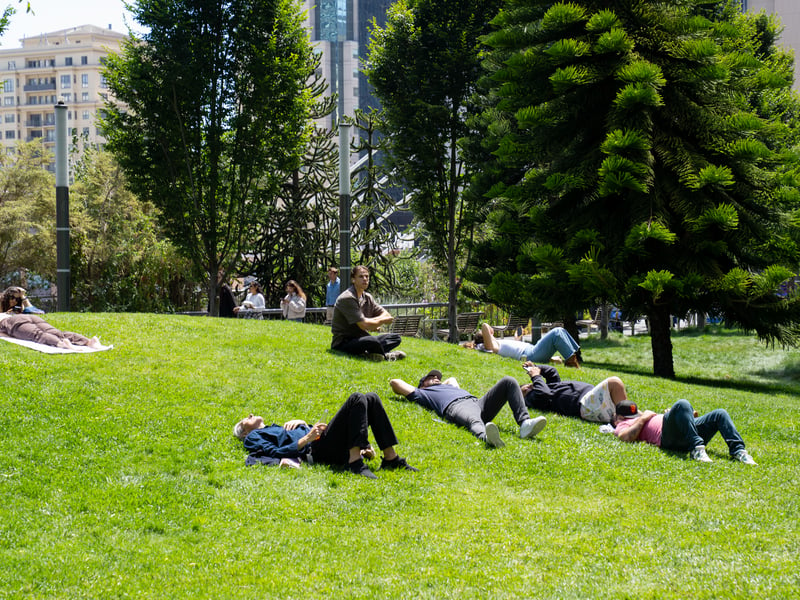
SAN FRANCISCO (CN) — Part engineering marvel and part tech-fueled fever dream, Salesforce Park is undoubtedly one of the nicest green spaces in San Francisco.
Located 70 feet above street level, the park features 16,000 plants, 600 trees and 13 botanical gardens stretched out over more than four football fields. Its usual clientele — nearby residents and tech workers on break, mostly — can enjoy amenities like a half-mile walking path, a playground, a coffee shop, a pizza food truck and an open-air amphitheater that seats around 1,000 people.
Up here in this park in the sky, it’s quiet, clean and safe. There are times one can barely hear the cars on the streets below.
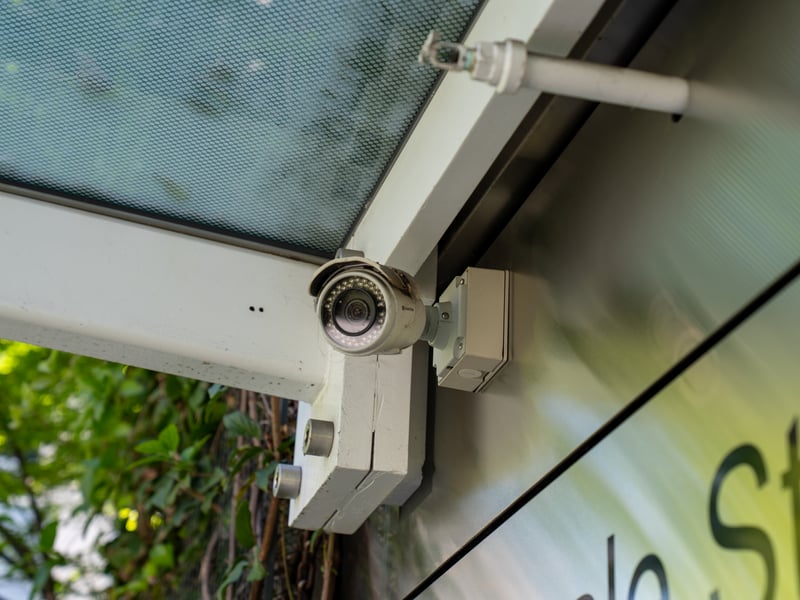
As for another defining feature of San Francisco’s streets — that is, homeless people — one neither sees nor hears them in Salesforce Park. Every part of this space seems designed to keep them out, including two on-duty police officers, three private security guards and at least 92 surveillance cameras.
Due to its location, public access is inherently limited. For those who can’t access park-level entrances from neighboring office towers and apartments, the only way in is via elevator or gondola.
Vague rules prohibit “defying direction from park staff” and “disturbing the park experience for other visitors in any way.” One can easily imagine authorities selectively applying these edicts against homeless people.
“The whole thing looks like a fortress and is kind of made to be impenetrable,” said Rory Thomas, an architecture critic who has written about the anti-homeless design of this place.
Four stories below Salesforce Park, 44-year-old Shaun Robinson lives on the streets. He sat on a nearby sidewalk on a recent afternoon, chomping on a protein bar as pigeons around him pecked at trash on the ground.
Robinson has been homeless for many years, though he was reluctant to say just how many. He didn’t know where he was sleeping that night, but it definitely wouldn’t be in Salesforce Park. He says he’s never visited.
“I don’t know why,” he remarked. “Just never have.”
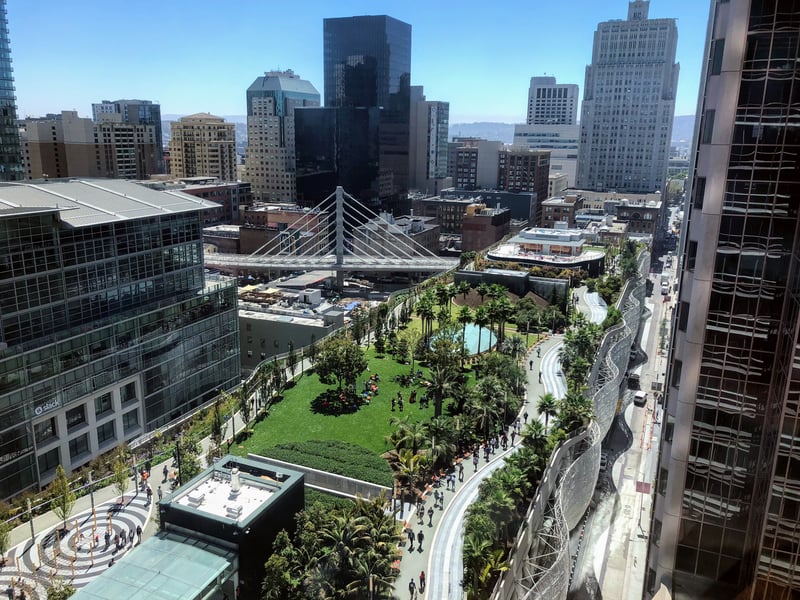
The exclusion of undesirable residents doesn’t seem to particularly bother most parkgoers.
If they even notice, that is. That’s the thing about anti-homeless design: When done right, it’s practically invisible.
Mike Helft, a resident who frequents Salesforce Park, said he likes how it creates a natural environment amid all the concrete and traffic of the city.
“I think it’s beloved,” the 84-year-old said. “I’ve never heard anyone say anything negative about it.” As for homeless San Franciscans, he acknowledged he barely saw them.
“I’ve never seen a homeless person staying here,” he said.
Salesforce Park opened in 2018 after almost a decade of construction. It sits atop Salesforce Transit Center, essentially a central bus depot for the Bay Area’s public-transit system.
The park and transit center cost $2.2 billion to build. Eventually, the city plans to integrate it with California’s high-speed rail system, if and when that long-running project ever wraps.
Despite the name, Salesforce Park isn’t actually owned by the $150 billion software company. Rather, Salesforce simply purchased its naming rights for $110 million in 2017 in the type of deal often seen with sports stadiums. It caused a lot of controversy, but the company says it has no say in park decisions.
Nonetheless, the name is a fitting metaphor for the criticism often leveled at San Francisco: that this once free-spirited city has become dominated by elitist tech weirdos.
Well-paid tech workers make up the bulk of daily visits at this exclusive park in the sky. They’re identifiable by their work badges, which they wear on their belts as they walk with co-workers, play with their kids or take midday naps on the green.
Critics of Salesforce Park zero in on its “hostile architecture” — a design trend meant to discourage specific behaviors.
Often, that means keeping homeless people from relaxing or sleeping.
The practice is well-documented in the city, from “anti-homeless spikes” to its “anti-sleep benches.” Some examples are even more overt, like when a group of neighbors placed boulders on their sidewalks to prevent homeless people from sleeping there.
Hostile architecture is often retrofitted into spaces after the fact. For example, a developer might notice that homeless people are regularly sleeping on a bench, then install dividers to convert it into an anti-sleep bench.
Rory Thomas, the architecture critic, says Salesforce Park goes a step further, “fully integrating” hostile design “from the get-go.”
An architectural assistant by day, Thomas is also co-founder of Umarell, a U.K. magazine that interrogates elitist design.
As he sees it, Salesforce Park has taken a multipronged approach to making homeless people feel unwelcome. Its lack of entrances discourages their entry, while its cameras let them know they’re being watched. Meanwhile, extensive rules put them on notice that they’ll be ejected by security if they’re “disturbing the experience,” whatever that means.
Even more galling, Thomas says park designers have incorporated anti-homeless elements under the pretext of accessibility.
For example, they hyped the park’s anti-sleep benches as “single-person benches,” ostensibly designed so that people in wheelchairs can sit alongside their friends. That earned them plaudits from accessibility advocates — but Thomas says such marketing is a “cop-out."
“They’re using this idea of ‘design for disability’ as a scapegoat for their hostile design, putting the onus on the disabled community and manufacturing this clash between the two communities — as if they can’t exist at the same place,” he said. “It’s just a family-friendly way of coating their anti-homeless architecture.” If designers wanted to make the space truly welcoming for all — including San Francisco’s many residents without stable homes — he says removing the cameras and opening up public stairways could be a start.
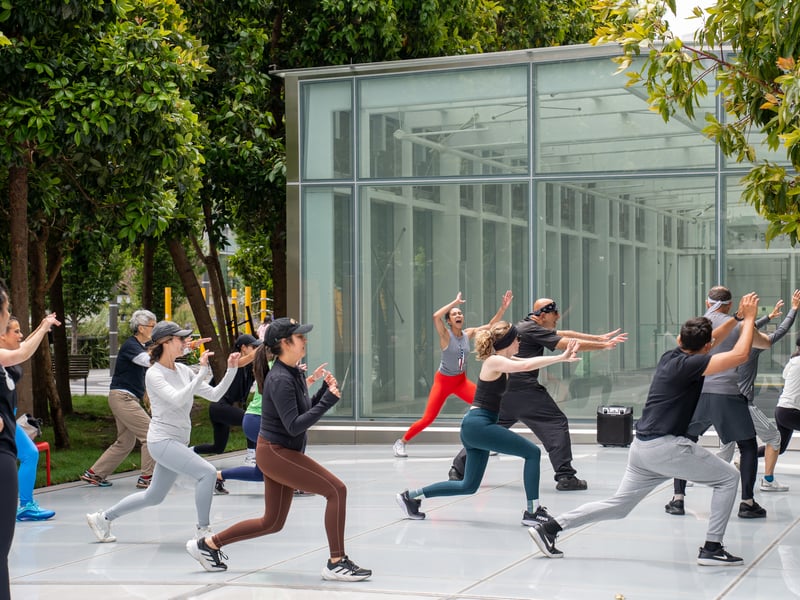
Some rules at Salesforce Park are pretty standard: No alcohol, no feeding the birds, no tents, no sleeping on benches. But to whom exactly do these rules apply?
Over multiple visits, Courthouse News observed several people sleeping in the park — only they weren’t homeless people. Instead, they were young, stylish Bay Area yuppies and tech workers.
Nobody hassled them to keep moving or even politely reminded them to wake up. Things seemed hunky-dory before 10 p.m., when the park officially closes and cops and private security conduct sweeps for anyone left inside. The Transbay Joint Powers Authority, the independent body created by the city to run the park, ultimately didn’t respond to requests for comment.
Although property crime in San Francisco has gone down in recent years, fears of it linger.
Thanks to all the security and security theater at Salesforce Park, people feel safe to do things here that they might not feel comfortable to do elsewhere in the city. They nap in the sun without fear. They leave their laptops on tables when they go to order from the park’s pizza truck.
But there are trade-offs, Thomas says: If a public space is designed for one type of person, it isn’t really a public space at all.
“Is it worth the exclusion of other groups?” he said. “Is your ten minutes being able to sleep under a tree in the sun worth a large portion of your city’s population feeling uncomfortable or being ousted?”
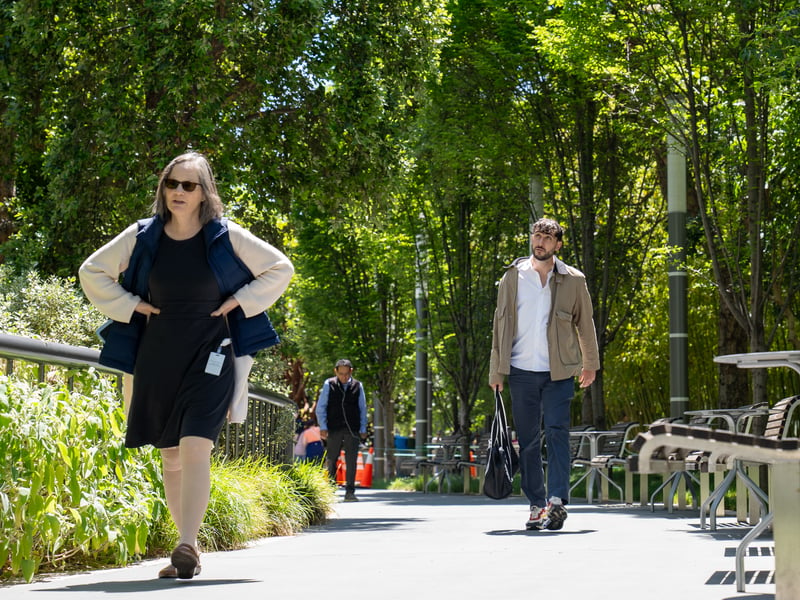
Some parkgoers — particularly younger ones — seem more aware and uneasy with those contradictions. Max McKnight, 22, said the park’s placement high above the city’s streets and homeless residents made him uncomfortable.
“It gives the sense that there’s this ‘upper city’ of the rich and powerful,” he said.
It was a Thursday at Salesforce Park. For parkgoers, that means it’s swing-dancing night.
Back at street level, Robinson, the homeless resident, was trying to figure out where he would settle in for the night. He mentioned a “safe sleep” site in the Mission District, apparently unaware that it closed down in 2023. These days, it seems there are fewer places than ever where the city’s homeless people can just exist in peace.
Subscribe to our free newsletters
Our weekly newsletter Closing Arguments offers the latest about ongoing trials, major litigation and rulings in courthouses around the U.S. and the world, while the monthly Under the Lights dishes the legal dirt from Hollywood, sports, Big Tech and the arts.