
 Search Articles


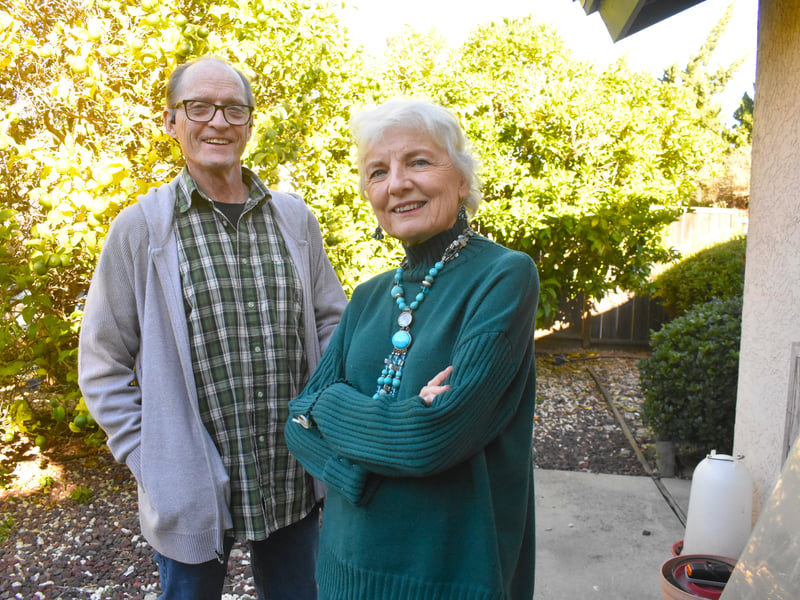
SAN LUIS OBISPO, Calif. (CN) — As a longtime prison hospice volunteer, Carson Dean often witnessed three stages each dying inmate experiences, beginning with a terminal diagnosis.
“The first one is denial,” said Dean, who was incarcerated for 45 years. “’There must be some mistake, right?’ Then there’s anger and bargaining: ‘God, look, get me out of this, and I’ll do all this great stuff and fix these things I should have fixed before.’ And then when none of that starts to work out for you, and you’re in that bed and maybe you can’t even leave the bed, then you want some understanding about your life.”
In his role as a volunteer at the California Men’s Colony (CMC) in San Luis Obispo, Dean has assisted 30 dying inmates, at times acting as a therapist, spiritual adviser and confessor. He details those experiences, along with gritty stories of prison violence and survival, in “Storming Heaven, Comforting the Dying in Prison,” a book he co-wrote with Lorie Adoff, who helped develop the hospice program in 2001.
Prior to the hospice program, prisoners at CMC often died alone, in windowless rooms in an environment surrounded by barbed wire fences and guard towers. The prison, once the most populated in the U.S., currently houses around 3,500 offenders, many of whom were transferred from other prisons. Because inmates sent there are generally less troublesome on the inside, the population includes many older inmates quietly serving life sentences.
“A lot of them weren’t career criminals,” Dean said. “Something went wrong with their life, and they blew it. And then you try to survive in a very criminal environment that’s violent and sadistic and get through that without killing anybody else or being killed.”
Though not without violence, prisoners view CMC as a desirable place to serve time, unlike prisons known for violence including Pelican Bay and San Quentin, where Dean served the first eight years of his sentence. With CMC’s age demographics, death by natural causes is far more common than violent death. With that in mind, Adoff helped launch and implement the hospice program, serving as the prison’s supportive care service spiritual advisor.
While developing the program, she vetted and instructed the volunteers — initially a group of 20, who underwent 10 weeks of training. Each one, she said, was a convicted murderer who wanted to do something positive.
“We would get them in their late 30s, 40s or 50s,” she said. “They were the best volunteers.”
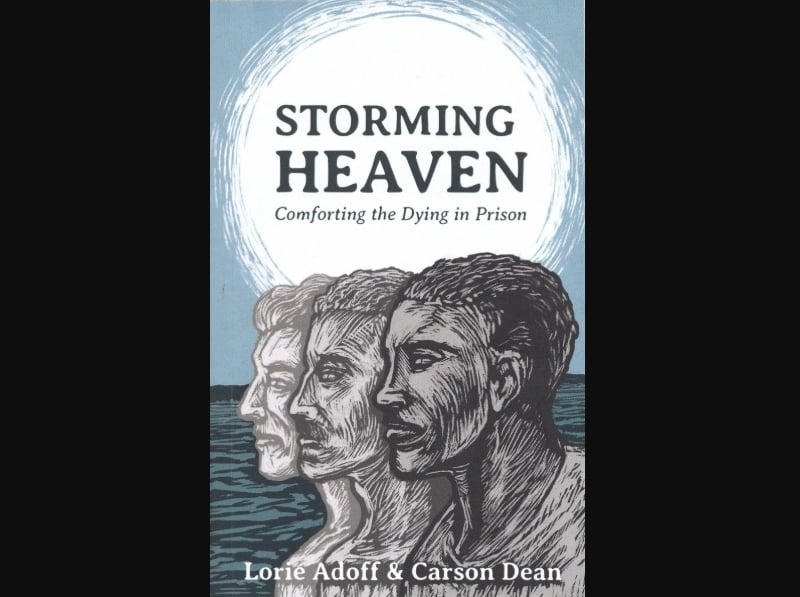
One of them included Dean, who uses a pseudonym, he said, out of respect for his victim’s survivors. In high school, Dean was a writer with potential who eventually completed three years of college, including time at San Jose State, as a business major.
Dean doesn’t detail his crime in the book, but he does allude to his actions, writing at one point, “The foul crime I committed sickens me.”
According to a parole hearing transcript, in 1979 Dean, then 24, took out a $35,000 life insurance policy on his pregnant wife. He then paid $1,500 to have her killed.
After pleading guilty to first-degree murder, Dean was sentenced to 25 years to life in prison, starting at San Quentin — which he calls “The House of Frankenstein.”
At San Quentin, Dean began writing again, often relating stories from the notorious Bay Area prison. He continued to write at CMC, documenting stories of the dying inmates.
“[Carson] had written a lot of hospice stories while I was working there,” Adoff said. “He would come in and give me an essay or a little chapter, and I read those and filed them away.”
Adoff worked at CMC for 13 years. After her husband died in 2019 and her son suggested she write a book about her experiences in the prison, she requested assistance from Dean, who had taken correspondence writing courses from UC Berkeley while in prison. The two worked on the project for four years, beginning during the pandemic.
In the book, chapters alternate between writers. In Dean’s chapters, he weaves stories about hospice with stark stories about prison life, including suicides, murder and fatal guard shootings.
At San Quentin, survival skills were learned on the fly, he wrote.
“It’s good cover to have a slightly crazy, unpredictable reputation,” he wrote, noting that a guard once advised him to fight early in his sentence, saying, “You’ll only have to fight once or twice, and then they’ll leave you the hell alone.”
Fighting skills, a cunning ego and mental discipline, he wrote, helped him through San Quentin.
Adoff’s chapters describe the CMC hospice program, which incorporated poetry, art, psalms, music and rituals. One flute player, she wrote, played songs in the key of D for those suffering from bone cancer and in the key of E for those with diseases of the liver or brain.
Adoff also notes the intense training provided to the volunteers, including advice from coma experts.
In prison, inmates seldom share details of their crimes, Dean said. And, Adoff added, they didn’t trust chaplains because they are employed by the state. But dying inmates often felt the need to talk. So volunteers became death bed confessors.
“There’s actually kind of a bond, and guys would tell me things they were never convicted of, things that they regretted,” Dean said. “We were in a unique place, as kind of being in the priest position where they knew they were dying and anything they said could not come back to them on the yard, where they would be judged. So it was a safe spot, and it allowed them to feel forgiven because I would listen without judgment."
For volunteers, listening was more important than talking or offering false hope.
“Don’t lie to them,” Dean said, detailing one of the training tenets. “Don’t make promises you can’t keep to make them feel better.”
Breathing exercises helped calm the patients, with volunteers often mimicking the patient patterns to reduce anxiety, a common trait among dying patients. After a death, the volunteers would often gather, Adoff said, and discuss their experiences, sometimes crying over friends they had assisted.
After working as a volunteer for eight years, Dean had to confront mortality personally, having been diagnosed with cancer and pneumonia. After intense treatment, including radiation, Dean survived and resumed his volunteer work.
He was still in prison when he began writing the book with Adoff, often sharing passages or ideas via mail or telephone. Adoff eventually began visiting Dean, where the two discussed the book and played Scrabble.
Years after she retired from the prison and the death of her husband, the visits took a turn.
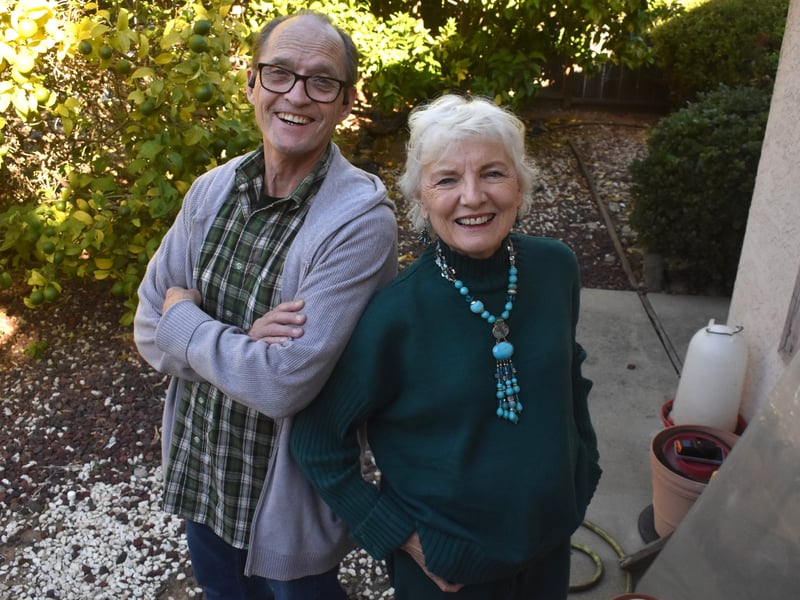
“During the course of writing the book, we developed deeper feelings,” Dean said. “I had never met a human being like her in my life that was compassionate and forgiving and without judgment who could be there for so many people.”
Through his decades of incarceration, Dean saw many of his peers earn a parole date — of the 150 hospice volunteers, he said, all but three have been released. And they have successfully transitioned to the outside world, Adoff wrote, with only two returning to prison for parole violations.
After numerous rejections, Dean was granted parole in January 2024. When Adoff picked him up from transitional housing a year and a half ago, they immediately drove to Morro Rock, at Dean’s request.
The 580-foot volcanic creation sits at the ocean’s edge, a picturesque landmark in the seaside town of Morro Bay, just 10 minutes north of CMC.
“I hadn’t been outdoors,” Dean said. “Everything was behind a wall for 45 years. So we went there, and I saw people, just normal families, on the beach and seagulls flying and surfers and dogs running. It was surreal. Everything was bright and alive versus stilled, controlled, framed.”
Today, the 70-year-old Dean lives in Adoff’s home, where an upstairs room is filled with writings, both nonfiction and fiction, from his life in prison.
His writing is fluid, honest and based on real experiences. After San Quentin guards fatally shot two inmates in a fight, Dean volunteered to mop up the aftermath so he could describe a pool of blood’s physical properties. And when dying inmates confessed their crimes, he took note of their motivations.
“I processed everything in writing,” he said. “All the terrible things I saw and the people I met, I made composites of them in the stories. I have 18 novels up there in boxes. Probably 80 short stories. And at this point in my life, I don’t really know what to do with them.”
While he suffers from post-traumatic stress disorder — he still ensures no one can sneak up behind him by standing or sitting against walls — Adoff said he had adapted well to freedom.
“He doesn’t have that edge, that chip on his shoulder,” she said. “I love being around him.”
Subscribe to our free newsletters
Our weekly newsletter Closing Arguments offers the latest about ongoing trials, major litigation and rulings in courthouses around the U.S. and the world, while the monthly Under the Lights dishes the legal dirt from Hollywood, sports, Big Tech and the arts.