
 Search Articles



MARSEILLE, France (CN) — After months of deadlock, France is entering the first week of a new right-leaning government that presents a stark contrast to elections in which a left-wing coalition won the most votes.
Freshly appointed Prime Minister Michel Barnier named his new team Saturday, with centrist and conservative ministers almost exclusively dominating its ranks.
“It’s a government that is very right wing,” Olivier Costa, a director at the Center for Political Research at Sciences Po, told Courthouse News.
When President Emmanuel Macron announced the dissolution of the government on June 9 — the night of the European elections, in which his bloc received a drubbing — parties across the spectrum scrambled to form coalitions in the hopes of winning an absolute majority in the National Assembly, France’s 577-seat lower chamber of parliament.
The left-wing New Popular Front coalition came out on top, winning 193 seats in the July legislative elections. Macron’s centrist alliance followed with 165, while the extreme-right National Rally finished third with 142 — but no party got an outright majority.
Now, the government is being predominantly run by Barnier’s right-wing Les Républicains party, which garnered 47 seats, and Macron’s Renaissance camp. Socialist Didier Migaud, the new minister of justice, is the only left-wing minister on the roster.
Barnier’s fellow Les Républicains member Bruno Retailleau is taking over as minister of interior, replacing the controversial Gérald Darmanin. The role effectively gives Retailleau control of the country’s police force.
Antoine Armand is the new minister of finance, a challenging position for a country on the brink of a financial crisis. At 33, Armand is part of the trend of young French politicians making gains in the government; he is part of Macron’s Renaissance party.
Sebastien Lecornu, appointed minister of defense, belonged to Les Républicains before joining Macron’s camp in 2017.
Rachida Dati, a controversial Les Républicains figure who has been charged with corruption, kept her job as France’s minister of culture.
“It still is a somewhat paradoxical situation where the two parties that lost the legislative elections — because [Macron’s party] lost almost a hundred seats and Les Républicans did very badly — find themselves in government, and that’s a bit curious,” Costa said.
On X, formerly Twitter, people referred to the new appointees as a “government of losers." People are wondering why Macron dissolved the government in the first place.
On Monday morning, Allison Sachett was opening a bookshop in central Marseille, reflecting on the new government. She can’t wrap her head around the fact that the country has a new right-wing parliament, despite the left’s relative win in the summer’s vote. She identifies as borderline extreme left but doesn’t think their policies are extreme.
“It was very demoralizing, and it’s a big blow to democracy,” she told Courthouse News. “It’s very unnerving and scary for the future.”
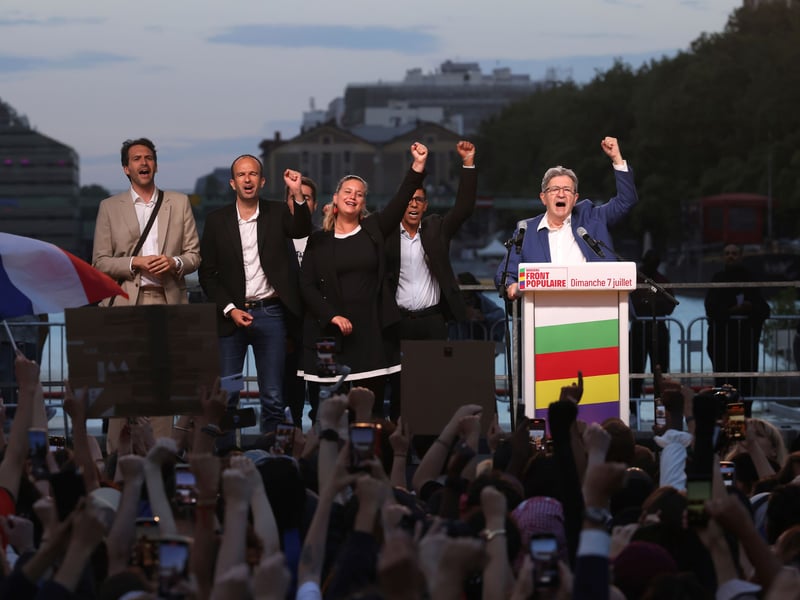
But experts say there’s a clear method to the madness, and it essentially comes down to numbers. Although the New Popular Front won a relative majority in the elections, they wouldn’t have enough power to survive a vote of no confidence; the center, right and far-right would have united to take them out, Costa argues.
“So we have this government simply because there are no other options — that’s it,” he said.
The New Popular Front refused to collaborate with centrists and even some center-leftists; a successful coalition would have been nearly impossible if the prime minister had been appointed from their ranks.
Macron refused to appoint their choice for prime minister, prompting the coalition to cry foul.
“So even if they came out on top, they could not set up a stable government because they would never have a majority in the National Assembly, so that was a very important point for the president of the republic,” Luc Rouban, a senior research fellow at Sciences Po Paris, told Courthouse News.
Controversially, the success of the government effectively hinges on the approval of the National Rally, France’s extreme-right party headed by Marine Le Pen and her 29-year-old protégé Jordan Bardella. It is likely that the New Popular Front will frequently try to dismantle the government. If the National Rally, known by its French initials RN, ever decides to join them, the government will topple.
“Macron in a way today is totally dependent on the National Rally, because it is the National Rally that can bring down the government whenever they want,” Costa explained. “I think that there will be a motion of censure every week from the left, and all it takes is for the RN at a given moment to say, ‘we’re voting with them’ and it’s over for the Barnier government.”
This will likely have an impact on policy, since Barnier will need to appease the RN.
“I think that there will certainly be positions taken on issues that are closely monitored by the National Rally, like the question of immigration, with certainly a much firmer and much stricter policy,” Rouban said. “Perhaps also on everything concerning security, justice and criminal repression.”
Macron appointed Barnier Sept. 5 after leaving the question of the prime minister in limbo for almost two months.
The first major test will be the 2025 budget, which Barnier must present in the beginning of October. If there is enough weight against the plan, the government will crumble, potentially bringing France back to square one.
In Costa’s view, the first order of business is simple.
“The government’s objective is to manage to hold on,” he said.
 Follow @lilyradz
Subscribe to our free newsletters
Our weekly newsletter Closing Arguments offers the latest about ongoing trials, major litigation and rulings in courthouses around the U.S. and the world, while the monthly Under the Lights dishes the legal dirt from Hollywood, sports, Big Tech and the arts.