
 Search Articles


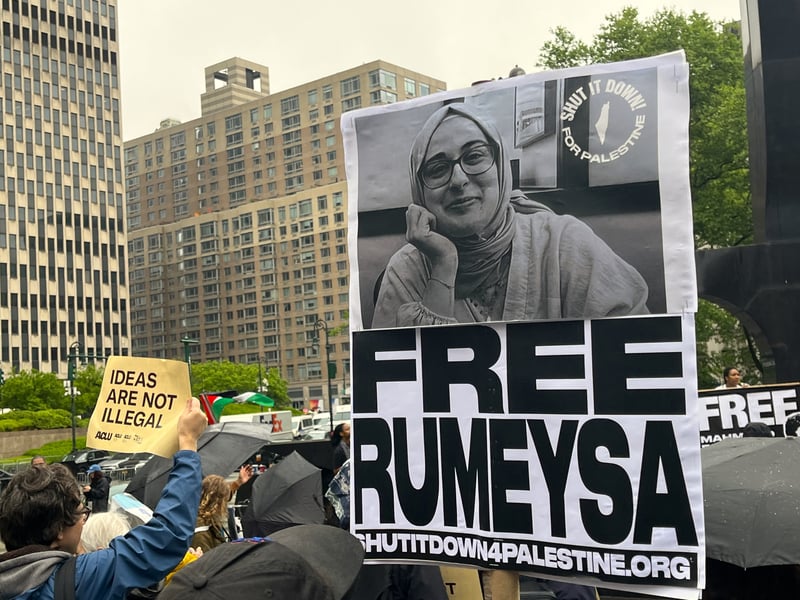
MANHATTAN (CN) — “I’m lost,” a Second Circuit judge said Tuesday while grappling with the government’s bid to re-detain pro-Palestinian student protesters Rumeysa Ozturk and Mohsen Mahdawi.
Federal authorities are challenging separate federal court orders that freed Ozturk and Mahdawi from immigration custody, pending deportation proceedings, after the pair were among several noncitizen scholars swept up for deportation arrests due to their criticism of Israel’s ongoing bombing campaign in the Gaza Strip.
Both students claim in habeas corpus petitions that their arrests were unlawful affronts on their First Amendment rights — direct retaliation for their varying participation in Palestinian advocacy.
Ozturk co-wrote an op-ed for her school newspaper,** The Tufts Daily,** in which she criticized the university’s response to demonstrations on campus. Mahdawi is a longtime Palestinian activist who grew up in the West Bank and protested at Columbia University, where he was pursuing a philosophy degree.
The government claims that the Immigration and Nationality Act strips federal courts of their ability to hear habeas claims challenging unconstitutional detentions, and are thus seeking to reverse the orders in those cases that granted the students their tentative freedom.
“The government is asking this court to become the first to ever hold that the executive can detain someone to censor and punish her speech and that of others without any access to a habeas court for review,” ACLU lawyer Esha Bhandari, representing Ozturk, argued to the court on Tuesday. “There is simply no precedent for that breathtaking proposition.”
Throughout the more than two-hour oral arguments that spanned both Ozturk’s and Mahdawi’s cases, the panel of Second Circuit judges at times struggled to grasp precisely what the government was appealing.
In Ozturk’s case, Justice Department lawyer Tyler Becker argued that the government was being prejudiced by a federal judge’s order that would have transferred her from Louisiana — where she spent roughly six weeks in an immigration jail — to Vermont, had she not been released on bail already.
“I thought that was the release order that keeps you from detaining her,” U.S. Circuit Judge William Nardini said, puzzled by why the appeal wouldn’t be moot. “You’re saying it’s the transfer order that keeps you from detaining her?”
Becker replied that it was the transfer order that is keeping Ozturk in “a sort of habeas-like custody” in Vermont. That comment appeared to confuse Nardini further.
“I guess I’m still not following,” he said.
For Mahdawi, the government claims that he never should have been released on bail at all, invoking a controversial and highly contested account of antisemitism stemming from purported comments Mahdawi made over a decade ago.
“The government had evidence that Mr. Mahdawi told a gun shop owner that he had considerable firearm experience and used to build modified 9mm machine guns to kill Jews while he was in Palestine,” Becker said Tuesday.
The government has made much of this claim in the past, which came from a 2015 police report. Mahdawi has vehemently denied that he ever made these comments, and claimed they were completely fabricated. No charges were ever brought against Mahdawi, and the federal judge who released him on bail this year deemed the accusations unfounded.
“The FBI thoroughly investigated the allegations and took no action on them,” Mahdawi’s ACLU lawyer Michael Tan told the court.
Still, Nardini wasn’t ready to dismiss them outright.
“To me, that’s a dramatically flawed inference,” Nardini said. “In fact, very often what happens when the FBI can’t find evidence of criminal wrongdoing, is they turn around and say, ‘Well maybe the best thing to do is get this guy removed from the country.’”
Two Trump appointees were on Tuesday’s panel: Nardini and U.S. Circuit Judge Steven Menashi. Joining them was U.S. Circuit Judge Debra Livingston, a George W. Bush appointee and the court’s chief judge.
The panel didn’t immediately issue a ruling following the arguments. When they do, it could have wide-reaching effects on the country’s immigration procedure and determine whether federal judges can field these kinds of complaints at all.
Tuesday’s arguments took place just hours after a federal judge issued a scathing ruling finding Ozturk’s and Mahdawi’s detentions to be unlawful affronts to the U.S. Constitution.
U.S. District Judge William Young, a Ronald Reagan appointee in Boston, slammed the government for arresting the students to “intentionally chill the rights to freedom of speech.” But Young didn’t immediately order any remedies, meaning that ruling is unlikely to immediately affect the students’ fate in these appeals cases.
 Follow @Uebey
 Follow @uebey.bsky.social
Subscribe to our free newsletters
Our weekly newsletter Closing Arguments offers the latest about ongoing trials, major litigation and rulings in courthouses around the U.S. and the world, while the monthly Under the Lights dishes the legal dirt from Hollywood, sports, Big Tech and the arts.