
 Search Articles


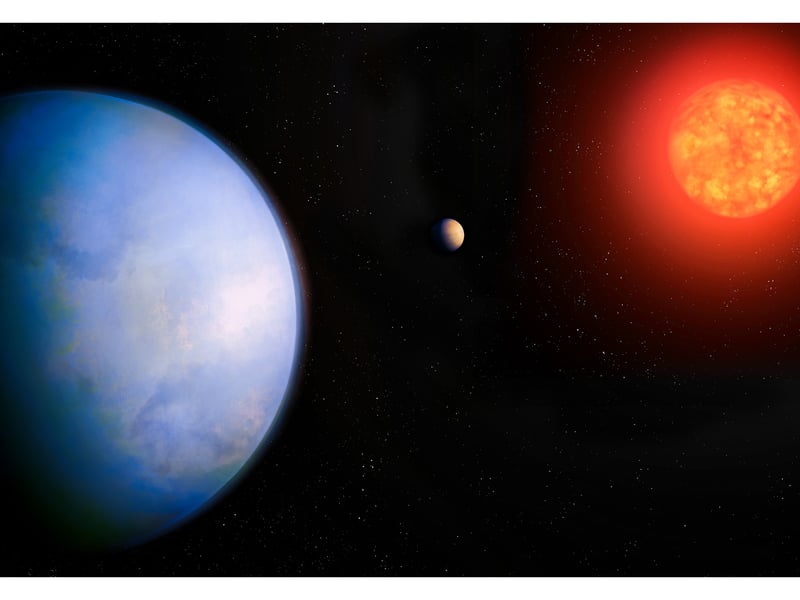
(CN) — Twenty years’ worth of global data and advanced telescopes helped an international research team recently find a potentially habitable super-Earth.
The exoplanet is called GJ 251 c, according to the researchers’ study published Thursday in The Astronomical Journal. They found it upon analyzing observational data that telescopes from around the world collected about the slight movement of the exoplanet’s host star, GJ 251.
The slight movement is called a wobble, which happens when an orbiting planet’s gravity causes tiny Doppler shifts in the star’s light. Analyzing it helped the researchers learn that GJ 251 c is 20 light-years away from Earth in a habitable zone, almost four times our planet’s size and likely a rocky planet, making it what they call a super-Earth.
It’s the latest finding in the search for habitable planets.
“The search for such planets will help us answer a fundamental question about whether life is common in the universe or rare,” said study co-author Suvrath Mahadevan, the Verne M. Willaman professor of astronomy at Penn State. “We know that life originated early in Earth’s history, but it is only by studying other such worlds that we can hope to understand more about the origin of life itself and put our own world in context.”
In order to find GJ 251 c, the researchers used the baseline observations of GJ 251 to improve the wobble measurements of inner planet GJ 251 b, which circles the star every 14 days. They then combined that data with new data from the Habitable-Zone Planet Finder, a high-precision, near-infrared spectrograph that detects Earth-like planets in nearby stars’ habitable zones. The HPF is fixed to the Hobby-Eberly Telescope at the McDonald Observatory in Texas.
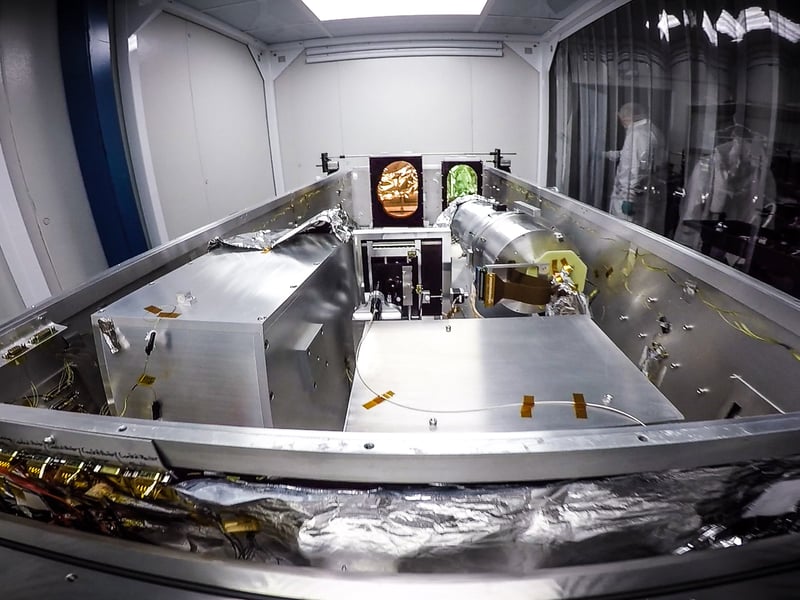
“We call it the Habitable-Zone Planet Finder, because we are looking for worlds that are at the right distance from their star where liquid water could exist on their surface. This has been the central goal of that survey,” said Mahadevan. “This discovery represents one of the best candidates in the search for the atmospheric signature of life elsewhere in the next five to ten years.”
Combining the HPF’s new data with the baseline data revealed a second, stronger signal of something that orbited the star in 54 days, which the researchers took as a sign of another, bigger planet in the system.
They confirmed this theory, the signal and the exoplanet’s existence with the NEID spectrometer that Penn State researchers built, which is attached to a telescope at Arizona’s Kitt Peak National Observatory.
The researchers overcame a major challenge in finding this distant world — separating a planetary signal from its star’s activity. Stellar activity like star spots can mimic a planet’s periodic motion, creating the illusion of a planet that doesn’t exist, so researchers must apply advanced computational techniques to analyze how signals change across wavelengths of light.
Another challenge for this type of study is that it requires collaboration between multiple institutions, global expertise and a sustained commitment to research, and actionable results could take decades to materialize.
But the next generation of telescopes could analyze the planet’s atmosphere and reveal chemical signs of life. Meanwhile, Mahadevan and his students are planning on what to do with telescopes that have advanced instruments, which could image nearby rocky planets in habitable zones.
“While we can’t yet confirm the presence of an atmosphere or life on GJ 251 c, the planet represents a promising target for future exploration,” said Mahadevan. “We made an exciting discovery, but there’s still much more to learn about this planet."
 Follow @kndrleon
Subscribe to our free newsletters
Our weekly newsletter Closing Arguments offers the latest about ongoing trials, major litigation and rulings in courthouses around the U.S. and the world, while the monthly Under the Lights dishes the legal dirt from Hollywood, sports, Big Tech and the arts.