
 Search Articles


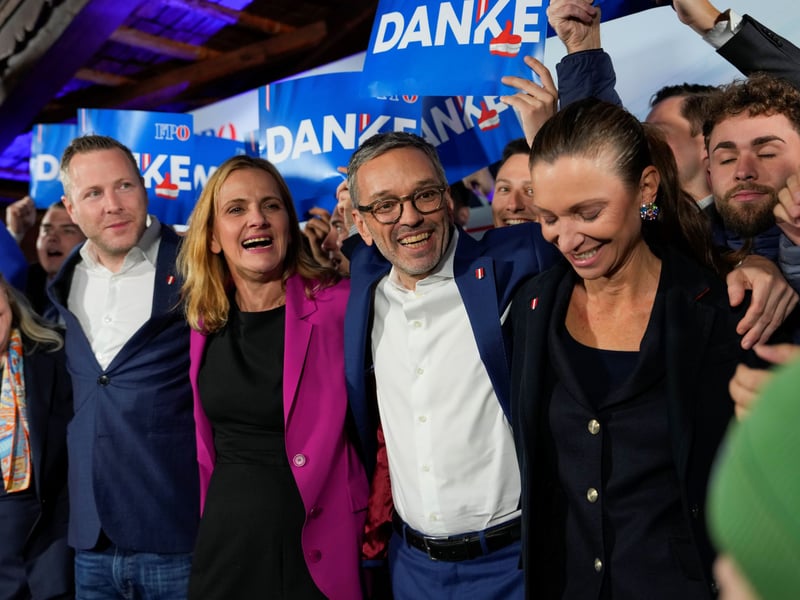
(CN) — Austria’s far-right Freedom Party, founded by former Nazis in the 1950s, won parliamentary elections for the first time on Sunday, but it appears unlikely to lead the country’s next government.
Running on an anti-immigrant “Fortress Austria” slogan and pledges to cut taxes and end support for Ukraine, the Freedom Party picked up about 29.2% of the vote, making surprisingly big gains among women, wealthier and younger voters while also garnering support from many longtime nonvoters. Turnout was high at about 78.5%.
It was the first time since the end of World War II for a far-right party to win national elections in Austria. Similar parties have grown in strength in recent years across Europe and upended traditional politics, most recently in regional elections in eastern Germany where a far-right party, the Alternative for Germany, won state elections in Thuringia, a first since the end of the Nazi regime.
Still, Austria’s traditional centrist parties on the right and left — respectively, the Austrian People’s Party and the Social Democrats — are likely to form a coalition to keep the Freedom Party out of government. Both parties suffered humiliating losses.
The People’s Party got 26.5% of the vote and saw its biggest drop in vote tally ever, down 11% from snap elections it won in 2019. The Social Democrats took in 21%, their worst result ever.
To obtain a stable majority in parliament, it seems they might form Austria’s first-ever three-party coalition with a small liberal party, the New Austria and Liberal Forum. It drew about 9%.
To block Europe’s surging radical right, cross-party coalitions of seemingly incompatible political views have become a common tactic to stave off right-wing populists in France, Germany, Poland and elsewhere in the European Union in recent years.
The Freedom Party has long been a force in Austrian politics and the People’s Party twice entered coalitions with it to form national governments. It first opened the doors to the far right in 2000 when the Freedom Party was led by Jörg Haider, a deeply controversial figure with his Nazi sympathies and anti-immigrant rhetoric.
The far-right win on Sunday was long forecast with opinion polls showing widespread dissatisfaction with the policies and bickering of Austria’s incumbent government, a coalition of the People’s Party and Greens, a party based around fighting climate change.
“Sometimes announced revolutions really take place and this was the case in Austria,” said Kathrin Stainer-Hämmerle, a political scientist at the Carinthia University of Applied Sciences in Austria.
“We had an election campaign that was dominated by fear: Fear of climate change, fear of migration, fear of losing wealth,” Stainer-Hämmerle said, analyzing the elections for reporters on Monday during an online event organized by the European Policy Centre, a Brussels-based think tank.
“There was no party talking about how we can cope with our future with all these challenges,” she added. “The right populist parties will win if we have this kind of emotion in a society dominating.”
The Freedom Party has thrived on anger over the country’s tough lockdowns and mandatory vaccination policy during the coronavirus pandemic, its pro-environment measures, soaring inflation in the wake of the EU’s cutoff of Russian energy supplies and societal strains stemming from immigration.
Stainer-Hämmerle noted a marked uptick in women voting for the Freedom Party and also the strong support it received from wealthier Austrians.
“For the first time, women voted for the Freedom Party,” she said.
In part, she said women may be concerned with immigrant children who struggle with German at school. She added the government’s decision to force people to get vaccinated during the pandemic left many Austrians, among them those who are financially better off, feeling their government was intruding on their private lives.
“We have this group of well-situated people, they are voting for the Freedom Party because they say: ‘First, they started in the pandemic keeping you at home, closing your job, closing your businesses, being vaccinated,” she said. “‘Now, they are coming with climate change: You are not allowed anymore to drive your car, to eat your schnitzel, which are very important in Austria.’ And then they go: ‘They tell you what you can say, what jokes you can make, what songs you have to sing; gender language, and so on.”
The far right also succeeded in getting many politically apathetic Austrians to go to the polls, she added.
“These are people who are not satisfied with what is going on in this country,” she said. Now, she added, they feel they have “a new mouthpiece” in the Freedom Party.
Courthouse News reporter Cain Burdeau is based in the European Union.
 Follow @cainburdeau
Subscribe to our free newsletters
Our weekly newsletter Closing Arguments offers the latest about ongoing trials, major litigation and rulings in courthouses around the U.S. and the world, while the monthly Under the Lights dishes the legal dirt from Hollywood, sports, Big Tech and the arts.