
 Search Articles


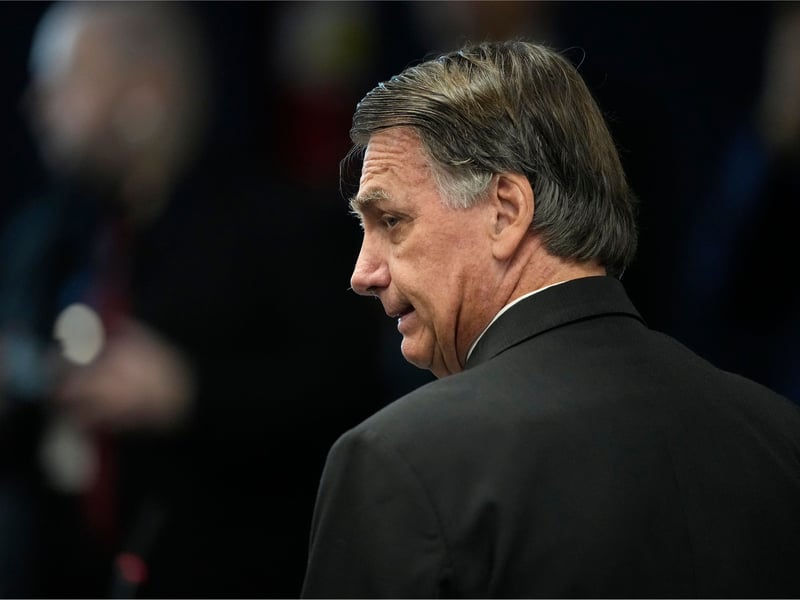
RIO DE JANEIRO (CN) — Brazil’s Supreme Court sentenced former President Jair Bolsonaro to 27 years and three months in prison for his role in a plot to overturn the 2022 election. The ruling is unprecedented: Never before has a former Brazilian head of state been convicted by the country’s highest court for attempting a coup.
The seven other defendants in the same case were also convicted, with sentences varying according to their degree of involvement.
Justice Alexandre de Moraes, the case’s rapporteur, reduced 70-year-old Bolsonaro’s sentence because of his age but stressed the gravity of the crimes, motivated by an effort to keep his group in power and risking a return to dictatorship.
“It is expected that someone elected democratically would act with more rigor,” de Moraes said. “That was not the case. What we saw during his four years in office was the implementation of a criminal organization with a plan to bring about a democratic rupture.”
Bruno Salles Ribeiro, a criminal lawyer, said the ruling “symbolizes the solidity of Brazilian democracy and projects to the world an example of institutional resilience and a non-negotiable respect for constitutional order.”
“This is the first time that a coup attempt has been punished institutionally at the highest level,” he said. “By convicting the former president and senior officials involved, the Supreme Court reaffirms that no one is above the Constitution, and that political and criminal responsibility reaches all who attack democratic pillars.”
The case reached the Supreme Court after federal prosecutors charged Bolsonaro and his allies with five crimes: armed criminal conspiracy, attempted coup, attempted violent abolition of the democratic state, qualified damage and destruction of protected property.
The indictment included speeches, livestreams, documents and testimony from whistleblower Lt. Col. Mauro Cid, Bolsonaro’s former aide-de-camp who described an organized plan to undermine trust in the electoral system and block the inauguration of President Luiz Inácio Lula da Silva.
The reading of votes began Tuesday with de Moraes, who called for the conviction of the plot’s central figures. Justice Flávio Dino followed him that same day.
The surprise came Wednesday, when Justice Luiz Fux delivered a sweeping dissent.
After arguing the court lacked jurisdiction and seeking annulment of the case, Fux read for more than 12 hours, calling for the acquittal of six of the eight defendants, including Bolsonaro, and conviction only of Mauro Cid and retired General Walter Braga Netto, limited to the charge of abolishing the democratic rule of law.
Fux dismissed four of the five charges pressed by prosecutors and described the Jan. 8, 2023, assault on government buildings in Brasília as the work of “disordered mobs.”
His stance contrasted not only with his colleagues but with his own track record. In earlier Jan. 8 cases, Fux had voted with the majority to convict dozens of rioters on coup-related charges.
On Thursday, Justice Cármen Lúcia began her opinion, noting that four of the eight defendants — including Bolsonaro — were among the officials who in 2021 signed the law that criminalized coup attempts and attacks on democratic rule. “The defendants could not claim ignorance about attacking the branches of government,” she said.
She found overwhelming evidence that Bolsonaro led a group of government officials, military officers and intelligence agents in a progressive, systematic plan to undermine institutions.
In her opinion, Cármen Lúcia recalled Brazil’s coup-ridden history and said the case reflects “the Brazil that pains me.”
“Our Republic has a somber history of having had few true republicans,” she said. “That is why this case carries such importance in the year we mark 40 years since the start of redemocratization.”
Rejecting defense arguments that Bolsonaro was “dragged” into the violence, she concluded instead that he led and caused the events culminating in Jan. 8.
She also rejected Fux’s claim that the Supreme Court lacked jurisdiction, citing 2012 precedents from the “mensalão” corruption trial to show the court can judge defendants without special forum privileges.
While she read her opinion, she allowed interruptions — a contrast with Fux, who had barred them the previous day.
Dino warned against proposals for amnesty, comparing Brazil to the United States.
Without naming Charlie Kirk, he referred to the “killing of a far-right influencer,” arguing that President Donald Trump’s pardons of Capitol rioters failed to deliver peace. “Sometimes peace is obtained through proper functioning of the state’s repressive mechanisms,” he said.
De Moraes also intervened, showing videos of Bolsonaro attacking the Supreme Court and of supporters calling for military intervention. He stressed there were no signs saying “Mauro Cid president” or “Braga Netto president,” only “Bolsonaro president” — evidence, he said, that the former president led the conspiracy.
Justice Cristiano Zanin, the chamber’s presiding judge and last to vote, sided with the rapporteur, rejecting all defense objections and voting to convict all defendants.
Lenio Streck, a legal theory professor, said legally Fux’s dissent “means nothing” but “creates a smokescreen, giving oxygen to democracy’s detractors and the judiciary’s enemies.”
Mayra Goulart, a political science professor at the Universidade Federal do Rio de Janeiro, said Fux’s dissent, far from weakening the case, reinforces the Supreme Court’s legitimacy as constitutional guardian. “It rebuts arguments questioning the court’s supposed bias,” she said, “because we have a completely divergent vote, respected, heard and with space inside the court.”
Rodrigo Stumpf González, a political science professor at the Universidade Federal do Rio Grande do Sul, said Fux’s dissent, while judicially normal, gained political weight by acquitting Bolsonaro while convicting subordinates and allies.
“Fux’s vote will be used as motivation in Congress for attempts to grant amnesty to Bolsonaro and the others convicted,” he said. “Whether that succeeds is harder to say, since the unanimous conviction of Braga Netto makes it impossible to deny there was a coup attempt and not just mere protests against the election results.”
Rodrigo Sartoti, a constitutional law attorney, explained that because a solid majority backed conviction, no appeal to the full court is possible, leaving the case to end in the First Panel.
He noted that the ruling has no immediate effect. Formal steps remain, including publication of the judgment and opinions.
In the meantime, prosecutors or the rapporteur could seek new precautionary measures if a flight risk arises. Bolsonaro remains under preventive house arrest with restrictions, and sentences will only begin after final appeals are exhausted.
Streck added that “even with the end of the trial of the main group, including Bolsonaro, democracy remains under attack: internally and externally. Brazilians must realize that.”
Courthouse News reporter Marília Marasciulo is based in Brazil.
Subscribe to our free newsletters
Our weekly newsletter Closing Arguments offers the latest about ongoing trials, major litigation and rulings in courthouses around the U.S. and the world, while the monthly Under the Lights dishes the legal dirt from Hollywood, sports, Big Tech and the arts.