
 Search Articles


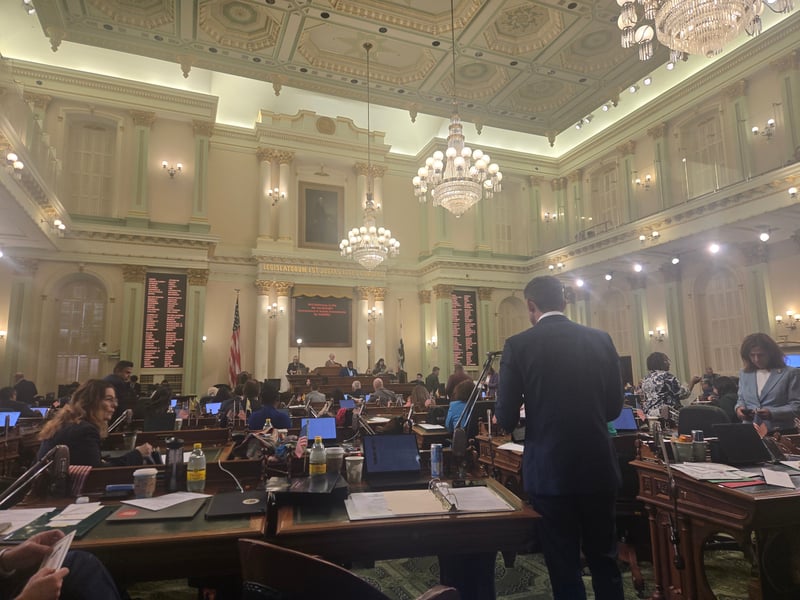
SACRAMENTO, Calif. (CN) — Some of the biggest bills of the California Legislature’s final week couldn’t reach a vote by lawmakers’ last day in session.
So they gave themselves an extra day.
Democratic leadership this week revealed a bill package they say is focused on energy affordability, the climate, and cap-and-trade. It was the result of months of negotiations between lawmakers and Governor Gavin Newsom, appearing publicly midweek in a legislative fanfare.
However, a rule requiring bills to be in print for 72 hours before legislators can vote on them meant they couldn’t reach a floor vote by Friday.
That didn’t mean lawmakers got a break on what’s typically one of the busiest days of their session. Both Assembly and state Senate moved quickly, passing hundreds of bills ranging from removing ultra-processed foods from school meals to allowing universities to give preference to applicants who are the descendants of enslaved people.
The energy affordability bill package, waiting in the wings, will lead lawmakers to return to the Capitol Saturday morning.
“Electricity affordability has been a key area of focus for us over the past year,” said Assemblymember Cottie Petrie-Norris, an Irvine Democrat, speaking about one of the bills at a Friday committee hearing. “We know that there is more work to do.”
A key part of the legislative package is Senate Bill 237, written by a handful of Democrats. It would, among other things, allow Kern County to approve 2,000 new well-drilling permits a year. State Senator Shannon Grove, a Bakersfield Republican, has praised the legislation, saying the state allowed only 84 new well permits last year.
The bill package was touted as a means to stabilize oil production in the state, offer savings to ratepayers through California’s wildfire fund, explore a regional electricity partnership across the West and advance the Golden State’s climate program.
Democrats say the bills will improve utility affordability — a key goal they set at the year’s start, but some Republicans have decried the legislation.
Republicans have said the bill package is a last-minute end-run at making affordability, clean energy and cap-and-trade policy with little to no public input, claiming negotiations occurred behind closed doors.
State Senator Tony Strickland, a Huntington Beach Republican, blasted Senate Bill 840 in a statement, saying it would take $1 billion from the Greenhouse Gas Reduction Fund and funnel it to the high-speed rail project.
Another bill included in the package — Assembly Bill 1207 — would extend the state’s cap-and-trade program to 2045, which Strickland said would cause gas and electricity costs to climb.
Appearing Friday before the Assembly Natural Resources Committee, Senate Bill 237 moved quickly through the process.
State Senator Tim Grayson, a Concord Democrat and one of the bill’s authors, told committee members that Californians can pay as much as a dollar more for a gallon of gas than the residents of other states. One reason is that the Golden State mandates the special gasoline blend that’s more expensive to make.
The bill also gives the governor the power to suspend summer gas blend requirements, a blend typically costlier than others. Additionally, California would evaluate the use of regional fuel blends.
Much of that gasoline is refined in the state, as there are no gas lines connecting California to many different areas like in the Eastern United States.
“California faces severe supply-chain issues,” Grayson said.
The energy bill package, and a looming Saturday morning session, may have weighed on lawmakers’ minds, but it didn’t hamper the energy generated by legislators themselves.
At times, a festival atmosphere prevailed at the Capitol. Cheers from outside both houses’ chambers occasionally erupted, leading one lawmaker, in a tongue-in-cheek manner, to accept them as praise for her bill.
Freshman Assembly members passed around a “yearbook” with pictures of the body’s newest officials, gathering well wishes and signatures.
Members also would step away from their desks for private discussions about legislation. Moments later, they’d return to check bingo cards distributed earlier, hoping a member had intoned one of their squares.
“Decorum, please,” said Assemblymember Josh Lowenthal, serving as speaker pro tempore, in an apparent nod to the game.
Then there was the business of the Legislature itself — hundreds of bills and their authors pushing to beat the Friday deadline.
Touted as the first-of-its-kind, a bill that would define “ultra-processed food” passed its final hurdle Friday in a 72-to-1 vote. Assembly Bill 1264 — written by Assemblymember Jesse Gabriel, an Encino Democrat — sets a timeline for removing designated foods from school meals.
Assemblymember Carl DeMaio, a San Diego Republican, was the lone dissenter.
The state would determine by June 1, 2028, which ultra-processed foods should be removed from schools. Schools would prohibit vendors from offering the foods by mid-2032 and completely prohibit serving or selling them by mid-2035.
“We do have an epidemic in our country,” said Assemblymember James Gallagher, a Yuba City Republican, minority leader and a bill coauthor. “Our kids do have some of the highest rates of diabetes. They’re not healthy.”
Other bills passed and sent to the governor on Friday include:
— The Assembly in a 48-to-14 vote sent Assembly Bill 7 to the governor. The bill — written by Assemblymember Isaac Bryan, a Los Angeles Democrat — allows higher educational institutions to consider giving a preference in admissions to someone who’s descended from an enslaved person.
Bryan said that enslaved people faced beatings, mutilation and death if they learned to read and write. Punishments evolved and continued after emancipation. Some institutions practiced legacy admissions, ensuring wealthy families remained ensconced.
— Assembly Bill 56 passed 47 to 5. Written by Assemblymember Rebecca Bauer-Kahan, an Orinda Democrat, it will require certain social media companies to display a warning label to children when they begin using an app and at certain times afterward.
Newsom has until Oct. 13 to sign or veto the bills. If he does neither by the deadline, the bill becomes law automatically.
Subscribe to our free newsletters
Our weekly newsletter Closing Arguments offers the latest about ongoing trials, major litigation and rulings in courthouses around the U.S. and the world, while the monthly Under the Lights dishes the legal dirt from Hollywood, sports, Big Tech and the arts.