
 Search Articles


(CN) — As sunset approached after evening prayer on May 3, 1337, John Forde was walking along London’s Westcheap street with a fellow priest when three men connected to an ex-lover rushed in and stabbed him to death.
A group of 33 local men quickly assembled in a jury to investigate the crime, coming to the conclusion that Forde hadn’t just been slain in public, but that his death had been an outright assassination, likely ordered by the noblewoman Ela FitzPayne.
In fact, one man believed to have pulled the first knife to cut Forde’s throat was FitzPayne’s own brother, Hascup Neville. The other two men who stabbed Forde with long knives were her servants, including Hugh Colne, who was eventually indicted for the crime.
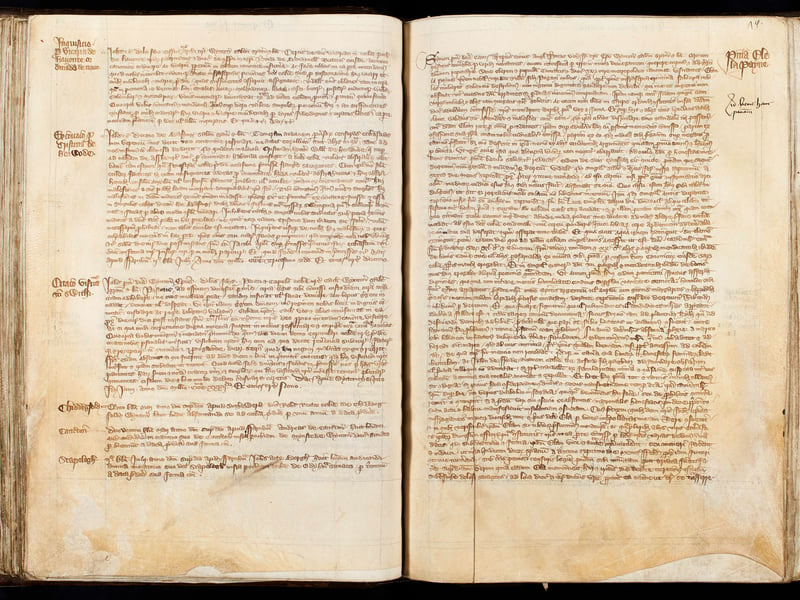
While analyzing a map depicting 355 medieval murders, University of Cambridge criminologist Manuel Eisner uncovered new evidence in Forde’s six-century-old homicide case, published Friday in Criminal Law Forum, that reveals the intimate nature of his relationship with the alleged murderess.
“Taken together, these records suggest a tale of shakedowns, sex and vengeance that expose tensions between the church and England’s elites, culminating in a mafia-style assassination of a fallen man of god by a gang of medieval hitmen,” Eisner said in a statement.
The documents Eisner found include evidence of FitzPayne’s criminal history, along with letters from the archbishop of Canterbury written five years before Forde’s death, condemning her adulterous affair with him.
At the time, Forde was a parish priest in Okeford Fitzpaine, the family estate in Dorset, and FitzPayne was married to a baron named Robert. In 1332, the trio were accused of stealing dozens of oxen, sheep, lambs, and swine from the prior of Stoke Curcy, only to return them on the promise of a ransom paid in resources over several years.
That same year, the archbishop accused FitzPayne of committing “adultery with knights and others, single and married, and even with clerics in holy orders.” Despite the long list of likely lovers, the letters named only Forde in the context of banning her from letting him into her chambers.
The archbishop prohibited FitzPayne from wearing makeup or jewelry or even riding a bejeweled saddle. For penance, the cleric ordered her to light a four-pound candle in a cathedral every year for seven years, while going barefoot and distributing alms to the friars and paupers.
When she ignored the ordered punishment, the archbishop ordered the noblewoman excommunicated and denounced — an act that Eisner speculates may have sown seeds of resentment and a “thirst for vengeance” against her former lover.
On the Medieval Murders podcast, Eisner explores the implications of the evidence with his daughter Nora, who questioned whether Fitzpayne might have also been a victim of her time.
“It doesn’t seem quite fair that they had this affair together, and she was the one who was punished, and John went on with everyday life,” Nora Eisner said on the podcast. “I can see how she felt humiliated, and she wanted revenge.”
Although the documents provide new evidence in the old case, they raise more questions than answers: Did FitzPayne order the death of her ex-lover, or was she a victim of salacious rumor? Did her brother conscript her servants to avenge her, or did Forde say something that provoked an attack?
Given the context of the time, Eisner sides with the former suggestions.
“We are looking at a murder commissioned by a leading figure of the English aristocracy,” Eisner said in the statement. “It is planned and cold-blooded, with a family member and close associates carrying it out, all of which suggests a revenge motive.”
“The public execution style of Forde’s killing, in front of crowds in broad daylight, is similar to the political killings we see now in countries like Russia or Mexico. It’s designed to be a reminder of who is in control,” the criminologist reasoned.
Forde’s death is one of hundreds depicted on the interactive Medieval Murder Map, which invites users to follow the paths of victims and assailants through the dirt-packed streets of old British cities.
The map revealed that the site of Forde’s death in Westcheap was a particularly dangerous area of London at the time, especially for guildsmen who often feuded with one another. Being a sailor or playing backgammon in public could also contribute to an untimely death.
London, York, and Oxford all exhibited patterns typical of high homicide areas, with more than 90% of murders carried out by and against men. Guild members, craftsmen and textile workers made up 30% of homicides in London and more than 60% of reported killings in York. In Oxford, 75% of murders were carried out against clerics and church members, more than eight times the rate in the other two cities.
In fact, Oxford appears to be the murder capital of medieval England, even though it only held a population of 6,000 at the time, compared to London’s 80,000. Eisner attributed the hotbed of conflict to “town-gown” tensions between student factions and local townspeople.
Long knives and short knives proved to be the most popular medieval murder weapons, though arms varied based on who did the killing, with swords, staffs, sticks, stones and hands topping the list.
Though biased toward letting aristocrats off easy, the juries of medieval England appear to have distinguished between justified and excessive uses of force, even accepting self-defense as a reasonable explanation for murder. In the case of Forde’s death, the alleged murderers simply couldn’t be found to account for their crime in May 1337. FitzPayne’s servant, Hugh Colne, was indicted while in prison for another offense at a later time.
Eisner was joined in the research by an international team of scholars spanning the United Kingdom, Switzerland and the U.S. In future projects, the researchers hope to analyze the “changes in urban governance and spatial organization” that successfully drove down urban violence.
 Follow @bright_lamp
Subscribe to our free newsletters
Our weekly newsletter Closing Arguments offers the latest about ongoing trials, major litigation and rulings in courthouses around the U.S. and the world, while the monthly Under the Lights dishes the legal dirt from Hollywood, sports, Big Tech and the arts.