
 Search Articles


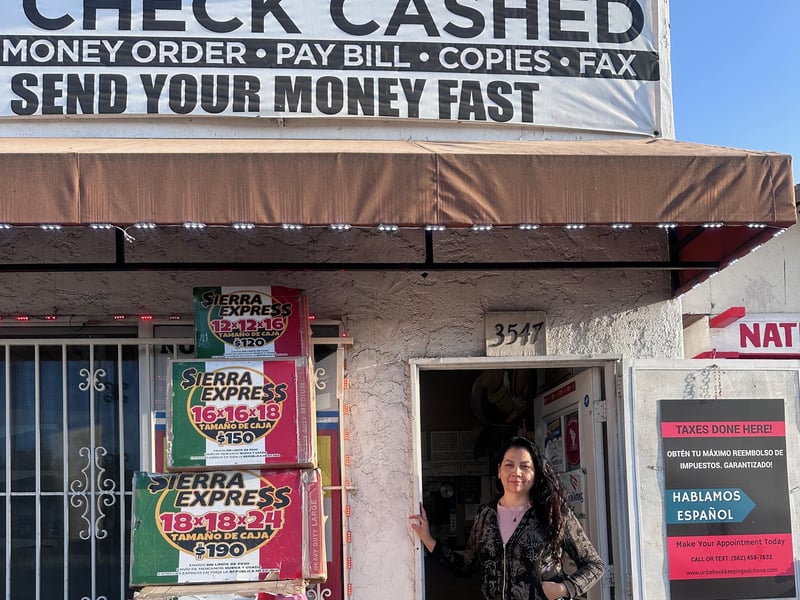
SAN DIEGO (CN) — A federal judge on Tuesday ordered a pause in a case challenging the Trump administration’s new requirement that check cashers, currency exchangers and other money service businesses along the Mexican border report all cash transactions over $200 to federal law enforcement while the government’s appeal moves through the Ninth Circuit.
In March, the Treasury Department’s Financial Crimes Enforcement Network ordered businesses in 30 ZIP codes across Texas and California to follow a rule aimed at uncovering evidence of money laundering and other financial transactions by Mexican drug cartels.
However, Esperanza Gomez, who runs a small money transfer business in San Diego, sued in April, claiming the rule forces owners to surveil customers without probable cause and creates excessive paperwork.
In May, U.S. District Judge Janis Sammartino, a George W. Bush appointee, granted Gomez’s request for a preliminary injunction, halting enforcement of the rule.
Sammartino’s ruling applies only to San Diego and Imperial counties, which fall under her jurisdiction in the Southern District of California.
The federal government appealed to the Ninth Circuit and filed a motion in the San Diego federal court to stay the case pending the Ninth Circuit’s ruling.
Gomez opposed the stay, arguing the Ninth Circuit might rule only on procedural issues, not the case’s core merits.
Gomez argued that lifting the injunction could force businesses to comply with a rule the district court might soon strike down.
The government countered that without a stay, it would have to spend resources on legal arguments that may become irrelevant depending on the Ninth Circuit’s decision.
“The parties’ arguments on the balance of hardships cancel each other out. With respect to the prejudice to defendants in the absence of a stay, such prejudice is minimal,” Sammartino wrote in her order on Tuesday.
Nevertheless, prior case law says that forcing a party to conduct motions on issues that a pending appeal could moot may amount to a hardship that may justify a stay, Sammartino wrote.
“So while the burden on defendants of briefing cross-motions for summary judgment is slight, it remains an important consideration weighing in favor of granting a stay,” she added.
While she recognizes that the plaintiffs could also face prejudice, that could be mitigated by restarting the district case and litigating the actual merits of the case once the Ninth Circuit publishes its opinion, Sammartino wrote.
“Today’s decision means that proceedings in the lower court are paused while the Ninth Circuit reviews the preliminary injunction. We are confident the Ninth Circuit will ultimately affirm the preliminary injunction, and we look forward to resuming litigation in the trial court after that happens. The GTO is an egregious government overreach that will destroy law-abiding businesses, with no discernable benefit in the fight against cartels, and every court that has looked at the issue so far has held that it ought to be enjoined,” wrote Betsy Sanz of the Institute for Justice, one of Gomez’s attorneys, in an email.
Representatives of the Financial Crimes Enforcement Network did not immediately respond to a request for comment.
Gomez’s attorneys are also litigating a parallel case in Texas, where a judge in May ordered the Financial Crimes Enforcement Network to stop enforcing the rule against 10 small money transfer businesses that were parties to the lawsuit.
The evidence of the rule’s damage to businesses in California prior to a temporary restraining order and its ongoing impact on businesses in Texas shows how harmful it is, said Robert Johnson, an attorney for the Texas plaintiffs and Gomez from the Institute for Justice, during a hearing in San Diego federal court in May.
While the rule was in effect for a week in California, Gomez saw a 50% to 60% drop in her customers and Western Union stopped providing cash transfers of any amount of money over $200, he said.
In her complaint, Gomez described her shop as a small, independent business offering perfectly legal services like money transfers, check cashing and money orders to local residents.
Before the FinCEN order, such businesses only had to collect customer info for transactions over $3,000 and report cash transactions above $10,000 via Currency Transaction Reports.
Most customers’ financial transactions range from $300 to $450, Gomez wrote, but each report takes about 24 minutes. She may need to hire staff she can’t afford and fears customers will switch to businesses outside the enforcement zone.
Of the 30 ZIP codes included in the order, 19 are located in Texas, while 11 are in California, affecting approximately 1.2 million people residing in those areas.
Johnson argued the rule is ineffective for targeting cartel money laundering, noting the ZIP codes are noncontiguous and exclude border areas in Arizona and New Mexico, making it easy to evade by visiting nearby businesses outside the zone.
Gomez claims the order violates the Fourth Amendment, calling it a general warrant that enables the government to collect data on private cash transactions without individualized suspicion or probable cause.
Gomez also claims that the order violates the Fifth Amendment, as it compels businesses to act as agents of the government in gathering information from their customers, thereby violating their right against self-incrimination.
The order also violates the nondelegation doctrine of the Constitution, which grants policy decision-making power to the legislature, not executive agencies, she wrote.
Subscribe to our free newsletters
Our weekly newsletter Closing Arguments offers the latest about ongoing trials, major litigation and rulings in courthouses around the U.S. and the world, while the monthly Under the Lights dishes the legal dirt from Hollywood, sports, Big Tech and the arts.