
 Search Articles


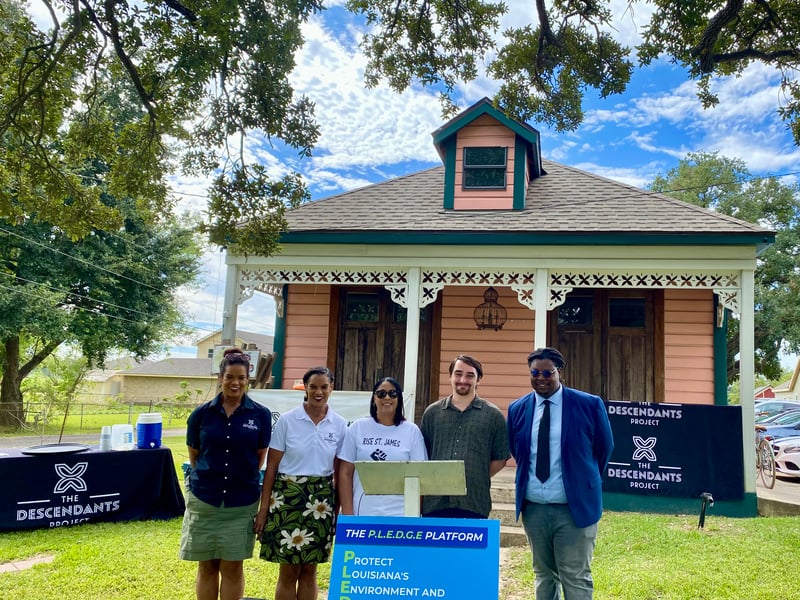
WALLACE, Louisiana (CN) — A coalition of Louisiana organizations kicked off a preelection campaign Monday that asks congressional candidates — and voters — to commit to environmental justice in the state.
Coalition members met Monday outside the Fee-Fo-Lay Café in Wallace, Louisiana, a tiny, mostly Black agricultural town in the heart of heavy industrialization.
The coalition organizations want candidates for Louisiana’s 2nd Congressional District to renounce campaign contributions from the oil and gas industry and pledge to end the pollution that brings the name “cancer alley” to a mostly Black, rural, and heavily industrial swath of land about 50 miles upriver from New Orleans.
The coalition calls its project the PLEDGE — Protect Louisiana’s Environment and Demand a Green Economy — platform.
Sisters Joy and Jo Banner run the Descendants Project, a member of the PLEDGE coalition and an organization “founded to preserve and protect the health, land, and lives of the Black descendent community located in Louisiana’s river parishes.”
“It’s a beautiful day,” Joy Banner said during Monday’s press conference.
“If you were here, you would be in the country under a beautiful oak tree,” Banner said, “but you can also smell the bauxite that is coming from the refinery across the river.”
Banner wasn’t exaggerating about the industrial smell. As if the setting had been ripped from the pages of a Dr. Suess storybook, despite a breeze and pretty country surrounding Monday’s morning meeting, there was nothing fresh about the air in Wallace. A heavy, unmistakable dirtiness entered the mouths of those present, and by the end of the 50-minute press conference, participants’ eyes burned. All the while, birds chirped and white clouds drifted across an otherwise clear autumn sky.
A block to the east of where Banner stood is the site where Greenfield Louisiana LLC had planned to build a massive grain elevator, despite fierce opposition. The company shocked its many opponents in August by abruptly shelving the project.
“This part of the community for far too long has been written off as a part that is worthy to be handed over to the petrochemical companies, and we say no more,” Jack Sweeney, an environmental and economic justice organizer who helped pull together the PLEDGE platform said during Monday’s meeting.
Shamell Lavigne, of the environmental justice group Rise St. James, urged congressional candidates Monday to pledge to stop the country’s dependance on oil and gas that she said has turned Wallace and areas all around it into a “sacrifice zone” for the oil industry.
“Our community in St. James is full,” Lavigne said. “Communities in St. John Parish are full. Cancer alley is full. We cannot withstand the threat that a further petrochemical buildout represents, and we will not allow that threat to our communities to come to pass.”
Lavigne urged policymakers in Washington to lend a hand to help transform cancer alley into a clean and renewable energy sector before it’s too late, saying she and the rest of her community were unwilling to stand by and let their representatives fail them.
“We need representatives in Washington, D.C. who will stand with us in fighting that threat to our communities and demanding a total moratorium on new petrochemical development in St. James and throughout Cancer Alley,” Lavigne said.
“We need representatives in Washington, D.C. who will also fight to protect us and our communities from the already existing threats of toxic pollution in our air, water, and soil, as well as industrial influence over our regulatory agencies, elected representatives, and our economic future,” Lavigne said.
She said that if state agencies, like the Louisiana Department of Environmental Quality and the Louisiana Department of Health “continue to represent petrochemical companies rather than the public and their health, federal representatives will have to sound the alarm and push for federal action to hold them accountable.”
People in cancer alley reportedly have a 95% greater chance of developing cancer than people in other regions.
Devin Davis, a candidate for the 2nd Congressional District, said he has a family member who worked at a petrochemical plant in Wallace and died of colon cancer.
“The tragedy to me is that this was not an isolated incident,” Davis said of his family member.
“It saddens me that we have a candidate who has taken money from this very industry that is poisoning our people and land and air and water,” Davis added, presumably referring to Democratic Representative Troy Carter, who ran on a campaign pledge that he would not take oil and gas money and since has accepted at least $19,000 from the industry.
The PLEDGE platform asks candidates to commit to not taking contributions from fossil fuel companies and executives, support a moratorium on new petrochemical development in cancer alley, work to strengthen and enforce federal protections from and regulations on pollutants, promote economic diversification and clean energy in Louisiana, and provide compensation for damages caused by the petrochemical industry to Louisiana’s health, environment and communities.
Coalition member organizations include Alliance for Affordable Energy, Concerned Citizens of St. John, The Descendants Project, Greater New Orleans Interfaith Climate Coalition, Inclusive Louisiana, Rise St. James and Sprout New Orleans.
The name “cancer alley” originated in the 1980s because of residents’ poor health and environmental pollution within an 85-mile stretch of land along the Mississippi River between Baton Rouge and New Orleans. The area is home to many petrochemical factories that opened during a period of rapid industrial growth.
 Follow @SabrinaCanfiel2
Subscribe to our free newsletters
Our weekly newsletter Closing Arguments offers the latest about ongoing trials, major litigation and rulings in courthouses around the U.S. and the world, while the monthly Under the Lights dishes the legal dirt from Hollywood, sports, Big Tech and the arts.