
 Search Articles


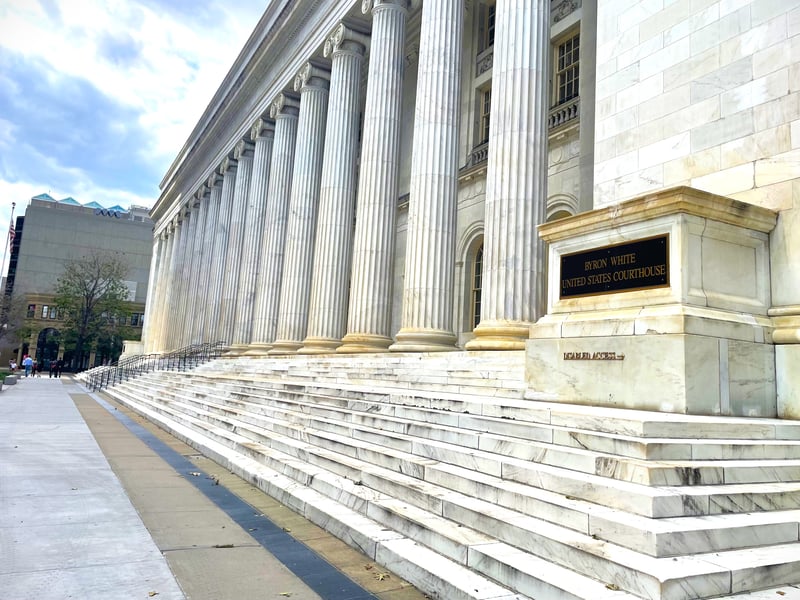
DENVER (CN) — Qualified immunity does not shield a Douglas County sheriff’s deputy and a dog handler from suit after they blindly sent a police canine into a home with a broken window in Highlands Ranch, Colorado, according to the 10th Circuit on Tuesday in affirming a lower court’s order.
“In short, it is clearly established under Tenth Circuit law that it violates the Fourth Amendment to use force without warning against a non-violent, non-resisting suspect who is given no chance to comply,” wrote U.S. Circuit Judge Carolyn McHugh in a 37-page opinion.
“It was clearly established under our case law in February 2022 that using a canine to restrain a non-violent, non-fleeing suspect could constitute excessive force,” the Barack Obama appointee added.
On Feb. 11, 2022, a person in the Denver suburb of Highlands Ranch called 911 to report a man breaking a window to climb inside a house. Douglas County Sheriff’s Deputy Scott Kelly and canine handler Tyler Kyle investigated. After hearing a voice inside the house, they said they feared a hostage situation, and sent a police canine named Sig in through the window. Sig quickly located and bit the sleeping homeowner, Tyler Luethje.
Luethje told officers he lived there and admitted breaking the window when he couldn’t find his key. Nevertheless, Kyle and Kelly handcuffed Luethje, placed him in a patrol car wearing only his sweatpants and called an ambulance. When Luethje left for the hospital, the deputies searched his home.
The deputies found no evidence of a crime and filed no charges against Luethje.
Luethje sued the deputies on Nov. 17, 2023, claiming they used excessive force and conducted an unlawful search and arrest, in violation of his Fourth Amendment rights.
A federal judge denied the deputies’ motion for qualified immunity on June 5, 2024, finding they had no justification for the use of force and lacked probable cause to support arresting the homeowner. The deputies appealed.
“Physical entry of the home is the chief evil against which the wording of the Fourth Amendment is directed,” wrote McHugh, quoting the 1980 Supreme Court case Payton v. New York that found police cannot search a suspect’s home without a warrant unless there is an emergency.
Although urgent circumstances can override the prohibition on warrantless searches, the court found the deputies faced no immediacy that required entering the home without Luethje’s permission, and didn’t uncover any new information before sending the dog in.
During oral argument, McHugh raised the concern that the dog was just as likely to bite a child as a burglar since the deputies didn’t even know who lived in the house.
“The deputies’ argument they reasonably believed there was a suspect inside who was reluctant to talk to the police stretches the facts alleged beyond recognition,” McHugh wrote.
In addition to lacking enough information to enter the home, the court found the deputies’ arrest of Luethje was also unfounded.
McHugh said no reasonable police officer would have released a police dog into a home through a broken window with the amount of information Kyle and Kelly had. Facing the broken window with the information relayed over the 911 call, McHugh concluded that a reasonable officer “could not have reasonably believed that probable cause existed to arrest the first person inside for criminal mischief.”
Luethje’s attorney Raymond Bryant said he was pleased with the decision and looks forward to getting the case in front of a jury.
“We think this is a very important and precedential decision that makes clear police officers may not enter a person’s home based on unfounded assertions of criminal activity and that they may not use canine force on a non-violent, non-resistive person,” Bryant told Courthouse News over email.
Kyle and Kelly are represented by Douglas County Attorney Kelly Dunnaway. A spokesperson for the Douglas County Sheriff’s Office said they stand by the deputy’s actions.
“While we respect the Court’s judgment, we are confident that when all of the facts are known, it will be clear that our deputies acted legally and properly,” said public information officer Deputy Cocha Heyden via email. “On the advice of counsel, we cannot comment further on this matter while litigation is still pending.”
Obama-appointed U.S. Circuit Judges Gregory Phillips and Scott Matheson signed onto the opinion, sending the case back to Joe Biden-appointed U.S. Judge Charlotte Sweeney.
 Follow @bright_lamp
Subscribe to our free newsletters
Our weekly newsletter Closing Arguments offers the latest about ongoing trials, major litigation and rulings in courthouses around the U.S. and the world, while the monthly Under the Lights dishes the legal dirt from Hollywood, sports, Big Tech and the arts.