
 Search Articles


DENVER (CN) — Prosecutors from the 11th Judicial District Attorney’s Office in Colorado asked a federal judge on Wednesday to apply absolute immunity and dismiss a $15 million lawsuit filed by a widower who was arrested on suspicion of murdering his wife in 2021.
Barry Morphew’s wife, Suzanne, disappeared from their home in Maysville, Colorado on Mother’s Day in 2020. Chaffee County sheriffs arrested Morphew more than a year later in May 2021 and held him until he posted bond four months later. The charges against Morphew were dismissed in April 2022, just before a scheduled trial.
On May 2, 2023, Morphew sued Chaffee County, along with its sheriff’s department, the 11th Judicial District Attorney’s office and more than a dozen individuals who investigated the case and contributed to a faulty arrest affidavit. Morphew asks the court to award $15 million in damages and order law enforcement to release his property — including family photos and expensive hunting scopes.
Investigators recovered Suzanne’s body in Saguache County last September, transferring jurisdiction of the case to the 12th Judicial District. Her murder remains unsolved.
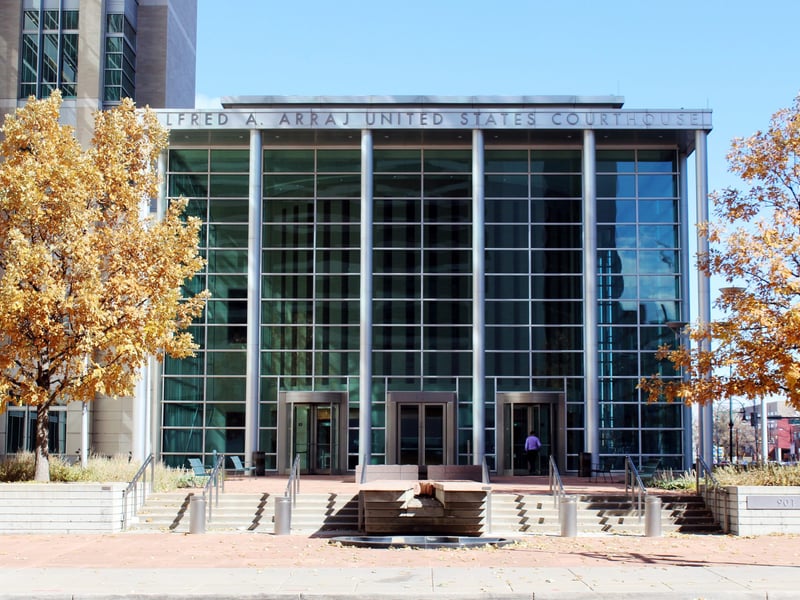
At a motions hearing at the Alfred Araaj U.S. Courthouse in downtown Denver Wednesday, defense attorneys asked U.S. District Judge Daniel Domenico to apply absolute and qualified immunity and toss the case.
Representing Deputy District Attorney Jeff Lindsay, defense attorney William O’Connoll of Wells Anderson, argued, “Mr. Lindsay is alleged to have taken an active hand in drafting the arrest warrant affidavit, which is part and parcel of his role as an advocate the court, it’s part of the judicial process, and it relies on his professionalism judgment for what to include, what not to include.”
Morphew’s attorney, Iris Eytan, urged Domenico look beyond the shield of immunity and hold the actors responsible for supporting a faulty arrest, but the Donald Trump appointee declined.
“You understand I’m just here at the bottom rung and I apply the law set in precedent, so if you are trying to preserve your argument for a higher court, you’ve done it,” Domenico said. “Immunity is something we’re going to have to deal with.”
Analyzing the warrant in question, Domenico said he could see it supporting probable cause for an arrest, but postulated the question should be answered by a judge, not a jury.
“You are not a potted plant, you have a low bar to find whether or not the case survives qualified immunity,” explained Hollis Whitson, also on behalf of Morphew. “All the court needs to do is decide whether we have sufficiently alleged violations. and could a jury make the determination that there was probable cause lacking.”
At the time of Suzanne Morphew’s disappearance, she and Barry had been married 20 years and had two daughters, Mallory and Macy, ages 20 and 16.
Morphew says in his complaint that he was in Broomfield at the time of his wife’s disappearance, a three-hour drive away, preparing for a landscaping job, while his daughters were on a road trip to Utah and due to arrive home at any time.
When his wife stopped responding to calls and texts, Morphew says in the suit that he sent a neighbor to check on her and then called law enforcement. Officers soon recovered Suzanne Morphew’s bike near a ravine up the road. Her helmet was found another mile down the road.
Morphew helped search for his wife and provided clothes for the police dog Rosco to sniff. Despite his alibi and cooperation, investigators began to suspect him of “hunting Suzanne the same way he hunted animals,” he says.
Six months into the investigation, law enforcement found secret recordings on a spy pen that indicated Suzanne was having an affair with a man from her high school in Indiana. Investigators reasoned that Morphew could have been motivated by jealousy to murder his wife, he says in the complaint.
“The defendants theorized that on May 9, 2020, Barry arrived home from work around 2:30 p.m., chased Suzanne around the house, killed her using tranquilizer serum in a dart shot by a gun, disposed of her body and all evidence of the crime, and then created an alibi by going to Broomfield the next day, Sunday, May 10, 2020,” Morphew explains in his 185-page lawsuit.
Morphew claims in the complaint he only learned about Suzanne’s affair in January 2021 from investigators, and that he was “shocked.”
As evidence of probable cause, police pointed to “what was believed to be a needle cover to a syringe, by itself at the bottom of the empty clothes dryer.” Not only was the cap not really associated with Morphew’s tranquilizer guns, he argues, he hadn’t filled a prescription for animal tranquilizer in years — facts not disclosed in the arrest warrant.
When filing for an arrest warrant however, investigators failed to disclose the fact that DNA found in the house and Suzanne’s car was linked to two other unsolved sex offenses in Arizona. Local law enforcement also relied on questionable GPA data despite being cautioned against it by the federal investigators, Morphew claims.
“All defendants caused the arrest warrant to be issued despite knowing there was no probable cause,” Morphew says in the complaint. “All defendants caused the murder and related charges to be brought despite knowing there was no probable cause.”
Domenico did not indicate how he would decide the motions before him but promised a written order in the coming weeks.
 Follow @bright_lamp
Subscribe to our free newsletters
Our weekly newsletter Closing Arguments offers the latest about ongoing trials, major litigation and rulings in courthouses around the U.S. and the world, while the monthly Under the Lights dishes the legal dirt from Hollywood, sports, Big Tech and the arts.