
 Search Articles


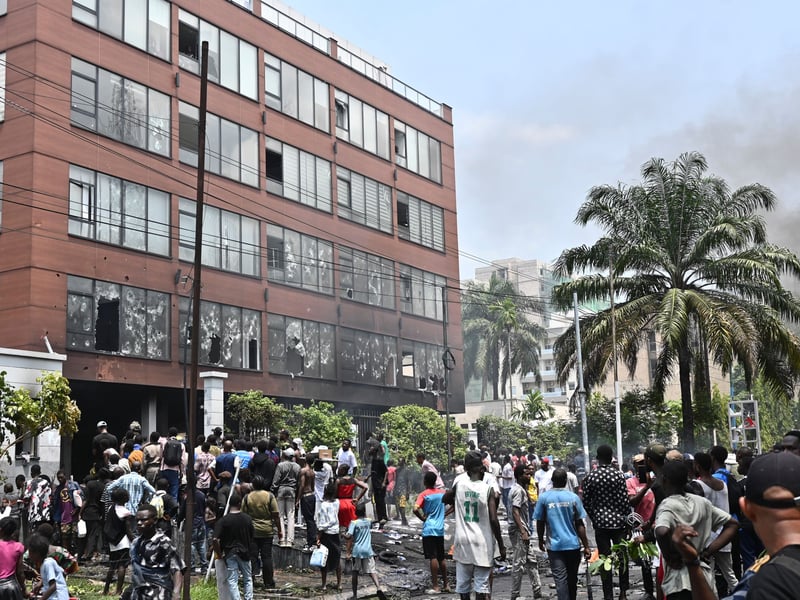
GOMA, Congo — An armed group backed by Rwandan troops took control of the airport in the besieged Democratic Republic of Congo city of Goma on Tuesday, a security source said, dealing a major blow to Congolese forces and putting the regional capital on the brink of falling.
The main city in eastern Democratic Republic of Congo has become a battleground since fighters from the Tutsi-led M23 armed group and Rwandan forces entered central Goma on Sunday night after a weekslong advance through the region.
Intense fighting has left bodies in the streets and overwhelmed hospitals in Goma, while protesters complaining of international inaction over the crisis have attacked embassies in the capital Kinshasa.
It has not been clear which parts of Goma were under the control of Congolese forces or the Rwandan-backed M23, which claimed it had taken the city on Sunday night.
But a security source told AFP that M23 fighters had taken the airport on Tuesday, adding that “more than 1,200 Congolese soldiers have surrendered and are confined” to the airport base of the U.N.’s mission in Congo.
The lightning offensive marks a major escalation in the Democratic Republic of Congo’s mineral-rich east, which has been plagued by fighting between armed groups backed by regional rivals since the 1994 Rwandan genocide.
It has also triggered a spiraling humanitarian crisis, with the U.N. warning about hundreds of thousands forced from their homes, serious food shortages, looted aid, overwhelmed hospitals and the spread of disease in and around Goma.
Goma, a city of 1 million which was already home to an estimated 700,000 internally displaced people before the latest violence, sits on the shores of Lake Kivu on the border with Rwanda.
Destin Jamaica Kela, one of around 1,200 people in Goma registered by Rwanda to have fled over the border in the last 24 hours, told AFP that “things changed very fast.”
“Bombs were falling and killing other people everywhere, we saw dead bodies,” the 24-year-old said.
Burundian Salim Nzisabira, a trucker who had been stuck in Goma, said: “We found ourselves in a war zone. The last few days have been the hardest I’ve ever experienced, no water, no food, nowhere to sleep.”
On the other side of the country roughly the size of continental western Europe, protesters in the capital Kinshasa attacked the embassies of numerous nations.
Rwanda, France, Belgium, the United States, Kenya, Uganda and South Africa were among those targeted, with demonstrators torching tires outside several.
Kenya’s foreign ministry condemned the attack on its embassy by “a riotous mob.”
With tensions rising, the U.N. Security Council was scheduled to meet Tuesday.
In Goma, gunshots could still be heard on Tuesday although the intensity of the fighting appeared to have decreased.
‘Extremely worrying’
At least 17 people have been killed and 367 wounded during two days of fighting, according to reports from overwhelmed hospitals.
“The humanitarian situation in and around Goma remains extremely worrying,” said Jens Laerke, spokesman for U.N. humanitarian agency OCHA.
U.N. colleagues have reported “heavy small arms fire and mortar fire across the city, and the presence of many dead bodies in the streets,” he added.
The Red Cross warned there could be “unimaginable consequences” if samples of Ebola and other pathogens held at a local laboratory in Goma were allowed to spread amid the fighting.
The violence around Goma has forced half a million people from their homes since the start of the year, according to the U.N. refugee agency.
‘Lay down arms’: African Union
At an emergency meeting on Tuesday, the African Union called on the M23 to “lay down arms.”
After a previous U.N. Security Council meeting on Sunday, the Congolese government expressed “dismay” at the council’s “vague” statement, which stopped short of naming Rwanda.
Congo has accused Rwanda of wanting to profit from the region’s abundant minerals that include gold, coltan, copper and cobalt, calling for stronger U.N. action.
Rwanda has denied the claims, saying its aim is to tackle an armed group called the FDLR, primarily composed of Hutu militants formed in the wake of the Rwandan genocide.
South Africa’s defense force said Tuesday that four more of its soldiers were killed fighting the M23, raising the death toll of peacekeepers from a southern Africa regional force and the U.N. mission in Congo to 17.
Congolese President Felix Tshisekedi, who has not yet spoken publicly since the pro-Rwandan forces entered Goma, was due to address the nation.
Kenya also announced a crisis summit on Wednesday to be attended by Tshisekedi and his Rwandan counterpart Paul Kagame.
A ceasefire in August failed to keep the peace and Angola-mediated talks were abruptly cancelled last month.
The M23 briefly occupied Goma at the end of 2012 and was defeated by Congolese forces and the U.N. the following year.
The group reemerged in late 2021 and started seizing large swaths of North Kivu province.
A U.N. expert report in July said up to 4,000 Rwandan soldiers were fighting alongside M23 and that Rwanda had “de facto control” of the group’s operations.
—
By AFP reporters in North Kivu, Agence France-Presse
Subscribe to our free newsletters
Our weekly newsletter Closing Arguments offers the latest about ongoing trials, major litigation and rulings in courthouses around the U.S. and the world, while the monthly Under the Lights dishes the legal dirt from Hollywood, sports, Big Tech and the arts.