
 Search Articles


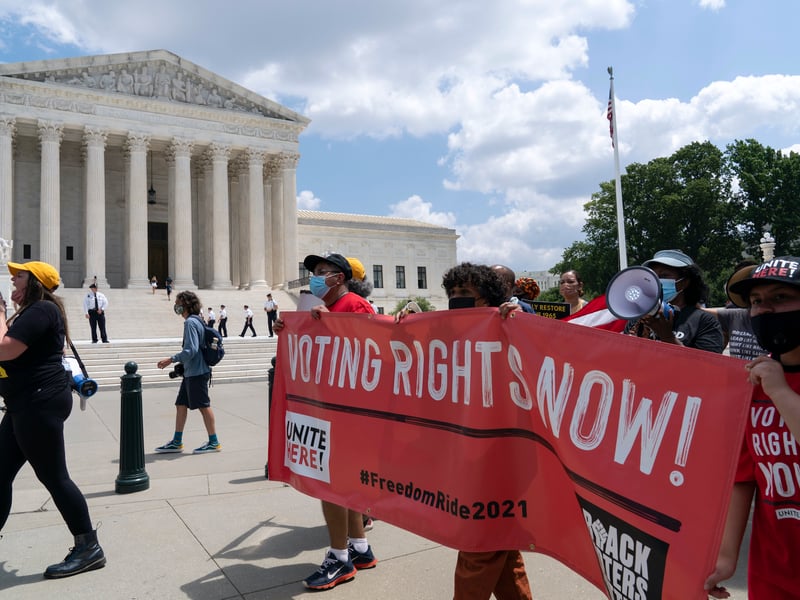
WASHINGTON (CN) — The creation of a Black majority voting district in Louisiana had the Supreme Court feuding Monday over whether the state should have followed a court ruling it didn’t like.
Civil rights groups sued Louisiana over the state’s 2022 voting maps, which included only one majority Black district despite Black voters making up 30% of the voting-age population in the state. After a protracted legal battle and federal court ruling, the Legislature drew new maps in 2024 with a second majority Black district. In response, a group of “non-African American voters” sued the state — so far unsuccessfully — claiming the new maps are unconstitutional.
On Monday, Justice Samuel Alito questioned why the Louisiana Legislature would draw a second majority Black district on its voting map if the state believed doing so might conflict with the equal protection clause.
“What if the district court decision is wrong?” the George W. Bush appointee asked.
Benjamin Aguiñaga, the state’s solicitor general, told the high court, said the Legislature acted against its interests because it was ordered to do so by a federal court. “Louisiana would rather not be here,” he said.
The justices have weighed in on Louisiana’s map dispute twice before. In 2022, they paused the redraw and maintained the single majority Black district for the midterm elections while considering another case in Alabama. Last year, the court offered another pause for the presidential election; however, they kept in place the newly drawn map with the second Black majority district.
In the yearslong fight over its congressional maps, Louisiana has taken the position that Section 2 of the Voting Rights Act is unconstitutional as applied.
“The reality today is we have lost that argument so far, and we are duty-bound to comply with the VRA — especially in this context where you have federal court decisions telling us what the VRA likely requires,” Aguiñaga said.
Chief Justice John Roberts, a George W. Bush appointee, and Justice Neil Gorsuch, a Donald Trump appointee, criticized the state’s 2024 map. Roberts suggested that the 2024 map might be unlawful, calling the new district a “snake that runs from one end of the state to the other.”
Louisiana’s Sixth Congressional District includes a 250-mile stretch from Shreveport in the northwest to Baton Rouge in the southeast. The 2024 map increased that district’s Black voting age population from 24% to 54%. The state and civil rights groups argue that politics, not race, was the driving force behind the new map.
Justice Amy Coney Barrett, another Trump appointee, probed how wrong the lower court ruling would have to be for Louisiana to disregard it.
However, Barrett said if Louisiana had continued its challenge to adding a second majority-Black district, the Legislature risked using a court-imposed map in the 2024 elections. “It’s not just a matter of your obedience to the federal court order, which, I appreciate that you would be obedient to the federal court order,” she said.
Without the Legislature’s intervention, Louisiana said U.S. Representative Julia Letlow, a Republican, would have been placed in a majority Democrat district. The state said it drew its map to protect high-profile incumbents, including House Speaker Mike Johnson.
Gorsuch appeared unimpressed by the explanation. He questioned how lawmakers could exclude race-based sorting when creating a second majority Black district.
“Certainly politics played a role in this district, but didn’t race?” Gorsuch asked.
The Trump appointee’s reasoning seemed to align with the self-described “non-African American” voters who claim the 2024 map violated the equal protection clause. The voters say states routinely claim to use politics to address racial gerrymanders, but Louisiana relied too heavily on race when drawing the new majority Black district.
The voters suggested Louisiana could have continued to oppose the lower court ruling because it wasn’t a final judgment. When the state gave up the argument, the voters said they had to step in.
Flummoxed, the liberal justices pushed back on their conservative colleagues. Justice Ketanji Brown Jackson, a Joe Biden appointee, said the high court didn’t have to consider whether the lower court was wrong at all. The case before the justices asks whether Louisiana correctly added a second majority Black district as the lower court ordered — not whether doing so was unconstitutional.
“The question is: Did they believe that a court was ordering them to do it?” Jackson said. “I am concerned about your view … that a court order compelling you to do something is not a good reason for you to do it.”
Justice Elena Kagan, a Barack Obama appointee, said that at some point Louisiana has to accept its loss.
“What should Louisiana have done?” Kagan asked. “Louisiana litigated this case. It lost in the district court. It lost twice in the Circuit Court. If I read the list of the judges — I’m just going to tell you that if you lose those judges, you’re going to lose.”
The conservative justices’ questions on Monday hinted that the unexpected win for the Voting Rights Act almost two years ago might be short-lived. Justice Brett Kavanaugh, another Trump appointee, joined Roberts and the liberals in rejecting an effort to reshape Section 2 by including a “race-neutral benchmark.”
At the time, Kavanaugh signaled skepticism of the Voting Rights Act, writing that its safeguards “cannot extend indefinitely into the future.” He repeated the same critique on Monday.
“The court’s long said, that race-based remedial action must have a logical endpoint, must be limited in time and must be a temporary matter in school desegregation and university admissions,” Kavanaugh said. “How does that principle apply to Section 2?”
Louisiana pleaded with the justices for a final ruling to end the ordeal. It wasn’t clear if the justices would offer any relief.
“With all due respect, we’d rather not be back at the podium this fall defending a new map against a new challenge,” Aguiñaga said.
 Follow @KelseyReichmann
 Follow @kelseyreichmann.bsky.social
Subscribe to our free newsletters
Our weekly newsletter Closing Arguments offers the latest about ongoing trials, major litigation and rulings in courthouses around the U.S. and the world, while the monthly Under the Lights dishes the legal dirt from Hollywood, sports, Big Tech and the arts.