
 Search Articles


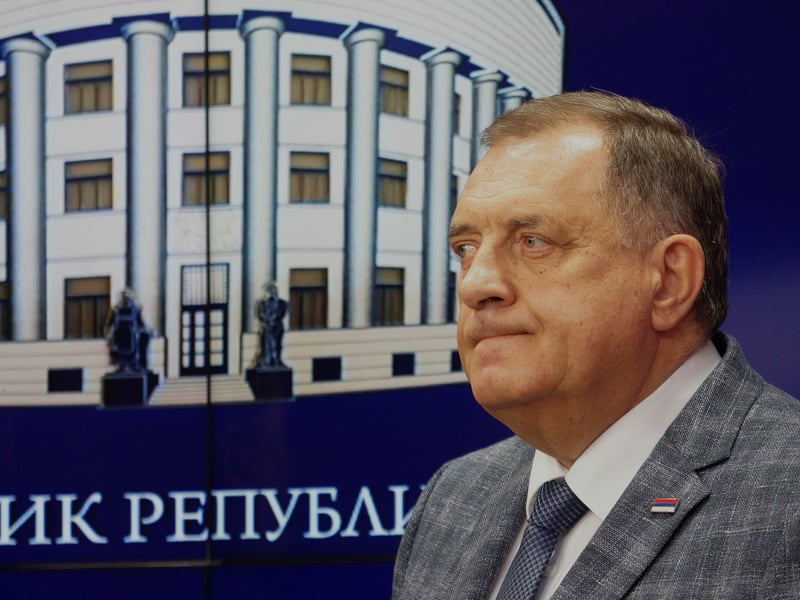
(CN) — On his side of the border, Milorad Dodik is still kissing babies, shaking hands, making fiery speeches, signing decrees, attending public events and getting treated as the legitimate head of state of the semi-autonomous Republika Srpska, the Serb-dominated half of Bosnia-Herzegovina.
But he’s not the legitimate president — at least not under the laws of Bosnia-Herzegovina, thewar-scarred multiethnic Balkans country under whose jurisdiction the Republika Srpska and its 1.2 million people have lived, often uncomfortably, ever since the Bosnian War ended with the Dayton Peace Accords 30 years ago this November**.**
On Aug. 18, the Court of Bosnia and Herzegovina in Sarajevo, the country’s highest court, upheld a decision to ban Dodik from public office for six years because his secessionist-driven politics were deemed a threat to the constitutional order and violation of the Dayton peace agreement.
But the 66-year-old Dodik, a man-of-the-people figure backed by Russia and a friend of authoritarians like Hungarian Prime Minister Viktor Orbán, isn’t budging.
Indeed, Dodik’s official schedule has been quite busy in recent days with visits to religious summer festivals, a furniture factory, an international basketball game and the National Assembly, the Republika Srpska’s parliament in Banja Luka, the statelet’s capital.
“Legally speaking, he is not the president anymore,” said Adnan Huskić, a professor of politics at the Sarajevo School of Science and Technology. “He cannot sign any legal act into law. So, he cannot enforce anything. His signature as the president of the Republika Srpska is no longer valid.”
Dodik, though, sees it differently. He claims the Sarajevo court’s ruling runs counter to the Republika Srpska’s constitution. He denounces the court and the Office of the High Representative, an international body that enforces the Dayton treaty with the power to impose and annul laws, as illegitimate.
In other words, a constitutional crisis long in the making is culminating in the center of the Balkans and the outcome is hard to predict.
This clash intensified in February when the Court of Bosnia and Herzegovina found Dodik guilty of undermining the constitutional order and sentenced him to one year in jail and banned him from public office for six years. But he rejected the ruling.
In April, Bosnia’s State Investigation and Protection Agency, a national police force, attempted to arrest Dodik in East Sarajevo, a Serbian section of Sarajevo inside the Republika Srpska, but its agents were blocked by officers from the statelet. The standoff ended with the SIPA officers retreating.
Dodik no longer faces arrest after the Sarajevo court commuted his jail sentence on Aug. 12 after he agreed to pay fines. However, his ban from office remains intact. The question is whether he can be forced out of the president’s seat.
“The truth is, legal decisions are meaningless unless they can be enforced, or whose enforcement can at least be credibly threatened,” said Mak Kasapovic, a Balkans expert at Oxford Analytica, a firm that analyses geopolitical risks. “Dodik feels no such pressure.”
After the failed arrest in April, Kasapovic said Dodik believes national authorities will not attempt to force him out of office for fear of sparking violence.
“All of this buys Dodik some time,” Kasapovic said in an email. “He may choose to reluctantly but voluntarily step down at some point or he may choose to escalate further and refuse to vacate his post, but he seems unlikely to be forcibly removed.”
Over the past two decades, Dodik has dominated the bitter and toxic postwar politics of the Republika Srpska, a Serb-controlled entity forged in the wars that broke out with the disintegration of the former Yugoslavia.
In 1992, Bosnian Serb nationalists opposed to Bosnia-Herzegovina’s declaration of independence from Serb-dominated Yugoslavia declared their own independence from Bosnia and said their new state, the Republika Srpska or Serb Republic, would remain part of Yugoslavia.
War ensued and ended three years later with the Serb Republic’s army, led byRatko Mladić, in retreat but still holding onto nearly half of the territory of Bosnia-Herzegovina, though not Sarajevo, the capital city. Under the Dayton peace accord, the Republika Srpska was recognized as an entity with its own parliament and government but ultimately under the jurisdiction of the federalized nation of Bosnia-Herzegovina.
Thirty years later, Bosnia’s peace is as uneasy and unsure as it has ever been since the end of the war and, outside of the Republika Srpska, Dodik is viewed as the chief culprit for this precarious state of affairs.
“For the past two decades, Dodik has been the single most destabilizing political actor,” said Emina Muzaferija, a Balkans expert at the New Lines Institute for Strategy and Policy, a Washington think tank.
Dodik and his allies have been accused of turning the Republika Srpska into a corrupt fiefdom where they control the media, siphon off state funds, rig elections and stoke ethnic animosities with ultranationalistic rhetoric.
For years, pressure has been building to remove Dodik. In 2022, the United States imposed financial sanctions on him and on a television station he owns. The U.S. accused him of corruption and undermining the Dayton accords by passing laws to remove the statelet from the authority of Bosnia-Herzegovina. More U.S. sanctions were slapped on his adult children in 2023.
“He’s the guy who controls financial flows in the Republika Srpska,” Huskić said in a phone interview. “He’s the guy who’s behind or near every large embezzlement scandal over the past, I don’t know, 15 years.”
For now, the confrontation between the Republika Srpska and Bosnian authorities is set to intensify.
On Oct. 25, the Republika Srpska plans to hold a referendum on whether the entity should recognize the court’s verdict against Dodik. The vote will likely go Dodik’s way, but it will almost certainly be dismissed as unlawful by Bosnian courts and authorities and also by Christian Schmidt, a German who heads the Office of the High Representative.
“None of Bosnia’s state institutions will treat it as either legal or binding,” Muzaferija said in an email.
Still, Kasapovic said winning the referendum “could give [Dodik] some semblance of democratic legitimacy for his decision to escalate.”
Meanwhile, Dodik and his ruling party, the Alliance of Independent Social Democrats, say they will oppose an order from Bosnian authorities to hold elections on Nov. 23 to pick a new president for the Republika Srpska. Dodik’s media office did not reply to a query from Courthouse News seeking comment.
Muzaferija said Dodik and the Republika Srpska face getting hit with sanctions by the U.S., the United Kingdom and the European Union for going ahead with the referendum.
Huskić said the financial pressures on Dodik may force him out of office.
“He’s now trying to basically broker a kind of withdrawal deal which would allow him to retake control of his finances and probably flee with the money,” he said. “All of these things that you see right now — referendum, talk of secession — have only one goal, and that is to somehow push people into making concessions by easing sanctions, in particular the Americans.”
Huskić also questioned how much support Dodik enjoys inside the Republika Srpska following years of economic stagnation and a population exodus.
Still, he feared the crisis could escalate further because Dodik, with his back against the wall, could resort “to something more serious” and even seek to push the Republika Srpska into seceding from Bosnia.
An important factor to consider is unrest taking place in neighboring Serbia. In Serbia, the government of President Aleksandar Vučić is at risk of being toppled by mass protests led by students angry over corruption.
“Serbia’s sustained protests and tightening police response decrease Vučić’s bandwidth and appetite for materially underwriting Republika Srpska brinkmanship,” Muzaferija said.
Kasapovic said the protest mood in Serbia could even spread to the Republika Srpska and lead to protests against Dodik should he refuse to step down.
“In a sense, staying in power could prove to be a poisoned chalice for Dodik,” he said.
Huskić was hopeful Dodik’s exit was imminent and that it would lead to more moderate voices taking power in Banja Luka.
“He is the source of the problem, and if you remove the source, we can start healing,” he said. “We can start talking about how to move forward.”
“There’s no single individual who can replace Dodik and continue in his path,” he said. “The remaining political actors will first not be able to command as much support as he did.”
He added that Dodik’s opponents realize “independence is not achievable” and that pursuing that goal is “only making us exhausted, wasting time and energy.”
“If you’re interested in having a strong Republika Srpska,” he said, “the way to do it is through Bosnia, by making Bosnia function first.”
Courthouse News reporter Cain Burdeau is based in the European Union.
 Follow @cainburdeau
Subscribe to our free newsletters
Our weekly newsletter Closing Arguments offers the latest about ongoing trials, major litigation and rulings in courthouses around the U.S. and the world, while the monthly Under the Lights dishes the legal dirt from Hollywood, sports, Big Tech and the arts.