
 Search Articles


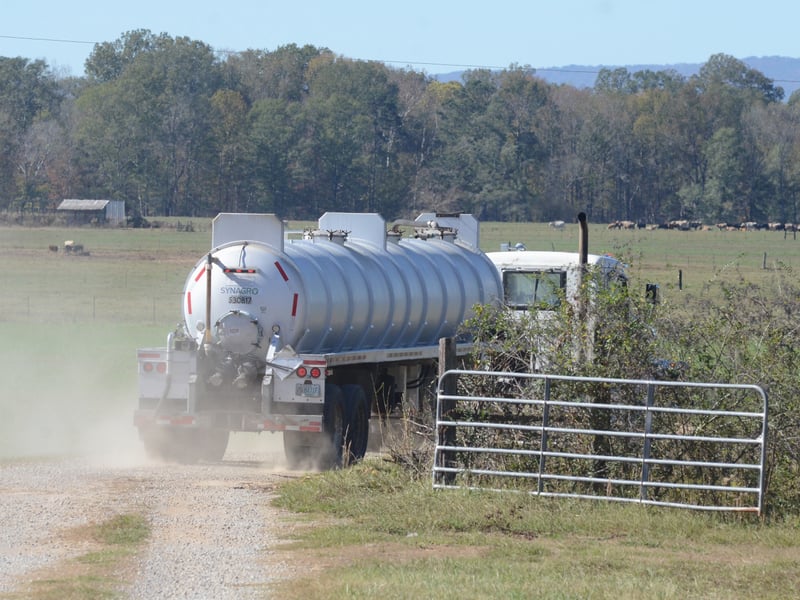
ST. CLAIR COUNTY, Ala. (CN) — On a stretch of Highway 411 outside of Ashville, Alabama, old sheds, barns and trees dot an expansive pasture. Big Canoe Creek meanders in the background, with the Appalachian Mountains rising beyond it.
The scene is bucolic — until you roll down the window.
“It smells like death,” said Steven Battles, a state law-enforcement officer who built a home for his family here.
The source of the stench is biosolids: organic, nutrient-rich fertilizer created from waste products like sewage sludge. In Alabama and elsewhere, the product is marketed and sold as a cheap and natural alternative to chemical fertilizers. It’s largely unregulated, and a growing body of science suggests chemicals in biosolids may present hazards to human health.
Biosolid fertilizer can contain forever chemicals, heavy metals and medicines, according to Derrick Heckman, a conservationist with a background in forestry who lives in the area. There’s also sewage and waste from industrial operations, chicken and pig farms, hospitals and funeral homes.
“It’s disturbing to think about what or whose remains are going back into the soil,” he said. He noted that any such pollutant “is eaten by the deer and cattle and ends up back on our dinner plates.”
A longtime resident of St. Clair County, Heckman said the community started noticing “sludge trucks” on local roads about three years ago. Residents watched as tankers stopped by farms, often leaving a stench in their wake.
“Fertilizer is expensive,” Heckman said — and biosolid fertilizer companies offer farmers an amazing deal. “We have this product that has nitrogen, phosphorus and potassium,” he said. “Not only can we give it to you for free, but we’ll also transport it and apply it at our own expense with our own equipment.”
But there are trade-offs, including the pervasive stink. Last year, Battles drained the family’s backyard pool. The constant odor made it unenjoyable.
“There was never a problem until two or three years ago, with this continuous smell that never goes away,” Battles said. He compared the smell to roadkill, as if someone took “100 dead animals and put them in your yard in the summer and let them decay there.”
One morning in November, a biosolids truck pulled up to a farm in this stretch of St. Clair County. The tanker was inconspicuous except for the brand SYNAGRO stamped on the back.
One of many companies in the biosolids market, Synagro touts itself as “the largest recycler of organic by-products in North America.” The company takes waste from more than 1,000 municipal, industrial water and wastewater facilities nationwide and processes it into products like compost, fertilizer and soil amendments. These products improve soil health and sequester carbon, according to Synagro, making them environmentally friendly.
But these products have become increasingly controversial in recent years amid evidence that biosolids contain large concentrations of harmful contaminants like forever chemicals, including PFAS.
In Michigan, regulators in 2017 clamped down on biosolid fertilizer afterfinding excessive PFAS in cattle blood and tissue. Both Maine and Connecticut have passed laws banning the sale or application of biosolids containing PFAS.
In February 2024, a group of farming families in Texassued the Environmental Protection Agency, claiming their health and livelihoods were damaged because the EPA wasn’t adequately regulating PFAS-laden biosolids on adjacent properties. The plaintiffs claim that under the Clean Water Act, the EPA has a requirement to establish limits on certain chemical pollutants, including PFAS-containing biosolids, to protect human health.
The plaintiffs in the case never applied biosolids on their own properties, said Laura Dumais, a staff attorney with Public Employees for Environmental Responsibility who is representing them. Instead, their land was contaminated by runoff from neighbors.
“Shortly after this material was spread, terrible things started happening,” Dumais said. “All the fish in their ponds turned up floating dead. Animals started getting sick and dying, and it smelled awful, too.”
Independent investigators undertook studies and discovered “astronomical levels of PFAS” traced back to the biosolids. On one plaintiff’s property, researchers discovered sky-high PFAS levels in the liver of a stillborn calf.
Contaminants in biosolids remain “a really huge problem,” Dumais said. “For decades, this has been the cheapest way for wastewater treatment facilities to dispose of all of the waste sludge that they have. You either incinerate it, landfill it, or sell it or give it away for free, and those two last options are phenomenally cheaper than the first two. ”
Synagro did not respond to multiple requests for comment for this story. The company has also been sued in Texas state court for its role in applying contaminated biosolids.
In a2023 internal report, the company acknowledged the challenges presented by PFAS in biosolids. It said it did not generate PFAS “or use them in our processes” and was instead a “passive receiver” of contaminants in the supply chain. It said it was investing in technology to “destroy PFAS.”
EPA data on biosolids application is incomplete. According to one industry group, an estimated 2.3 million metric tons were spread on agricultural operations nationwide in 2018, including at least 157,000 tons in Texas and more than 16,000 tons in Alabama.
Until there’s a better option, many farmers will likely keep relying on the stuff.
Doug Bass is an experienced farm manager in St. Clair County.
He’s used to getting bad press over biosolid fertilizer.
The farm where he works, a cattle and hay operation, had recently been the subject of a “hit piece,” he said in an interview with Courthouse News outside the property. A local TV crew flew a drone over the farm, then used the footage in a one-sided news report.
“Nobody has ever asked us about biosolids,” Bass said.
Bass admits the stuff stinks — but he says it’s just chicken waste from facilities nearby. He says Synagro provided him with a chemical analysis showing no elevated levels of hazardous chemicals.
“This is all-natural fertilizer,” he said. “I have all the paperwork.” While he acknowledged it might contain PFAS, he said it was “way below the legal limit.”
“Anyway, PFAS is in everything now,” he said.
The Centers for Disease Control and Prevention say most Americans already have PFAS in their bodies. The EPA does not currently regulate PFAS in biosolids, but it’s issued an advisory and warned of human health risks with too much exposure.
With forever chemicals omnipresent in the modern world, that might not be enough reason for farmers to abandon it. Using biosolids can save about two-thirds of fertilizer cost, Bass said — money that can then be spent or payroll or maintaining equipment.
It was basic economics. “Nobody is out here getting rich off this,” he said. “The margins are still low.” When it came to using biosolid fertilizer, the risks to him seemed quite low, too. “We rely on their health and the health of the land to make a living,” he said. “If there was any way that this would harm the environment — the ground, the water, the cattle, the wildlife — I absolutely would not be doing it.”
 Follow @gabetynes
Subscribe to our free newsletters
Our weekly newsletter Closing Arguments offers the latest about ongoing trials, major litigation and rulings in courthouses around the U.S. and the world, while the monthly Under the Lights dishes the legal dirt from Hollywood, sports, Big Tech and the arts.