
 Search Articles


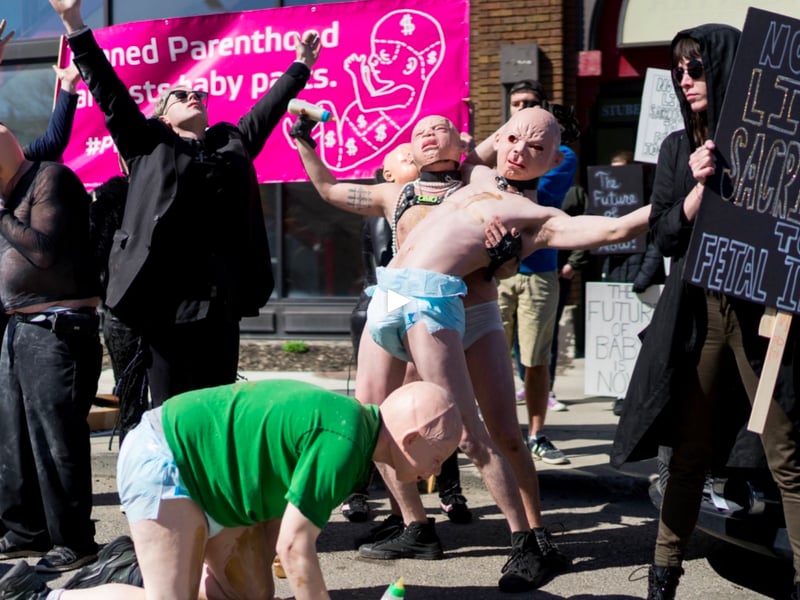
One of the things that always makes me happy is spotting an informative tidbit in a court ruling that begs to be an answer to a trivia question.
The U.S. Court of Appeals for the Ninth Circuit provided one for us last week in an amended ruling. Let’s make this multiple choice.
Question : What is a Satanic Abortion Ritual?
A) A ritual of positive affirmations.
B) A two-hour-and-fifteen-minute session of chanting and dancing.
C) A contemplative poetry reading.
D) A nonstop binge watch of “The Good Place.”
E) A cosplay session featuring people wearing goat heads emceed by a “demon” in a business suit.
F) All of the above.
G) None of the above.
Yes, I know those are a lot of choices, but I was feeling devilish. The answer is below.
The tidbit, by the way, appeared in a ruling on a challenge by The Satanic Temple to Idaho’s anti-abortion laws.
The court ruled that the Temple lacked standing because it couldn’t produce any Idaho Satanists who needed the Temple’s help getting an abortion.
The devout don’t get into trouble.
False truth? Can you have too much truth? Can truth also be a lie?
If you can sue over a phantom discount, shouldn’t you be able to sue over a phantom health benefit?
I really love idle questions.
I bring this up because a federal judge recently ruled on a class action complaint described this way: “The crux of plaintiff’s lawsuit is that defendants mislead consumers by using a non-GMO label on their products because all avocado products are free from GMOs.”
If it’s true, can you sue?
(Side note: I believe all significant legal issues should be reduced to rhyme. Why wouldn’t you?)
The plaintiff claimed that the non-GMO label was misleading even though it was true because consumers might be convinced to pay a premium if they thought similar avocado oil products weren’t the same. The defendant claimed a “reasonable consumer” who cared about GMOs would know there aren’t any commercially available GMO avocados.
So why put the non-GMO label on there? For the unreasonable consumers?
On the other hand, can you sue someone for telling the truth?
Maybe they didn’t mean to mislead you.
Maybe they did.
I love these philosophical questions.
The judge in this particular case sided with the defendant: “Plaintiff’s argument is an allegation of implied meaning and does not apply to the reasonable consumer.”
There must be a few reasonable consumers out there somewhere.
I can’t wait for the appellate rulings on this.
**The answer. It’s A . I can’t think of anything more hellish for a grumpy person than having to listen to positive affirmations.
Subscribe to our free newsletters
Our weekly newsletter Closing Arguments offers the latest about ongoing trials, major litigation and rulings in courthouses around the U.S. and the world, while the monthly Under the Lights dishes the legal dirt from Hollywood, sports, Big Tech and the arts.