
 Search Articles


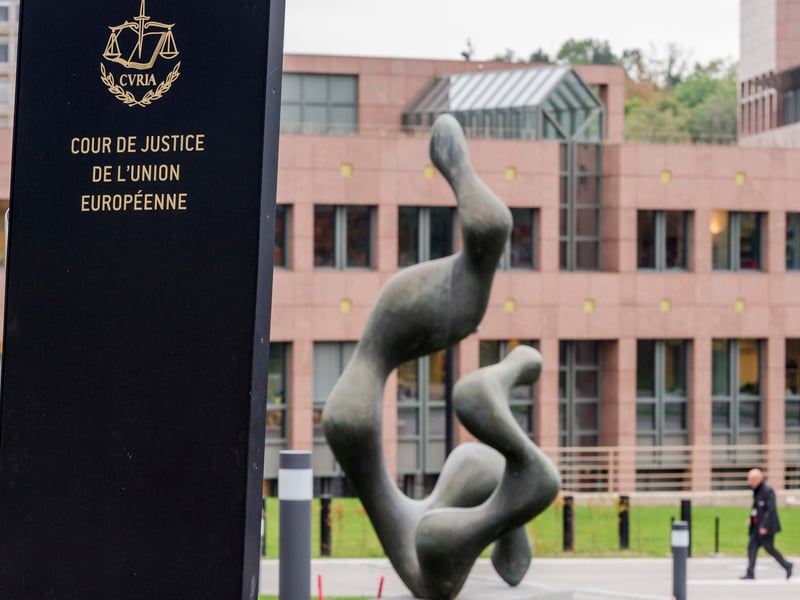
THE HAGUE, Netherlands (CN) — Poland’s push to reconcile a politicized judiciary returned to the European Court of Justice Thursday, where the judges said national laws can’t force courts to obey rulings from bodies whose independence is in doubt.
The story started almost 20 years ago with a fight between two Polish publishers over crossword magazines. What looked like a routine trademark spat soon morphed into a test of Poland’s judicial system, after the prosecutor general dusted off the case in 2020 — more than a decade after it was supposed to be settled for good.
“This judgment fits a now-settled line from the CJEU: A chamber of the Polish Supreme Court staffed with ‘neo-judges’ recommended by a politically captured National Council of the Judiciary is not an independent and impartial court established by law,” said Jakub Jaraczewski, research coordinator at Democracy Reporting International. “What is striking here is the origin story. A very ordinary fight over crossword magazine design ended up surfacing high-level questions about judicial independence.”
He noted that the impact goes far beyond one old publishing spat. “Because this chamber also handles sensitive issues like electoral protests and the legal validity of elections, this ruling will almost certainly rekindle the political debate,” he added.
The EU court has repeatedly ruled against judicial reforms enacted by Poland’s former right-wing and anti-EU Law and Justice government, including declaring some tribunals unlawfully constituted.
The case landed in the Extraordinary Control and Public Affairs Chamber, set up in 2017 during a wave of reforms that handed politicians greater control over who sits on the bench. Critics in Poland and abroad slammed the process as tainted, saying it blurred the line between politics and justice. Four years ago, that chamber ripped up what had long been a final ruling and tossed the fight back to the Kraków Court of Appeal, forcing judges to relive the dispute.
The appeals court balked. Looking at earlier rulings from the European Court of Human Rights and from the EU court itself, it argued the chamber did not meet the standards of a lawful, independent tribunal.
So the judges asked Luxembourg a blunt question: Could they simply ignore that decision, even though Polish law told them they had to follow it?
Luxembourg’s answer was clear. EU law comes first. National rules cannot force lower courts to accept rulings from panels whose independence is in doubt, so the Kraków judges could treat the 2021 decision as if it never existed.
The EU judges went further, tackling the fate of the 2021 ruling head-on. They wrote that “a decision taken by such a body, by which the case concerned is referred back to a lower court for reexamination, must be regarded as null and void, where such a consequence is essential in view of the procedural situation at issue in order to ensure the primacy of EU law.”
Adam Bodnar, professor of law at SWPS University and a Polish senator, said: “Today’s ruling gives clear, practical instructions on how to disregard rulings issued by the ECPA Chamber. A lower court that is properly established may assess that chamber’s status and declare its rulings null and void when necessary to protect a party’s rights under the primacy of EU law.”
He stressed that the impact goes well beyond one chamber.
“This has serious implications. It signals the need to abolish the chamber and equips courts with a tool to challenge its activity in individual cases, alongside recourse to the European Court of Human Rights in Strasbourg,” Bodnar said.
Since 2017, Polish law has let prosecutors reopen even decades-old cases through extraordinary appeals, a tool critics say gave politicians a back door to undo inconvenient rulings. By making clear that verdicts from improperly appointed judges can be treated as void, the EU court has now pulled much of the punch out of that tactic.
The judgment also hit Polish laws designed to muzzle the bench. Under those rules, judges risked punishment — even removal — if they questioned a colleague’s appointment. Europe’s top court reminded Warsaw it had already struck down that tactic in 2023, stressing once again that even constitutional provisions in domestic law cannot be invoked to stop EU judges from upholding the primacy of European law.
For Poland’s judges, the ruling works as both protection and marching orders. Lower courts now have cover from Luxembourg to ignore directives from the ECPA Chamber if its members were picked through a tainted process. But with that power comes a duty: They must still guarantee every litigant the right to, in the court’s words, “an independent and impartial tribunal previously established by law.”
“This is another judgment confirming that the ECPA Chamber, added to the Supreme Court in 2018, is not an independent court under EU law,” said Anna Wójcik, a legal scholar at Koźmiński University in Warsaw who specializes in rule of law and human rights. “Since December 2023, the CJEU has refused to accept preliminary references from this chamber because it does not meet EU standards of judicial independence.”
She pointed out that the decision also has a clear takeaway for judges on the ground. “The ruling also gives Polish courts an argument to disregard this chamber’s orders to rehear cases,” she said, adding that even though the Justice Ministry has floated a draft law to liquidate the chamber, any reform would likely face a veto from the president.
Poland’s Ministry of Justice did not immediately respond to a request for comment.
Courthouse News reporter Eunseo Hong is based in the Netherlands.
Subscribe to our free newsletters
Our weekly newsletter Closing Arguments offers the latest about ongoing trials, major litigation and rulings in courthouses around the U.S. and the world, while the monthly Under the Lights dishes the legal dirt from Hollywood, sports, Big Tech and the arts.