
 Search Articles


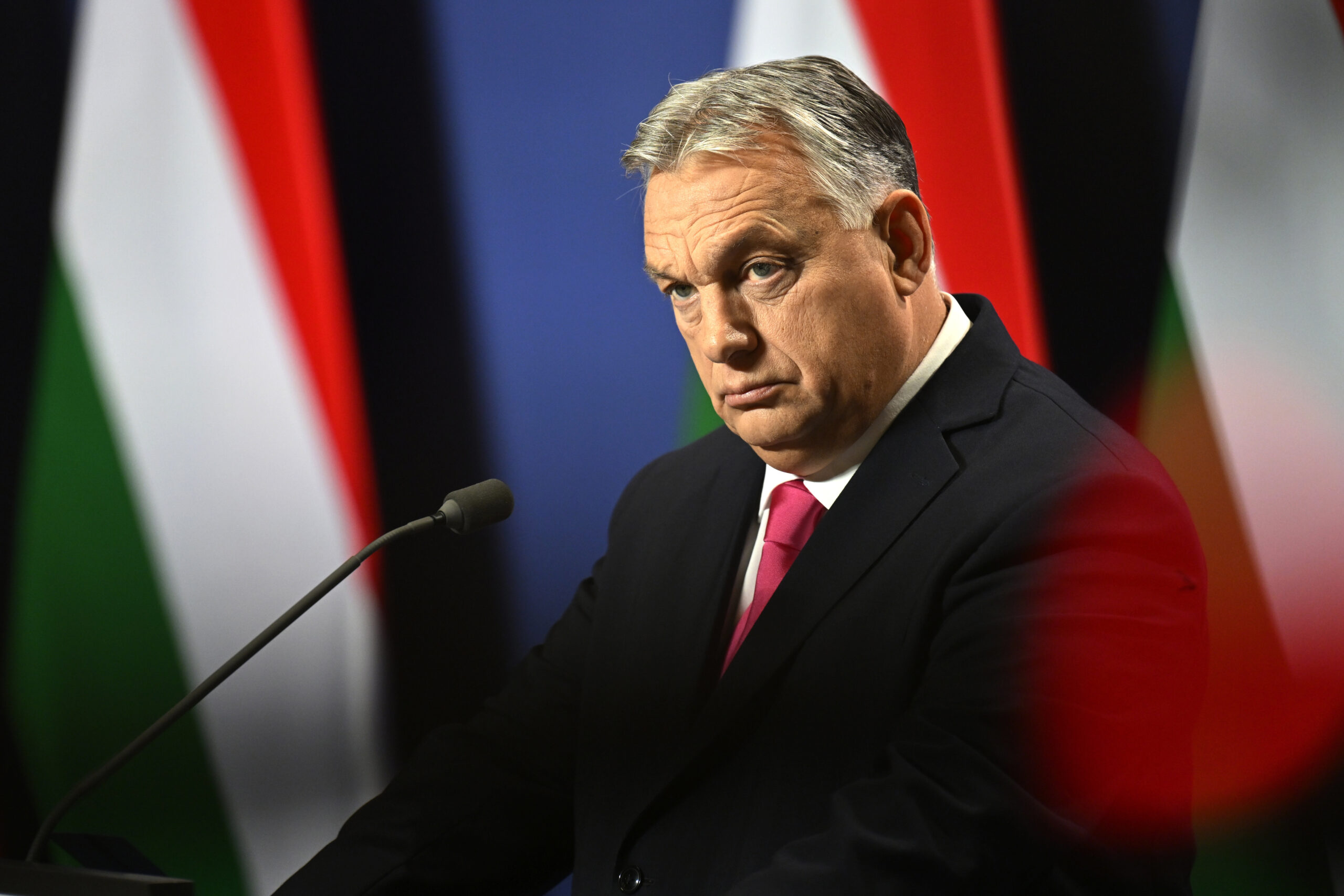
(CN) — The European Union on Thursday sued to stop Hungarian Prime Minister Viktor Orbán’s far-right authoritarian government from harassing and targeting civil society groups, critics, journalists and opposition figures under the guise of a new law aimed at ferreting out foreign funds from Hungary’s political landscape.
The European Commission, the EU’s executive branch, asked the European Court of Justice, the EU’s Luxembourg-based top court, to declare Hungary’s so-called “Sovereignty Protection Act” illegal.
Passed in December 2023, the law set up a special office to investigate the foreign funding of non-government groups, media outlets and politicians. Already, the office has launched investigations into Transparency International Hungary, a global anti-corruption organization, and Átlátszó, an investigative non-profit supported by international donations. The law also is being used to investigate the financing of Orbán’s chief political rival, Péter Magyar, a former Orbán ally turned whistleblower and a rising star seriously challenging the prime minister.
The EU says the law is a blatant violation of democratic principles and that Orbán is using it to target critics and opponents.
In defending the law, Orbán’s government argues the country’s politics have been hijacked by foreign actors and funds, putting Hungary’s sovereignty at risk. Similar laws around the world have been used by authoritarian governments to consolidate power and attack opponents.
In a statement, the commission said the law violated several fundamental rights enshrined under EU law, such as the rights to privacy, freedom of expression and free assembly, and breached EU regulations related to free trade within the bloc and data protection.
The commission said the investigatory bureau set up by the law was given “broad powers and discretion” to investigate a “wide range of persons and entities, including civil society organizations, media outlets and journalists in a disproportionate manner.”
Besides being intrusive, the commission blasted the law because it requires “extensive publicity about the individual investigations and their findings.”
“This will have negative consequences for the concerned entities including a stigmatizing effect,” it said.
But the commission did not ask the court to expedite the case and immediately block the law, moves that mean it could take years before the court issues a ruling.
“Time matters — and the commission has put this case on a slow track,” said Kim Lane Scheppele, a professor of sociology and international affairs at Princeton University and an expert on Hungary. “The case will drag on for long enough that Orbán can do what he always intended to do with the Sovereignty Protection Act and that is to further weaken the opposition politicians, press and NGOs.”
Jördis Ferroli, a commission spokeswoman, said during a Thursday briefing that the commission will ask the court to deal with the case quickly. She declined to say why it did not ask the court to take immediate action.
Thursday’s legal maneuver adds more tension to a bitter fight between Brussels and Budapest over a range of disagreements. Orbán and his pan-European far-right nationalist agenda is viewed by many as a dire threat to the EU.
“Orbán and the EU have been on a collision course for years now,” said Gabriela Greilinger, an expert on Hungarian politics at the University of Georgia in the United States. “This is just the latest attempt of Orbán trying to implement a law that undermines democracy and fundamental EU values, and the EU reacting to it."
He has become a particularly divisive figure due to his close relationships with Russian President Vladimir Putin, former U.S. President Donald Trump and Chinese President Xi Jinping. In a recent debate with U.S. Vice President Kamala Harris, Trump referred to Orbán as one of the world leaders he respects the most. Orbán’s visit to the Kremlin in early July, shortly after he took over the rotating presidency of the EU, was widely denounced by other EU leaders.
The clash between Brussels and Budapest is getting uglier since Hungary refused this summer to pay a 200 million euro ($220 million) fine imposed on it by the Court of Justice over strict asylum policies deemed illegal. Brussels is threatening to deduct the money from EU funds meant for Hungary and in turn Budapest is threatening to send buses bound for Brussels with migrants onboard. Like others on the far right, Orbán has made fierce anti-migrant rhetoric and policies a central theme.
Meanwhile, Orbán’s newly formed parliamentary group in the European Parliament, the Patriots for Europe, has launched a legal battle against the parliament after its members were excluded from committee assignments.
Scheppele said these fights Orbán’s picked with the EU are part of a long-running strategy developed over 18 years as Hungary’s prime minister. Orbán first served as leader between 1998 and 2002 and he’s reigned over Hungary since 2010.
“He knows how the EU works since he has been in the European Council longer than anyone else,” she said in an email. “So, he will poke at the EU, frustrate it, expose its weaknesses — and then he will retreat before any serious collision occurs.”
But she doubted Brussels, especially under the leadership of European Commission Ursula von der Leyen, would be able to restrain Orbán.
“It would take a European Commission with a stronger backbone than von der Leyen has to actually crack down on autocracy in Hungary,” she said.
She said Orbán’s grip on power was cemented in 2013 when he “finally captured the Constitutional Court and other key institutions” in Hungary. Then, he changed the electoral law “so that no one else could beat him,” she added.
She said the Sovereignty Protection Act is part of a long pattern by Orbán “to cut off all sources of money to the political opposition.”
“Under this new law, it’s unclear whether the few remaining independent news outlets in Hungary can be shut down because they have foreigners subscribing to their online portals,” she said. “And it is unclear whether opposition groups that are chapters of international organizations (like Transparency International or the Hungarian Helsinki Committee) can continue to operate given their international connections.”
Greilinger said Orbán will seek to capitalize on the court battle over the sovereignty law as he faces a tough reelection in 2026 with the rise of Magyar and his Tisza party. Magyar, 43, represents Orbán’s biggest threat since he returned to power in 2010.
“Orbán might use the EU’s challenge against the law to his advantage by painting this as another attack of the Brussels elites against the Hungarian people,” she said in an email.
Ultimately, though, she said Orbán sees the law as a tool to consolidate power.
It is, she said, “fundamentally in line with what the Orbán regime stands for: an undemocratic government that seeks to further secure its power and undermine any potential challenge from in or outside.”
Courthouse News reporter Cain Burdeau is based in the European Union.
 Follow @cainburdeau
Subscribe to our free newsletters
Our weekly newsletter Closing Arguments offers the latest about ongoing trials, major litigation and rulings in courthouses around the U.S. and the world, while the monthly Under the Lights dishes the legal dirt from Hollywood, sports, Big Tech and the arts.