
 Search Articles


BRUSSELS (CN) — The European Union this week ramped up pressure on Elon Musk’s X over compliance with strict digital regulations, escalating existing tensions between Brussels and the tech giant that are likely to carry over into future administrations on both sides of the Atlantic.
In Brussels, the Tesla and SpaceX CEO is increasingly seen as key in turning the platform, formerly known as Twitter, into a megaphone for right-wing conspiracy theories that could also impact political debates in Europe.
And the EU is serious about moves to tame digital platforms, using the Digital Services Act, the bloc’s new landmark content moderation regulation known as the DSA.
On Friday, the EU asked Meta Platforms, the owner of Facebook and Instagram, how it is complying with the DSA in light of the company’s shutdown of CrowdTangle, a tool widely used by researchers, watchdog organizations and journalists to monitor social media posts, especially to track how misinformation spreads on the company’s platforms.
Meta has until Sept. 6 to provide details on how researchers can find publicly-accessible data on its platforms, and how it plans to update its election monitoring functionalities.
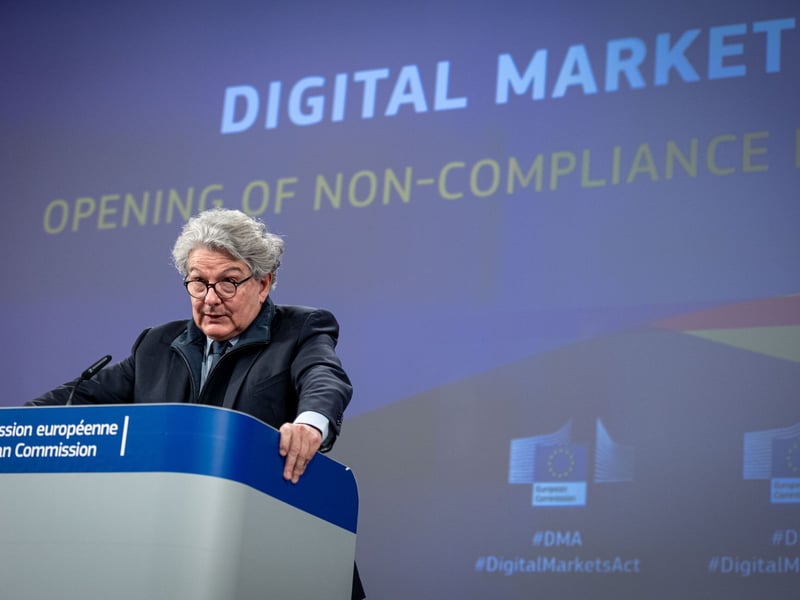
Following on the heels of a July ruling that X breached the DSA with its paid “blue checks,” European Commissioner Thierry Breton, the EU’s top digital enforcer, sent Musk a strongly worded letter Monday about X’s obligations.
The warning was motivated by the “risk of amplification of potentially harmful content in the EU,” Breton said before Musk’s live-streamed interview with candidate and former U.S. President Donald Trump. Breton also mentioned Musk’s recent comments, seen as inflammatory in Brussels, that “civil war is inevitable” after far-right riots in the United Kingdom.
The tech billionaire didn’t let the EU’s combative step sit for long.
“To be honest, I really wanted to respond with this Tropic Thunder meme,” Musk respondedon X, posting an offensive meme from a Hollywood blockbuster. “But I would NEVER do something so rude & irresponsible!”
Since the letter, Musk has continued to post frequently on X about what he says are issues of freedom of speech and attempts to control political discourse.
X CEO Linda Yaccarinom, meanwhile, called Breton’s letter “an unprecedented attempt to stretch a law intended to apply in Europe to political activities in the U.S.”
Breton’s aggressive step was not without controversy in Brussels either.
Within hours of the letter’s publication, Breton, who has used a loud and confident communication style over his five years in office, faced accusations of interfering in U.S. politics, causing his cabinet to tone down the rhetoric.
However, EU officials say that despite the discontent, the latest standoff is only likely to intensify Brussels’ tough line against the platform.
Collision course
Last month, EU tech regulators ruled that X breached the DSA and deceived users about the potential trustworthiness of online content through the introduction of paid “blue checks,” which previously denoted a verified account.
The digital platform was also accused of not being transparent about how actors purchased online advertising, and not providing access to its data — both of which would violate the EU legislation.
X said it disagreed with the compliance assessment; Musk threatened litigation.
The company has been asked to respond to the EU charges before a final decision is made, which Brussels insiders say would most likely be in early 2025.
The new legislation, which entered into force in February, aims to prevent any single platform from gaining too much control over the online landscape. The step has widely been viewed as a new chapter in the bloc’s attempts to tame the internet and take on Big Tech.
Some EU citizens, who in general tend to be more privacy-oriented than their American peers, are welcoming those steps.
“Making sure that online platforms abide by laws is super important,” Konrad, 29, a Hungarian based in Brussels who works for a small company, told Courthouse News.
“The new EU laws do not hamper free speech; they do nothing more but replicate the same consumer safeguards online that we already enjoy in the offline world,” he said. “But more regulation means more obligations that tech tycoons like Musk will hate — he is attacking the EU laws out of his own business interest, and it is sad if anyone believes he’s a genuine fighter for freedom of speech.”
Franziska, 33, a German based in Brussels who works in communications, told Courthouse News she would like to see even more decisive steps.
“Big Tech needs to be regulated, especially when it comes to content that is spreading hate speech and disinformation,” she said. “We’ve seen how much damage can be done when it comes to Covid-19, where conspiracy theories threaten lives, or when it comes to third actors such as Russia trying to influence how people vote,” she added.
Last September, the EU named one Chinese and five American companies as internet “gatekeepers” due to their massive reach — with more than 45 million European users — and huge profits in the EU single market.
Failure for these gatekeepers to comply can result in fines as high as 10% of a company’s total worldwide annual turnover, and up to 20% for repeated infringements.
Under the DSA, X is designated a Very Large Online Platform, or VLOP, which means it must adhere to strict transparency and risk management rules.
While the European Commission has so far not decided to designate X Ads as a gatekeeper, it launched an investigation into Musk’s platform in December over its potential designation as a gateway.
“The DSA obligations apply without exceptions or discrimination to the moderation of the whole user community and content of X (including yourself as a user with over 190 million followers),” Breton wrote to Musk.
“We are monitoring the potential risks in the EU associated with the dissemination of content that may incite violence, hate and racism in conjunction with major political — or societal — events around the world,” the EU’s top digital enforcer wrote.
“My services and I will be extremely vigilant to any evidence that points to breaches of the DSA and will not hesitate to make full use of our toolbox, including by adopting interim measures, should it be warranted to protect EU citizens from serious harm,” Thierry added.
Possible next steps
Andrea Renda, research director at the Center for European Policy Studies in Brussels, told Courthouse News, “It is difficult to say what the EU could do more, apart from enforcing the DSA to its fullest extent, which would mean sanctioning X for violation — 6% of the worldwide annual turnover following a non-compliance decision, or failure to comply."
For an urgent issue or persistent non-compliance, Brussels could also impose interim measures or request the temporary suspension of the service.
“That might not necessarily be too much of a scare for Musk, who may in return threaten to ’leave the EU,’ but certainly, we would see a lot of tension emerging between X and the European Commission,” Renda said.
“I see the dispute headed towards a much more specific indication of the measures that a VLOP like X should adopt to prevent the escalation of harmful content,” he added.
The European Commission could “ask VLOPs to place restrictive measures on individual accounts with a large number of followers,” Renda said.
“In the case of X, however, this would mean that Elon Musk engages in self-censorship,” he added.
Eyeing the next administration(s)
While the EU’s investigation is ongoing, Musk might count on winds of change in the U.S. and the EU.
It is unclear who will take over Breton’s role on the next European Commission team after June’s European elections, but Musk may be hoping for a different approach from a more right-wing European Parliament — and from a White House with different priorities.
“I would expect a Trump administration to step in rather aggressively in defense of X,” Renda said. Musk has endorsed Trump despite earlier difficulties between the two.
Recently, some experts have seen the DSA serving as a potential guidepost for the U.S. Indeed, a joint statement issued after the latest round of high-level EU-U.S. trade and tech talks in April pointed toward that end.
“A Harris administration may follow in the footsteps of the Biden one, which has carefully considered placing more responsibility on large-scale social media and has also welcomed the DSA as a very interesting piece of legislation,” Renda said of the Democratic nominee, Vice President Kamala Harris.
Beyond the X standoff, and despite distinct approaches, this year regulators in both the U.S. and EU have been on the offensive against digital giants Apple, Amazon, Microsoft, Meta and other tech companies they see as monopolies.
Subscribe to our free newsletters
Our weekly newsletter Closing Arguments offers the latest about ongoing trials, major litigation and rulings in courthouses around the U.S. and the world, while the monthly Under the Lights dishes the legal dirt from Hollywood, sports, Big Tech and the arts.