
 Search Articles


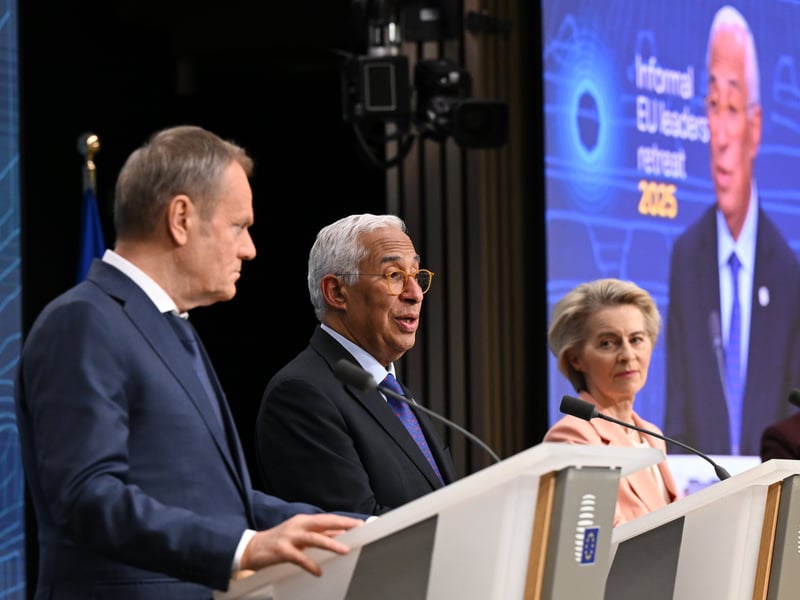
BRUSSELS (CN) — While European countries increasingly agree the continent needs to hike spending and fill gaps in its military capabilities, the question of how remains unanswered.
Since Russia’s invasion of Ukraine and amid the growing worry that a Donald Trump-led America won’t protect the continent as in previous decades, European countries have already ramped up their national defense spending.
With an estimated 500 billion euros ($518 billion) in investments needed over the next decade, EU leaders are increasingly pressed to determine what is urgently needed and how to pay for years of under-investment in the long term.
A senior EU official told reporters ahead of an EU and NATO defense meeting Monday that the bloc “faces a strong sense of urgency, but the discussions are very difficult.”
European Commission President Ursula von der Leyen told reporters after the summit, “Europe needs, basically, a surge in defense. And for that, our defense industrial base must be strengthened.”
“For many, many years, we have under-invested in defense. Thus there’s a great urgency to increase the defense spending with a big magnitude,” she said.
European Council President Antonio Costa agreed: “We need to do it better, stronger, faster — and we need to do it together," he said after the dedicated defense summit.
EU leaders agreed the bloc’s focus should primarily lie on filling critical gaps in their defenses such as air and missile defense system, missiles, ammunition production and barrier-free military transport across the bloc, EU diplomats said.
While there is an increasing push to ramp up the bloc’s own defense industry and “buy European,” an initiative led by France, an increasing number of member states warn that excluding U.S. arms manufacturers would send the wrong signal to Washington.
A key sticking point remains finding the funding for those capabilities.
Von der Leyen and Costa both said the EU had several potential defense financing options, including national spending, an expanded role for the EU’s European Investment Bank and private capital.
First steps have been made by potentially asking commercial banks, the European Investment Bank or a new defense bank to invest directly in military products by labelling defense as a “sustainable” sector, removing barriers that have previously prevented such investments.
The European Commission had also already been tasked by EU leaders to look for flexibility in rules it oversees on EU countries’ public finances to make defense spending easier by mobilizing bank loans.
The bloc’s Stability and Growth pact limits countries to a 3% deficit and 60% debt ceiling, a target which some European countries have blamed for keeping them from investing more in defense.
Future options could also include reallocating unspent financial resources from existing programs such as the EU’s pandemic recovery fund, or easing rules to spend the bloc’s cohesion funds, which usually benefit less developed countries and regions to help them reduce economic disparities.
A controversial joint borrowing proposal, which would see the bloc issuing joint debt to pay for defense spending — so-called Eurobonds — remains the least favorable option, as it is seen as politically too sensitive to sell to domestic audiences.
EU diplomats say that borrowing to finance loans rather than grants for military projects may be a possible compromise. They also believe that a decision by summer remains difficult, considering member states’ positions still remain too far apart.
Monday’s summit was also meant to give the EU executive pointers as it works on a long-term defense policy proposal — a European Commission White Paper on Defense — which is meant to be lay out all options within 100 days of the current EU executive’s mandate in March.
An EU leaders’ summit later in June would then discuss the proposals, which will have to be ultimately approved by all EU member states.
Subscribe to our free newsletters
Our weekly newsletter Closing Arguments offers the latest about ongoing trials, major litigation and rulings in courthouses around the U.S. and the world, while the monthly Under the Lights dishes the legal dirt from Hollywood, sports, Big Tech and the arts.