
 Search Articles


CINCINNATI (CN) – Kim Davis, the former county clerk briefly jailed over her refusal to recognize gay marriage in Kentucky, is not immune from civil claims by two of the couples she denied a license to wed, the Sixth Circuit ruled.
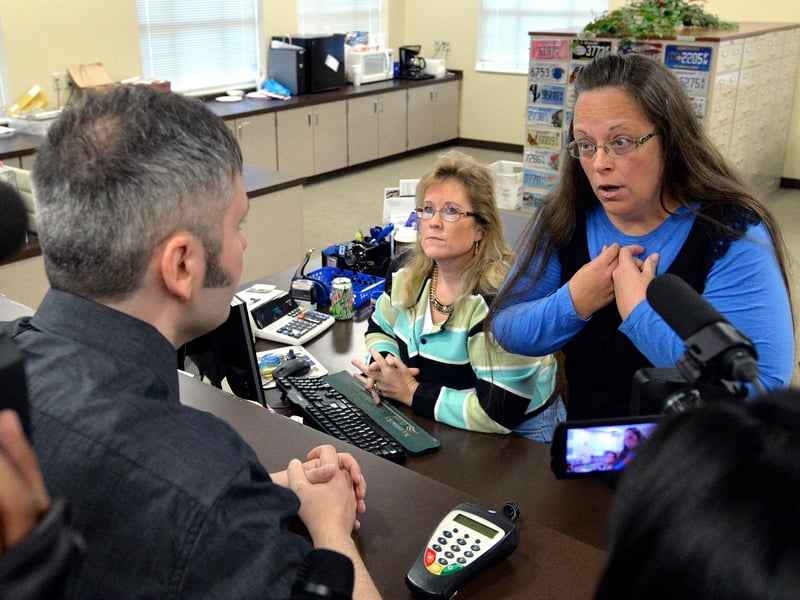
In mid-2015, when the U.S. Supreme Court ushered in same-sex marriage across the country with its landmark ruling in Obergefell v. Hodges, Davis had been presiding over the clerk’s office in Rowan County. That summer, however, Davis claimed that her religious beliefs as an Apostolic Christian blocked her from issuing marriage licenses to gay couples.
Two of the couples Davis spurned brought federal complaints, and Davis appealed to the Sixth Circuit after a judge in Ashland found that qualified immunity did not shield Davis in her individual capacity.
Affirming that determination Friday, U.S. Circuit Judge Richard Griffin wrote for a three-judge panel that the couples Davis turned away were exercising clearly established rights.
“For a reasonable official, Obergefell left no uncertainty,” Griffin wrote. “For Davis, however, the message apparently didn’t get through.
“And it still doesn’t appear to have gotten through: She now argues that* Obergefell* doesn’t even apply to her conduct.”
Trying to shift the focus to state liability, Davis argued that the couples who sued her could have gotten their marriage licenses elsewhere in Kentucky.
Griffin denied the argument out of hand, noting that Davis provided “no legal authority for that proposition.
“We can find none,” Griffin added. “And we know why: that’s not how qualified immunity works, and that’s not how constitutional rights work.”
Going further, Griffin emphasized that no iota of the Constitution or constitutional law says “that a government official may infringe constitutional rights so long as another official might not have.”
While U.S. Circuit Judge Helene White joined the ruling in full, U.S. Circuit Judge John Bush concurred in part.
“Unlike the majority, I don’t find that Davis’s actions constituted an outright ban of same-sex marriage,” Bush wrote, arguing that that “the facts … are more nuanced than that.”
Indeed Bush voiced support for Davis’ claim that “nothing prevented each plaintiff couple from travelling outside Rowan County, obtaining a marriage license from a different county clerk, and returning to Rowan County to solemnize their marriage.”
Despite this quarrel, however, Bush with the majority stated that immunity does not shield Davis since she “knew or ought to have known, to a legal certainty, that she could not refuse to issue marriage licenses … because of moral disapproval of homosexuality.”
 Follow @cnsjkelly
Subscribe to our free newsletters
Our weekly newsletter Closing Arguments offers the latest about ongoing trials, major litigation and rulings in courthouses around the U.S. and the world, while the monthly Under the Lights dishes the legal dirt from Hollywood, sports, Big Tech and the arts.