
 Search Articles


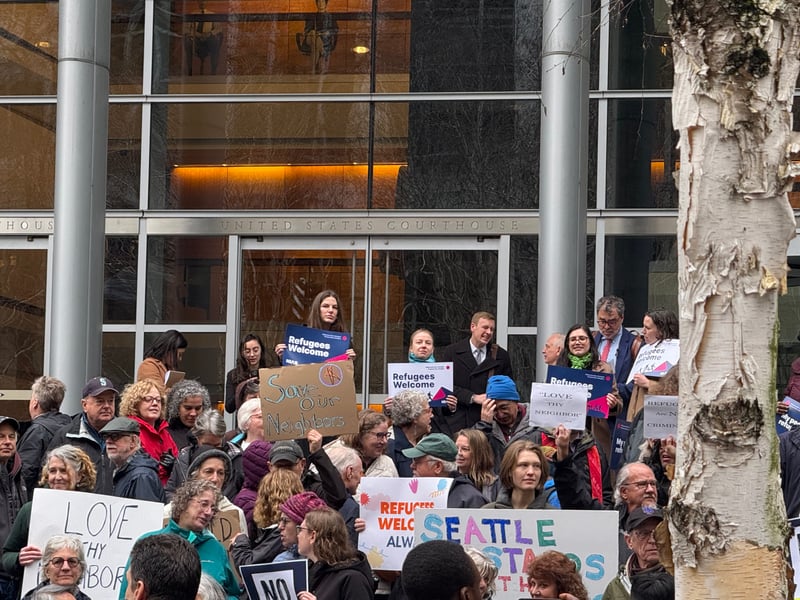
SEATTLE**** (CN) — An executive order cutting funding to the nation’s refugee resettlement program and pausing refugee admissions hit a roadblock after a federal judge issued a preliminary injunction from the bench Tuesday in Seattle.
The executive order, “Realigning the United States Refugee Admissions Program,” was one of dozens Trump signed shortly after taking office in January. Under the executive order, refugee admissions have come to a halt, leaving some refugees in the middle of the process stranded and organizations that help resettle refugees without funding.
On Feb. 10, three faith-based refugee assistance agencies and nine individual plaintiffs sued the administration, arguing the suspension violates Congress’ authority to make immigration laws. The assistance agencies said they have yet to be reimbursed for millions of dollars the State Department owes them for work in the late months of last year.
U.S. District Judge Jamal N. Whitehead, a Joe Biden appointee, sided with the refugees and aid organizations.
“To be sure, the president has substantial discretion to suspend refugee admissions, but that authority is not limitless,” Whitehead said after ruling from the bench. “I cannot ignore Congress’ detailed framework on refugee admissions. The plaintiffs face concrete irreparable harm.”
Whitehead’s order elicited a gasp and clap from the packed courtroom.
The nine individual refugees identified in the suit only by their first names join Church World Service, Lutheran Community Services Northwest, and HIAS, a trio of faith-based refugee services, as plaintiffs in the suit.
In the motion for a preliminary injunction, the plaintiffs argued that Trump exceeded his authority and that any changes to the program should have been subject to notice and comment rulemaking required under the Administrative Procedure Act.
Before the court, Deepa Alagesan, an attorney with the International Refugee Assistance Project representing the plaintiffs, argued that any relief short of an injunction would continue to force irreparable harm on the aid organizations and all the refugees caught in limbo.
“Like Humpty Dumpty falling off the wall, pieces are being broken that will not be put back together without immediate relief,” Alagesan said.
The agencies argued that the suspensions “take a wrecking ball to Congress’ carefully crafted statutory scheme — elevating an applicant’s refugee status to an inadmissibility bar of its own.”
The government, on the other hand, argued in its response to the motion for a preliminary injunction that the agencies and individuals don’t have standing to seek injunctive relief because the president “may not be enjoined in the performance of his official non-ministerial duties.”
August Flentje, Department of Justice attorney representing the federal defendants, refused to concede that the individual and organizational plaintiffs had suffered irreparable harm and implored Whitehead to limit any relief only to the individuals named in the lawsuit. He also argued that the organizational plaintiffs’ challenge to the executive order and program suspension is a contractual challenge since the aid organizations are government contractors.
The government also argued that the Immigration and Nationality Act of 1952, which the agencies argued prioritizes applications for family members of refugees, doesn’t entitle admission to relatives of refugees but merely allows them refugee status if they are admitted.
Further, the government argued that nothing in the country’s immigration laws requires the government to fund public or private agencies for refugee resettlement.
“The court should not interfere with, or second-guess, the foreign policy and national security judgments that the Constitution and [Immigration and Nationality Act] commit unequivocally to the duly elected president,” the government wrote.
On rebuttal, Alagesan pushed back on the government’s arguments, reminding the court to keep the plaintiffs’ declarations in mind. The aid organizations described the impacts of the executive order and suspension as “catastrophic,” and the individual plaintiffs each described how the changes radically impacted their lives.
“The idea that the refugees affected by this ban are not being harmed is belied by law and logic," Alagesan said.
The agencies asserted that thousands of refugees were trapped mid-process when the executive order immediately and suddenly shuttered refugee admissions, no matter where they were in the resettlement process.
For Pacito — one of the nine individuals named plaintiffs in the case — the executive order caused his travel to the United States to be abruptly canceled. He was approved to resettle in the U.S. but was stranded in a parking lot on Jan. 22 when those travel plans were canceled, despite the executive order stating the suspension would take place on Jan. 27.
“That night, my wife, my baby and I slept outside the transit center in the parking lot, along with other refugee families waiting to travel to the United States,” Pacito, who fled war in the Democratic Republic of the Congo when he was 13 years old, said in a statement. “In the morning, they told us President Trump had canceled all refugee travel. Now I don’t know what we’re going to do, we have nothing.”
Following the hearing, refugees spoke in support of the resettlement program.
“Today, I want to say thank you to every single person who helped resettle my family here and countless other families,” Emillie Binja, a refugee from the Democratic Republic of Congo, said. “It has broken my heart in the last couple of months to hear the myths and the ways that our struggles are being demonized and making us look like we do not belong here.”
Tshishiku Henry, who also fled the Democratic Republic of Congo, described being in the county as a “miracle of a second chance” and a testament to the generosity of the country.
“The American people who welcomed us with open arms, you didn’t just offer us safety,” Henry said. “You gave us back our futures.”
Congress enacted the Refugee Act in 1980, which details the policies and procedures governing refugee admission and resettlement in the country known collectively as the U.S. Refugee Admissions Program. Only certain refugees who are determined to be of special humanitarian concern to the country are eligible.
The act allows the president to determine the number of refugees the country can admit in a fiscal year. Late last year, former President Joe Biden set that number at 125,000 for fiscal year 2025. In 2024, just over 100,000 refugees were admitted.
Subscribe to our free newsletters
Our weekly newsletter Closing Arguments offers the latest about ongoing trials, major litigation and rulings in courthouses around the U.S. and the world, while the monthly Under the Lights dishes the legal dirt from Hollywood, sports, Big Tech and the arts.