
 Search Articles


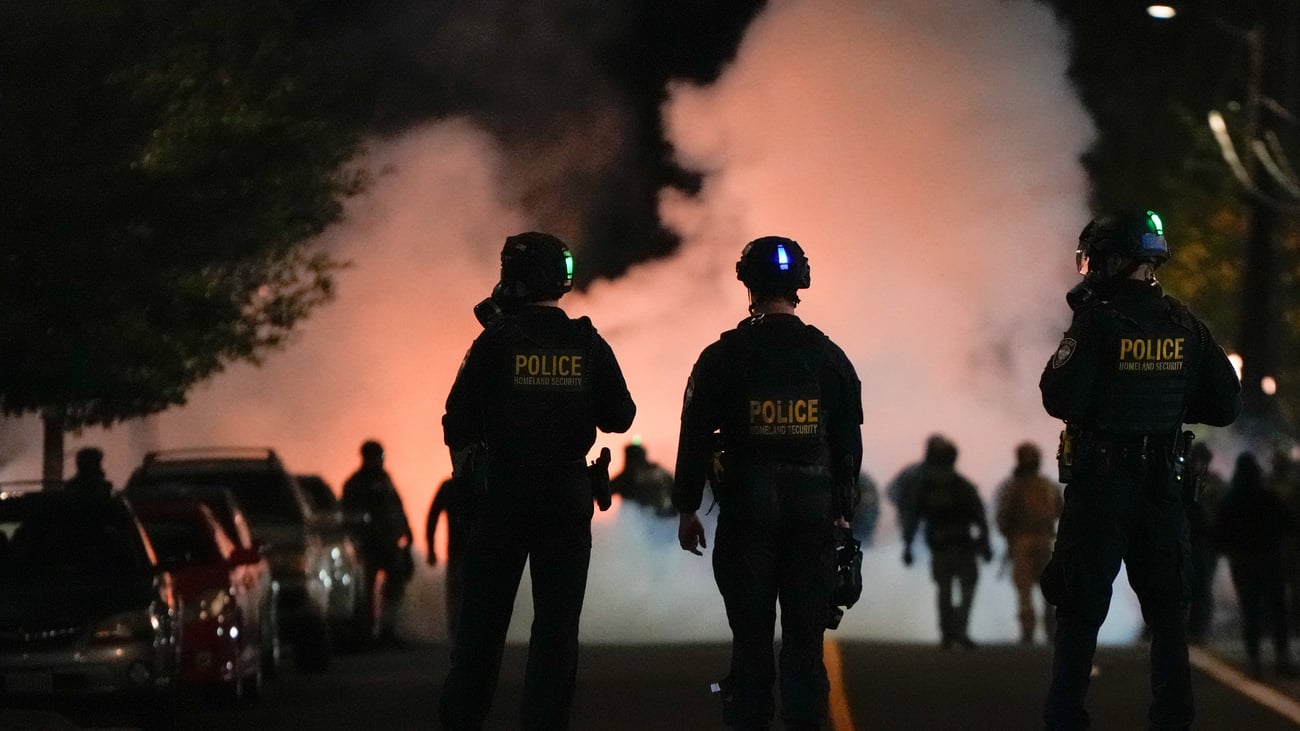
PORTLAND, Ore. (CN) — Federal agents assigned to protecting the U.S. Immigration and Customs Enforcement facility in Portland are clear to use chemical munitions and projectiles after a pair of Ninth Circuit rulings effectively blocked two court orders limiting such use of force.
In one ruling, the appeals court found there is no such right to “bodily integrity” to be free of exposure to chemicals released when federal officers used tear gas and other chemicals to disperse crowds at the facility. In the other, the court found the injunction was too broad.
“Federal courts are not the couture of law enforcement officers,” wrote U.S. Circuit Judge Kenneth Lee.
The same panel of judges decided both rulings in cases concerning the rights of protesters and bystanders near the ICE facility on the city’s south waterfront. Separate federal judges issued injunctions limiting the use of chemical agents outside the facility, and the government appealed, appearing before the Ninth Circuit panel earlier this month.
Donald Trump appointees Lee and U.S. Circuit Judge Eric Tung agreed with the government’s arguments in both cases, while Joe Biden-appointed U.S. Circuit Judge Ana de Alba dissented.
A group of protesters and journalists sued Trump, the Department of Homeland Security and its former Secretary Kristi Noem late last year, arguing federal officers deployed tear gas, pepper balls and other munitions outside of the ICE facility in retaliation for the exercise of First Amendment rights.
U.S. District Judge Michael Simon, a Barack Obama appointee, issued a temporary restraining order in early February blocking federal immigration officers from deploying chemical munitions or projectiles.
The residents of a low-income housing complex across the street from the ICE building also sued the federal government late last year, accusing federal agents of intentionally and repeatedly deploying chemical munitions near the apartment complex, violating their right to bodily integrity by exposing them to toxic airborne substances.
Following an evidentiary hearing, U.S. District Judge Amy Baggio, a Biden appointee, sided with the residents in early March and issued a preliminary injunction blocking federal agents from deploying crowd control devices in a way that would send the chemicals into the nearby low-income housing complex.
Three days later, Simon issued a preliminary injunction blocking agents from using chemical or projectile munitions unless they were legally justified in using deadly force against the target.
In the case of the apartment residents, the Ninth Circuit majority found Baggio erred by holding the plaintiffs had a substantive due process right to bodily integrity.
“Neither the District Court nor the plaintiffs have provided any indication that the substantive-due-process right they claim is to be found in our constitutional text or structure or is deeply rooted in our nation’s history and tradition,” Tung wrote.
The appeals court also found the injunction was too broad and vague to be workable. Under the injunction, the government is enjoined from deploying chemical munitions “in quantities such that” the chemicals are likely to reach the apartment complex.
“But how much is too much; whether the gas is ‘likely to reach’ the complex; all this is guesswork, and where a gas cloud travels will depend much on the weather,” Tung wrote. “The District Court’s order appears to presume federal control over nature’s elements. But the federal government has no more power to direct the winds than Cnut could command the tide.”
In her dissent, de Alba pushed back against that notion, writing the record reflects the government understands the ranges of the munitions it uses and that the argument is not simply about uncontrollable conditions.
“Indeed, it would be reckless if the government did not understand the impact of the munitions that it used, especially given the evidence that exposure to such munitions can create severe adverse health effects,” de Alba wrote.
The residents involved in the case issued a joint statement expressing deep disappointment with the majority’s decision.
“No one should be forced to endure exposure to chemical weapons in their own home,” the plaintiffs said in a statement. “The Constitution protects people’s right to safety, physical integrity, and the peaceful enjoyment of where they live.”
In the case of the protesters and journalists, the Ninth Circuit majority likewise found the injunction too broad. It also found the lower court made the wrong legal assumptions.
“It incorrectly concluded the five plaintiffs were likely being intentionally targeted for their First Amendment rights because there purportedly was no valid reason for the government to use tear gas and other non-lethal munitions,” Lee wrote. “Once that foundational — and faulty — assumption is cast aside, the court’s finding of intent to retaliate collapses.”
The Ninth Circuit instead concluded it was more likely the five plaintiffs were simply “rather unfortunate collateral casualties during a chaotic effort to quell disorder.”
Keeping the injunction in place, the majority concluded, would prevent federal agents from controlling crowds at the site even when the crowds are large and threatening public safety.
“This is not merely unworkable — it is also extremely dangerous to both federal officers and the public,” Lee wrote.
Dissenting again, de Alba wrote that she disagreed with the government’s theory of harm due to the injunction.
“In light of the government’s compliance with the temporary restraining order, the government does not show that the preliminary injunction is likely to impede federal officers’ ability to ‘protect themselves and the Portland ICE facility from attack and disruption.’”
Neither the protesters and journalists nor the federal government responded to a request for comment before press time.
Subscribe to our free newsletters
Our weekly newsletter Closing Arguments offers the latest about ongoing trials, major litigation and rulings in courthouses around the U.S. and the world, while the monthly Under the Lights dishes the legal dirt from Hollywood, sports, Big Tech and the arts.
Additional Reads

 Conservative physicians accuse medical boards of censorship April 27, 2026