
 Search Articles


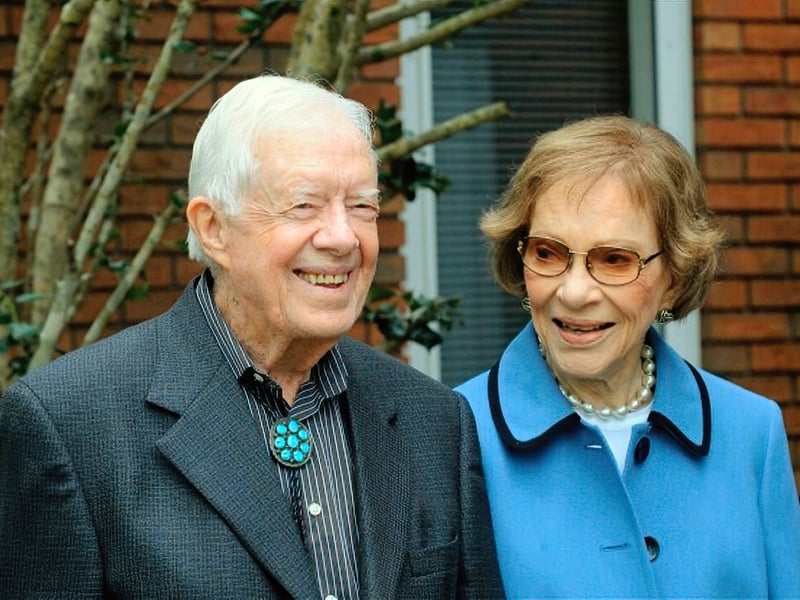
ATLANTA (CN) — Former President Jimmy Carter, who died Sunday at the age of 100, will be honored with a state funeral Jan. 9 at Washington National Cathedral.
The 39th president and Nobel Peace Prize winner will later be buried in a private ceremony in his hometown of Plains, Georgia, where he died, The Carter Center said.
Carter was known for his enduring commitment to philanthropy and humanitarian work as well as his political career that culminated in one term in office.
President Joe Biden also declared Jan. 9 a national day of mourning, with flags to be flown at half-staff over all government buildings for 30 days after Carter’s death.
“To all of the young people in this nation and for anyone in search of what it means to live a life of purpose and meaning — the good life — study Jimmy Carter, a man of principle, faith, and humility,” Biden said in a statement.
Biden said his longtime friend Carter had asked him to deliver a eulogy. The two presidents’ relationship dates back to 1976 when Biden, a first-term U.S. senator from Delaware, endorsed Carter for the Democratic presidential nomination.
Several state funerals for former presidents, including Dwight Eisenhower, Ronald Reagan, Gerald Ford and George H. W. Bush, took place at Washington National Cathedral, just miles north of the White House. A state funeral is usually a seven- to 10-day event with three stages.
The Carter Center said that arrangements are underway for public observances of Carter’s death in Atlanta, Georgia, and Washington.
Carter is expected to be buried next to his wife of 77 years, Rosalynn Carter, who died last year at the age of 96.
Carter made a rare public appearance to attend his wife’s memorial service, but had been secluded in hospice care since February 2023, in the same one-story brick home that he built with his wife in 1961.
‘A hero to everyone’
His eldest grandchild, Jason Carter, said the family hadn’t expected to see his 100th birthday on Oct. 1, as hospice care is typically intended for those with less than six months to live, but Carter surpassed those expectations.
“My father was a hero, not only to me but to everyone who believes in peace, human rights and unselfish love,” said Chip Carter, the former president’s son. “My brothers, sister and I shared him with the rest of the world through these common beliefs. The world is our family because of the way he brought people together, and we thank you for honoring his memory by continuing to live these shared beliefs.”
To mark his birthday as the longest-living president in U.S. history, Carter attended a naturalization ceremony held annually for 100 new citizens at his former high school in Plains, which is now a museum.
The small town of just 638 people cherishes the legacy of the man who once maintained his family’s peanut farm and supply company after graduating from the U.S. Naval Academy in Annapolis, Maryland.
His political career took root serving on the county board and grew as he went on to become a state senator, eventually winning a bid for governor.
In 1974 he decided to take on Washington politics and run for the presidency, promising Americans fatigued by former President Richard Nixon’s Watergate scandal that he would “never tell a lie.”
After winning the nomination, Carter defeated incumbent Republican President Gerald Ford in 1976 as the first and only Georgian to become president.
Though he was unable to instill enough confidence in Americans for a second term, Carter accomplished feats that long outlasted his presidency. He expanded major environmental protection by designating more national parks, particularly in Alaska, and also established the Superfund, a program that makes polluters pay.
The national school system was also reorganized under Carter’s formation of the Department of Education to ensure equal education opportunities.
In 1980, he appointed Ruth Bader Ginsburg to the U.S. Court of Appeals for the D.C. Circuit — considered to be a proving ground for would-be Supreme Court justices — before the liberal icon ascended to the high court.
University of Virginia professor Barber Perry noted last year in an essay on Ginsburg’s career that Carter was responsible for developing an affirmative action plan for the nation’s trial courts and courts of appeal. Ginsburg was one of 262 judicial nominations he sent forward during his term.
From Plains, Georgia, to Camp David
During his presidency, Carter faced steep challenges, from brinkmanship with Russia to a partial nuclear meltdown at Three Mile Island, to the Iranian hostage crisis and the global oil shortage that kicked off during the Iranian Revolution.
In the hot seat to act as oil prices skyrocketed and cars lined up in seemingly endless lines at fuel pumps crisscrossing the U.S., Carter delivered his now-famous “Crisis in Confidence” speech where he laid out an ambitious agenda for Americans to conserve energy, reduce oil consumption and improve energy independence more broadly.
His administration launched a comprehensive energy program conducted by a new Department of Energy, regulating existing energy suppliers and funding research on new sources of energy, particularly sustainable ones such as wind and solar power. The deregulation of oil and natural gas prices that resulted would lead to a vast increase in the supply of energy in the 1980s, and consequently a lowering of prices.
Carter also negotiated the Camp David Accords, a seminal 13-day meeting between Israeli Prime Minister Menachem Begin and Egyptian President Anwar Sadat at Maryland’s Camp David. The meeting ultimately led to a year of peace between the neighboring nations. Both Sadat and Begin received Nobel Peace Prizes for their part in the talks. Carter would not be recognized with a Nobel Peace Prize until 2002 for his role in the accord. The Norwegian Nobel Committee cited Carter’s “decades of untiring effort to find peaceful solutions to international conflicts, to advance democracy and human rights and to promote economic and social development.”
His advocacy for global human rights continued throughout his life. After leaving the White House in 1982, Carter founded the Carter Center, a nonpartisan and nonprofit center in Atlanta to protect human rights and democracy, resolve conflicts and prevent disease across the world. The center has spearheaded an international effort to eradicate six diseases, including the Guinea worm disease, which is poised to be the second human disease in history to be eliminated after smallpox.
Paige Alexander, CEO of the Atlanta-based Carter Center, said she remained in contact with Carter, whose main concern was of one of his long-term goals to eradicate the Guinea worm.
When the Carter Center assumed leadership of the global Guinea Worm Eradication Program in 1986, about 3.5 million people across Asia and Africa were afflicted with the debilitating illness caused by the parasite. Today, Alexander said that number has dropped to six cases in two countries.
“I’d like for the last Guinea worm to die before I do,” Carter told reporters during a 2015 news conference in Atlanta to discuss his cancer diagnosis.
He and his wife, Rosalynn, partnered with Habitat For Humanity to join volunteers in providing “safe, affordable housing” for 19 families in New York City’s East Village in 1984. For more than 35 years, the Carters continued to work alongside more than 100,000 volunteers to build, renovate and repair 4,290 homes in 14 countries.
And they never forgot about their home community in Plains, where Carter also regularly taught Sunday school in the Maranatha Baptist Church from the end of his presidency into his 90s.
“He’s a remarkable human being,” said Zac Steele, a deacon who served at the same church as the former president for about five years. Steele said he remembers Carter as someone who always put others before himself, and that he’s left a legacy that doesn’t end.
“His work here as a president, as a humanitarian, as a Christian, is unlike work that we’ll ever see again,” said Steele.
Carter was not afraid to speak out against inequality. He felt that many Southern Baptist leaders were taking the Bible’s teachings out of context in regards to women, causing him to sever ties with the Southern Baptist Convention in 2000. He dedicated much of his spiritual work to ending discrimination within the Baptist community and unifying Black, white and Hispanic churches.
Jason Carter said the centenarian president, who was born four years after women were granted the constitutional right to vote and four decades before Black women won ballot access, was eager to vote in the 2024 presidential election for Kamala Harris, the Democrat who would have been the first woman, second Black person and first person of south Asian descent to reach the White House.
Carter is survived by his four children — Jack, Chip, Jeff, and Amy; 11 grandchildren; and 14 great-grandchildren.
 Follow @Megwiththenews
Subscribe to our free newsletters
Our weekly newsletter Closing Arguments offers the latest about ongoing trials, major litigation and rulings in courthouses around the U.S. and the world, while the monthly Under the Lights dishes the legal dirt from Hollywood, sports, Big Tech and the arts.