
 Search Articles


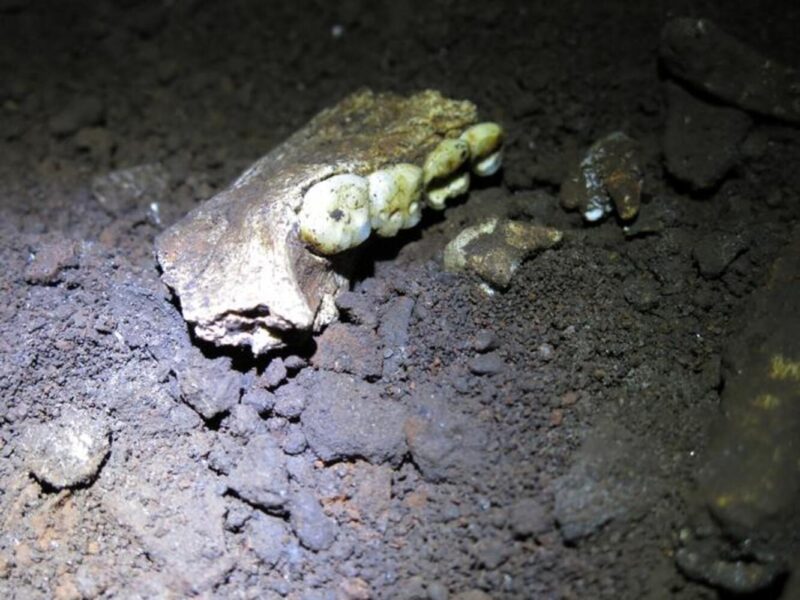
(CN) — A South African cave system may contain the oldest known sex-specific burial site on Earth, and the species responsible wasn’t even human.
A team of researchers from the University of York, the University of Copenhagen and more than 10 other international institutions analyzed proteins from 23 teeth representing at least 20 different individuals of Homo naledi, an extinct relative of modern humans that lived between 335,000 and 241,000 years ago. They found no male markers.
The findings were published Wednesday in Cell in a study titled “Ancient tooth protein reveals ‘all-female’ fossil site of extinct human relation.”
The fossils come from the Dinaledi Chamber of South Africa’s Rising Star Cave system, where Homo naledi remains were first discovered in 2013. The species has fascinated researchers because of its unusual mix of primitive, ape-like traits and human-like features.
For more than a decade, scientists have wondered why the fossils looked remarkably similar, showing almost none of the physical variation usually expected between males and females.
To investigate, they used a minimally destructive acid etching technique to extract microscopic protein fragments called peptides from the teeth. Then they analyzed the enamel for a protein called Amelogenin-Y, which is uniquely coded by the male Y chromosome.
They found no evidence of the protein in any of the samples.
To rule out contamination, a team at the University of York’s specialized chemistry facility analyzed amino acids in the samples to confirm the proteins were ancient.
Dr. Marc Dickinson of the University of York’s Department of Chemistry said the results open a window into how these ancient hominins lived.
“The lack of male markers within the group is truly fascinating,” Dickinson said. “These findings offer rare insights into a culture that has, until now, been difficult to access directly. Advances in ancient protein analysis are opening the door to a far richer and more nuanced understanding of ancient hominins.”
Their findings add momentum to a long-running debate over whether Homo naledi deliberately buried its dead. If proven, the Dinaledi Chamber would represent one of the oldest known examples of mortuary behavior among hominins.
If the chamber was reserved exclusively for females, it would suggest Homo naledi practiced a form of complex, symbolic burial behavior previously thought unique to modern humans. It would also make Rising Star Cave the first known sex-specific burial site by any non-Homo sapiens species.
But the scientists are also considering a competing theory. It’s possible the Homo naledi population was extremely isolated, causing the male-specific Amelogenin-Y gene to mutate or disappear entirely. In that case, males may have been present in the chamber but lacked the typical genetic signature.
Palesa Madupe, who completed the work as part of her postdoctoral research at the University of Copenhagen, said tooth enamel is uniquely suited to this kind of ancient protein research.
“Unlike those found in other remains like bone fragments, proteins in tooth enamel are preserved because dental enamel, the hardest tissue in the human body, shields proteins from environmental contamination even for millions of years,” Madupe said.
“This makes them ideal carriers of genetic information from deep time. Our study helps in the long-standing mystery of why Homo naledi lacked significant variation. It’s probably because they could have all belonged to one sex.”
The study examined the largest extinct hominin population ever subjected to protein analysis.
 Follow @JeremyYurow
Subscribe to our free newsletters
Our weekly newsletter Closing Arguments offers the latest about ongoing trials, major litigation and rulings in courthouses around the U.S. and the world, while the monthly Under the Lights dishes the legal dirt from Hollywood, sports, Big Tech and the arts.
Additional Reads


 Whale calls reveal cultural evolution June 23, 2026