
 Search Articles

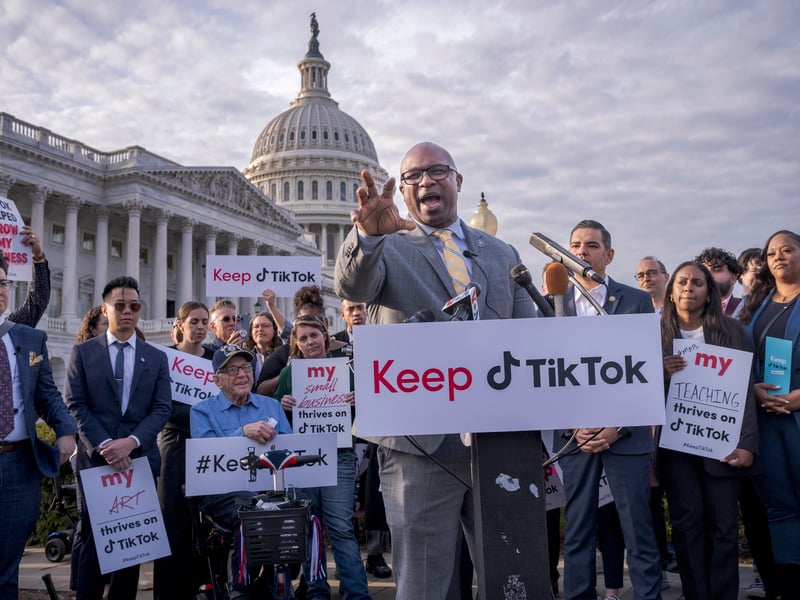
WASHINGTON (CN) — The U.S. Supreme Court will review a First Amendment battle royale over a looming TikTok ban Friday.
TikTok faces a nationwide ban under the Protecting Americans from Foreign Adversary Controlled Applications Act if its China-based owner ByteDance refuses to divest before Jan. 19.
The government claims foreign adversary control of social media apps threatens national security, suggesting the Chinese government could gain access to troves of U.S. user data through TikTok for nefarious purposes. However, the popular social media app says the law mandates government speech, violating core First Amendment rights.
The familiar tension between social media platforms and government regulation has starred in several cases on the court’s docket in recent terms, but so far the justices have bypassed major rulings on the issue. While some outcomes were attributed to case-specific issues, Justice Elena Kagan, a Barack Obama appointee, pointed out the justices themselves “are not the nine greatest experts on the internet.”
TikTok’s appeal carries major consequences, however, asking the justices to decide whether a social media site used by over 170 million Americans can be banned.
Milton Mueller, a professor at the Georgia Institute of Technology, said the justices will weigh a powerful new technology against fundamental rights.
“They have to put these high-tech media industries into the framework of fundamental rights," Mueller said in a phone call. “What is the right of an individual user to access information?”
The Biden administration says the controversial prohibition on foreign-owned apps has precedent in the Radio Act of 1912, which required radio operators to obtain a license from the government that was only available to U.S. citizens or companies.
Bars on foreign-owned or operated radio were expanded in 1927, and in 1934 the Communications Act gave the Federal Communications Commission authority to withhold licenses to “foreign-dominated” companies.
“The First Amendment would not have required our nation to tolerate Soviet ownership and control of American radio stations (or other channels of communication and critical infrastructure) during the Cold War, and it likewise does not require us to tolerate ownership and control of TikTok by a foreign adversary today,” U.S. Solicitor General Elizabeth Prelogar wrote.
Mueller said the comparison is bogus and underscores outdated government views on social media. Foreign-owned radio prohibitions were based on limited infrastructure and military concerns over foreign powers having their own infrastructure with military applications in the United States.
In contrast, the internet has an unlimited capacity for speech. Mueller said the law also differs because lawmakers’ justifications were based on concerns about propaganda.
“It’s a technologically naive view that any form of digitized data that goes into the hands of a foreign power is dangerous,” Mueller said. “This is an astoundingly out-of-touch view of the world we live in because everything we do is producing data.”
Mueller said the bogus comparison reveals the government’s misunderstanding of the technology.
“The idea that you can somehow shut off all of this digitized data in this globalized digitized world with apps and devices everywhere, that somehow you can prevent a foreign government from having any useful access to that data is just crazy,” Mueller said. “It’s just crazy talk.”
Experts don’t dispute the legitimacy of data privacy concerns, but they warned that lawmakers’ solutions create new problems. The Copia Institute, a technology policy think tank, said foreign investors could try to sabotage American companies based on how they invest by disqualifying the platform from the First Amendment protections Americans enjoy.
The group noted that the Saudis reportedly own 4% of X, and Russia owns Facebook shares.
Experts also worried that greenlighting the TikTok ban would have ripple effects for other social media tools.
“If, for instance, any algorithm or content curation practice could be deemed suspect and so easily stripped of First Amendment protection as the act does here, then we risk losing not just the more dubious algorithms but all algorithms, no matter how beneficial or useful they are, and not just the ones employed by non-Americans but any,” the think tank wrote.
The D.C. Circuit upheld the law as constitutional, finding that the government’s national security concerns warranted a narrow restriction on speech. However, court watchers and advocacy groups faulted the court for giving the government’s claims too much deference.
“If the court says whether you have rights depends on the factual issue of whether there are national security concerns, and, by the way, we’re going to take the other side word for it, it’s not a review,” Daniel Solove, a professor of intellectual property and technology law at George Washington University Law School, said. “This is throwing someone’s rights away because the government says so.”
In a blockbuster ruling last term, the justices rejected deference to government agencies when interpreting laws. Solove said he would think the same would apply in this case.
“I would think the argument for deference when it comes to constitutional rights would be even stronger than deference to agencies because constitutional rights are the fundamental backbone of freedom and government power in the United States,” Solove said. “So, deferring to [the government’s national security assessment] seems to be an abdication of the judicial role.”
The American Civil Liberties Union and other groups said the law was actually motivated by speech lawmakers disagreed with. The groups noted Representative Mike Gallagher, chairman of the House Select Committee on the Chinese Communist Party, said the most important reason for the ban was that young Americans are getting all their news from TikTok.
“At least 20 other legislators justified their support for the act’s provisions in content- and viewpoint-based terms, citing risks ranging from the proliferation of Chinese propaganda, to the sharing of content harmful to minors, to the alleged suppression of pro-Ukraine and pro-Israel views,” the ACLU wrote.
TikTok said the law is at war with the First Amendment, noting the government’s concession that the law was based on the fear the app could be pressured by the Chinese government. The app says the U.S. has traditionally combatted disfavored speech with more speech.
“Petitioners do not contest Congress’ compelling interest in protecting this nation’s security, or the many weapons it has to do so,” TikTok wrote. “But that arsenal simply does not include suppressing the speech of Americans because other Americans may be persuaded.”
 Follow @KelseyReichmann
 Follow @kelseyreichmann.bsky.social
Subscribe to our free newsletters
Our weekly newsletter Closing Arguments offers the latest about ongoing trials, major litigation and rulings in courthouses around the U.S. and the world, while the monthly Under the Lights dishes the legal dirt from Hollywood, sports, Big Tech and the arts.