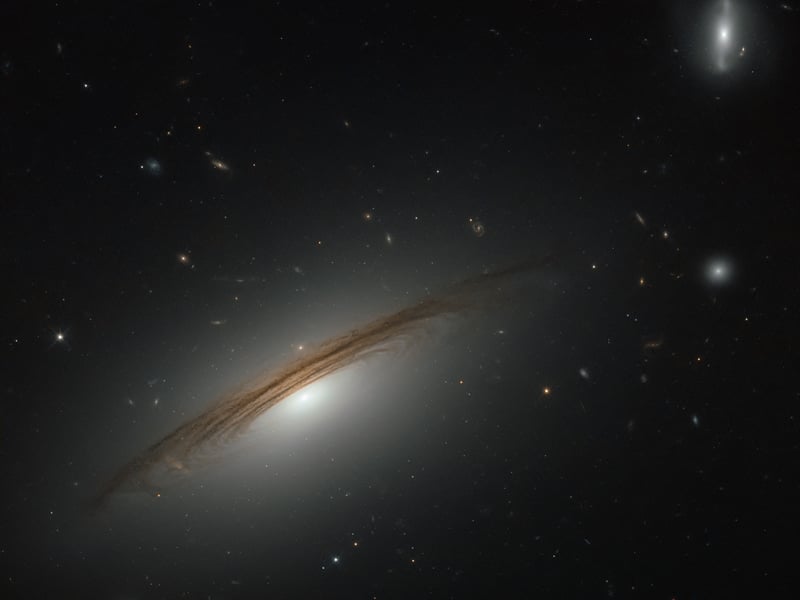
This NASA/ESA Hubble Space Telescope image showcases the remarkable galaxy UGC 12591. It lies just under 400 million light-years away from us in the westernmost region of the Pisces–Perseus Supercluster, a long chain of galaxy clusters that stretches out for hundreds of light-years — one of the largest known structures in the cosmos.
This NASA/ESA Hubble Space Telescope image showcases the remarkable galaxy UGC 12591. Classified as an S0/Sa galaxy, UGC 12591 sits somewhere between a lenticular and a spiral. It lies just under 400 million light-years away from us in the westernmost region of the Pisces–Perseus Supercluster, a long chain of galaxy clusters that stretches out for hundreds of light-years — one of the largest known structures in the cosmos. The galaxy itself is also extraordinary: it is incredibly massive. The galaxy and its halo together contain several hundred billion times the mass of the Sun; four times the mass of the Milky Way. It also whirls round extremely quickly, rotating at speeds of up to 1.8 million kilometres per hour! Observations with Hubble are helping astronomers to understand the mass of UGC 1259, and to determine whether the galaxy simply formed and grew slowly over time, or whether it might have grown unusually massive by colliding and merging with another large galaxy at some point in its past.
This NASA/ESA Hubble Space Telescope image showcases the remarkable galaxy UGC 12591. Classified as an S0/Sa galaxy, UGC 12591 sits somewhere between a lenticular and a spiral. It lies just under 400 million light-years away from us in the westernmost region of the Pisces–Perseus Supercluster, a long chain of galaxy clusters that stretches out for hundreds of light-years — one of the largest known structures in the cosmos.
The galaxy itself is also extraordinary: it is incredibly massive. The galaxy and its halo together contain several hundred billion times the mass of the sun; four times the mass of the Milky Way. It also whirls round extremely quickly, rotating at speeds of up to 1.8 million kilometers per hour.
Observations with Hubble are helping astronomers to understand the mass of UGC 1259, and to determine whether the galaxy simply formed and grew slowly over time, or whether it might have grown unusually massive by colliding and merging with another large galaxy at some point in its past.
Our weekly newsletter Closing Arguments offers the latest about ongoing
trials, major litigation and rulings in courthouses around the U.S. and the world,
while the monthly Under the Lights dishes the legal dirt from Hollywood,
sports, Big Tech and the arts.
Loading...
Privacy Preference Center
We use technologies like cookies to store and/or access device information. We do this to improve browsing experience and to show personalized ads. Consenting to these technologies will allow us to process data such as browsing behavior or unique IDs on this site. Not consenting or withdrawing consent, may adversely affect certain features and functions.
Strictly Necessary Cookies
Always active
These cookies are necessary for the website to function and cannot be switched off in our systems. They are usually only set in response to actions made by you which amount to a request for services, such as setting your privacy preferences, logging in or filling in forms. You can set your browser to block or alert you about these cookies, but some parts of the site will not then work. These cookies do not store any personally identifiable information.
Preferences
The technical storage or access is necessary for the legitimate purpose of storing preferences that are not requested by the subscriber or user.
Performance Cookies
The technical storage or access that is used exclusively for statistical purposes.The technical storage or access that is used exclusively for anonymous statistical purposes. Without a subpoena, voluntary compliance on the part of your Internet Service Provider, or additional records from a third party, information stored or retrieved for this purpose alone cannot usually be used to identify you.
Marketing
The technical storage or access is required to create user profiles to send advertising, or to track the user on a website or across several websites for similar marketing purposes.
To provide the best experiences, we use technologies like cookies to store and/or access device information. Consenting to these technologies will allow us to process data such as browsing behavior or unique IDs on this site. Not consenting or withdrawing consent, may adversely affect certain features and functions.
Strictly Necessary Cookies
Always active
These cookies are necessary for the website to function and cannot be switched off in our systems. They are usually only set in response to actions made by you which amount to a request for services, such as setting your privacy preferences, logging in or filling in forms. You can set your browser to block or alert you about these cookies, but some parts of the site will not then work. These cookies do not store any personally identifiable information.
Preferences
The technical storage or access is necessary for the legitimate purpose of storing preferences that are not requested by the subscriber or user.
Performance Cookies
The technical storage or access that is used exclusively for statistical purposes.The technical storage or access that is used exclusively for anonymous statistical purposes. Without a subpoena, voluntary compliance on the part of your Internet Service Provider, or additional records from a third party, information stored or retrieved for this purpose alone cannot usually be used to identify you.
Marketing
The technical storage or access is required to create user profiles to send advertising, or to track the user on a website or across several websites for similar marketing purposes.

 Search Articles