
 Search Articles


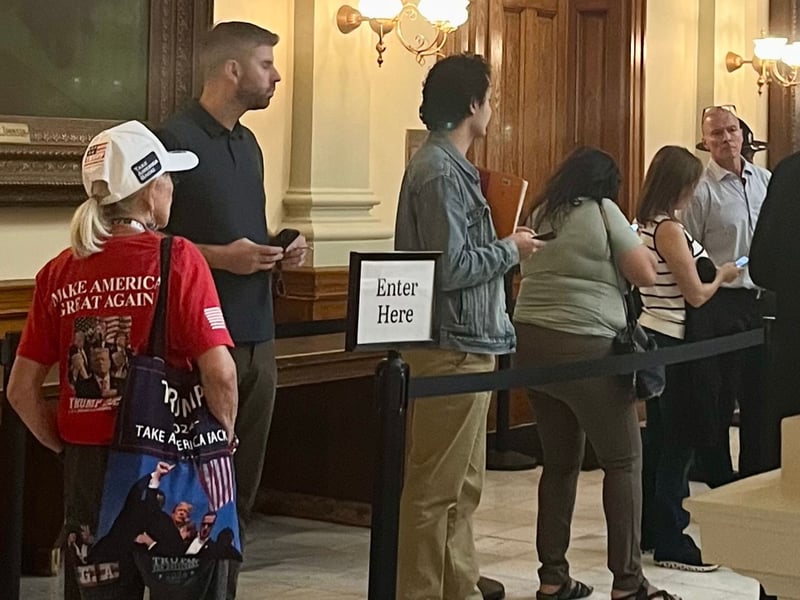
ATLANTA (CN) — The Georgia Supreme Court heard arguments Wednesday over whether the state’s GOP-heavy election board exceeded its authority by imposing new rules in the weeks before the presidential election last year.
A Fulton County judge overturned the board’s rules before the election, and Georgia’s high court unanimously denied the Republican National Party’s request for an expedited appeal of the ruling before Election Day.
The state and the Republican Party argued that the board’s proposed changes to election procedures supplemented state law without contradicting it.
“The State Election Board is a very unique agency,” attorney Bryan Tyson, representing the state, told the court. “It self controls.”
Multiple justices expressed concern over the state’s position and whether that conflicts with the separation of powers enshrined in the constitution.
“If it is so unique, is its uniqueness itself a violation of the separation of powers?” Justice Nels Peterson questioned.
Justice Charles Bethel noted that the Board of Natural Resources is also a unique agency, but is still required to operate under the rules of the Georgia legislature.
In the weeks before last year’s election, the State Election Board approved several rules, including new requirements for a “reasonable inquiry” before certifying results and a hand count of the number of ballots cast on election night.
The changes drew national attention as they were spearheaded by the board’s Republican majority, whom President Donald Trump called out by name during an Atlanta campaign rally in August, calling them “pit bulls fighting for honesty, transparency and victory.”
Supporters said the rules would have added safeguards to ensure elections are accurate and transparent. Critics of the rules, which include Democrats, county election directors and voting rights groups, worried the rules would provide justification for county election boards to reject or delay results, especially after Trump disputed his 2020 defeat.
After Trump won Georgia by 115,000 votes in November, county election boards unanimously certified the results, without any contention over vote-counting procedures the State Election Board tried to change.
Eternal Vigilance Action, a conservative-leaning, nonprofit voting advocacy group, asked the court to uphold the lower court’s decision and rein in the board’s power. Founded by former Republican state Representative Scot Turner, the group argues the board overstepped its authority in creating rules governing election processes outside of its duty to review investigations of fraud and irregularities.
Attorney Chris Anulewicz argued that only Georgia’s General Assembly, not the State Election Board, has the ability to enact a rule that expands the enumerated locations where poll watchers may be designated during an election.
But justices Peterson and Sarah Hawkins Warren expressed confusion on how the poll watcher rule would negatively impact Turner’s organization as it would expand access to observe an election.
“How is there harm that your group suffers?” Hawkins asked.
Anulewicz said it could lead to poll watchers intimidating poll workers trying to count votes.
A coalition of civil rights organizations intervened in the lawsuit challenging the hand count requirement rule. The Georgia State Conference of the NAACP and Georgia Coalition for the People’s Agenda argued that the rule would invite error and cause delays, making it more difficult for the state to meet the certification deadline and jeopardizing the right to vote.
Attorney Theresa Jeane Lee told the court there is a “statutory immediacy” to ensure the chain of custody of ballots is not disrupted after polls close.
The justices are expected to issue a ruling in the coming weeks or months.
 Follow @Megwiththenews
Subscribe to our free newsletters
Our weekly newsletter Closing Arguments offers the latest about ongoing trials, major litigation and rulings in courthouses around the U.S. and the world, while the monthly Under the Lights dishes the legal dirt from Hollywood, sports, Big Tech and the arts.