
 Search Articles


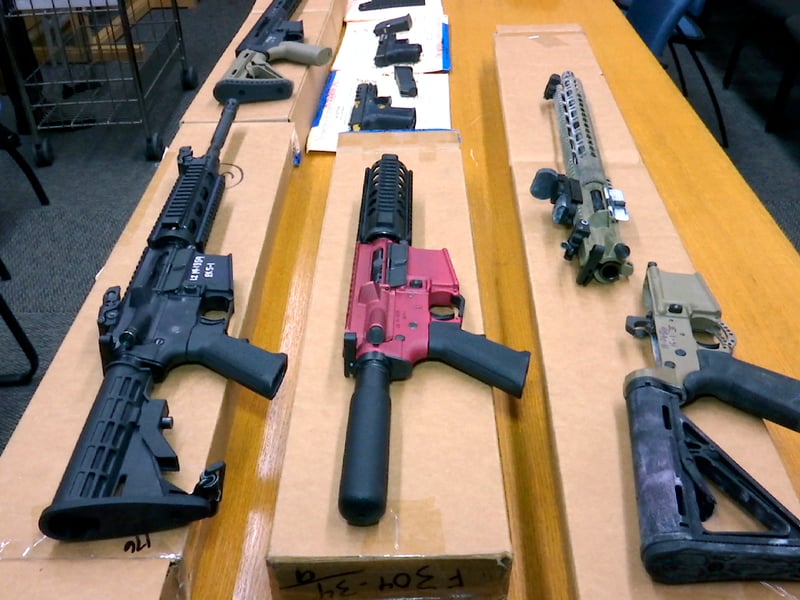
WASHINGTON (CN) — The Supreme Court seemed likely Tuesday to uphold the Biden administration’s ghost gun regulations, but the potential win didn’t dim criticism of judicial interference in agency regulation.
Most of the justices appeared skeptical that the Biden administration’s regulation of untraceable weapons from firearm parts kits, coined ghost guns, exceeded regulatory authority.
In 2022, the Bureau of Alcohol, Tobacco, Firearms and Explosives issued a new rule clarifying that gun parts kits are subject to the Gun Control Act of 1968. Without background checks or serial numbers, ghost guns became popular among individuals who couldn’t legally obtain firearms, particularly criminals and teenagers.
“What the evidence shows is that these guns were being purchased and used in crime,” U.S. Solicitor General Elizabeth Prelogar told the justices. “They were sold to be crime guns.”
She added manufacturers intentionally sold parts kits to circumvent gun laws.
“They’ve advertised the products, in their words, as ‘ridiculously easy to assemble and dummy-proof’ and touted that you can go from opening the mail to have a fully functional gun in as little as 15 minutes, no serial number, background check, or records required,” Prelogar said.
Under the Gun Control Act, any weapon that may be readily converted to expel a projectile by the action of an explosive is considered a firearm and subject to background checks and serialization. The Biden administration’s ghost gun rule made a slight edit, adding that readily completed weapons parts kits aimed at expelling a projectile by explosive are also firearms.
Gun owners and manufacturers claim ATF exceeded its authority by looping parts kits into the definition of firearms.
“ATF has expanded the definition of ‘firearm’ to include collections of parts that are not weapons and that do not include a frame or receiver,” Petter Patterson, an attorney with Cooper & Kirk representing the gunmakers and owners.
Manufacturers said incomplete kits can’t be considered firearms because they require additional tasks to transform them into guns.
Chief Justice John Roberts, a George W. Bush appointee, challenged why manufacturers would sell gun kits that were almost complete.
“What is the purpose of selling a receiver without the holes drilled in it?” Roberts asked.
Justice Sonia Sotomayor, a Barack Obama appointee, probed different assembly requirements on parts kits, questioning where the line between plug-and-play weapons and those that need additional development.
“If you have to drill a hole to attach it to something, that’s not a completed frame?” Sotomayor asked.
The manufacturers of the kits appealed to gun hobbyists and having to drill a hole could disqualify a parts kit from the definition because the customer would need specific tools or skills to complete the task.
Roberts was doubtful that the parts kits at the center of the case required such deftness.
“My understanding is that it’s not terribly difficult for someone to do this, and it’s certainly not terribly difficult to take the plastic piece out,” Roberts said referring to modifications required to turn some kits into functional firearms.
In June, the conservative supermajority shot down the Biden administration’s bump stock ban, finding that ATF couldn’t incorporate the add-on device into machinegun regulations without congressional authorization.
“Sometimes this court looks at regulations and it says, you know, there’s an old statute, and the old statute doesn’t contemplate a new problem, and a new problem comes up, and Congress can’t get its act together and deal with the old problem,” Justice Elena Kagan, a Barack Obama appointee, said.
Kagan hinted the ghost gun regulation didn’t fall into a similar trap.
“Is that a storyline that the respondents here can tell about this regulation?” Kagan asked the government.
Justice Ketanji Brown Jackson, a Joe Biden appointee, offered a more pointed critique of her colleagues’ intrusion into agency rulemaking. She was more concerned about the Supreme Court exceeding its authority.
“Justice Kagan talked about the problem of the agency potentially taking over what is Congress’s business,” Jackson said. “And I guess I’m worried about a different concern, which is about the court taking over what Congress may have intended for the agency to do in this situation.”
Jackson questioned whether the court planned to rescind regulations not based on statutory authority but on the justices’ opinion on the rule.
“I think it can’t be assumed that the agency exceeds its authority whenever it interprets a statutory term differently than we would such that all we have to do as a part of this claim here today is just decide what we think a firearm is,” Jackson said.
Eric Tirschwell, executive director of Everytown Law, said the court seemed to accept that the rule fell under lawmakers’ broad and flexible definition of firearms.
“Today the ghost gun industry’s fiction that its gun building kits are not firearms crashed into a brick wall of reality in the Supreme Court,” Tirschwell said in a statement.
Jared Carter, an assistant professor at Vermont Law and Graduate School, said because the question involved firearms regulations, the case attracted a lot of attention despite being a run-of-the-mill administrative law case. He said internet kits fell comfortably within ATF’s regulatory authority.
“The idea that something isn’t a firearm simply because you’re buying it in pieces rather than fully assembled doesn’t pass the smell test — these kits are meant to be firearms, and those that are manufacturing them and purchasing them know that perfectly well,” Carter said in a statement. “Of course, manufacturers don’t want to be regulated — that doesn’t mean such regulations aren’t legal or appropriate.
 Follow @KelseyReichmann
 Follow @kelseyreichmann.bsky.social
Subscribe to our free newsletters
Our weekly newsletter Closing Arguments offers the latest about ongoing trials, major litigation and rulings in courthouses around the U.S. and the world, while the monthly Under the Lights dishes the legal dirt from Hollywood, sports, Big Tech and the arts.