
 Search Articles


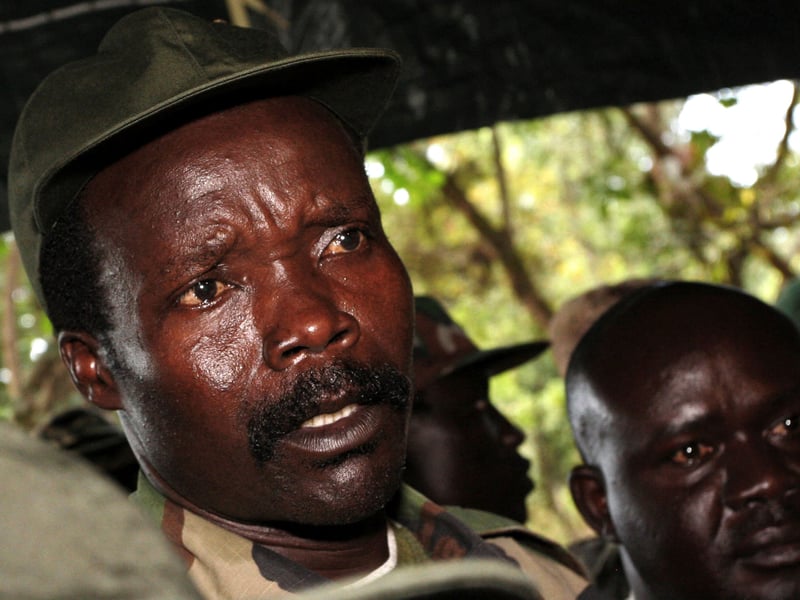
THE HAGUE, Netherlands (CN) — Joseph Kony, Uganda’s elusive warlord, finally faced his day in court — even if only in name.
Judges at the International Criminal Court in The Hague opened a three-day hearing Tuesday to weigh 39 counts of war crimes and crimes against humanity against the fugitive Lord’s Resistance Army (LRA) leader, marking the first time the court has pushed forward without the accused present.
The hearing breaks new ground for the ICC, using a rarely tested rule that lets judges move forward when a suspect remains out of reach despite years of effort to bring him in. Last October, the court decided that standard had been met after countless failed attempts to track Kony across Central and East Africa.
Kony has been on the ICC’s wanted list since 2005, when judges issued arrest warrants for him and other top LRA commanders. Some of his lieutenants have since died, and one — Dominic Ongwen — stood trial and was convicted in The Hague. But Kony himself has slipped through every net, eluding Interpol alerts, African Union missions and even U.S. military advisers sent to hunt him down.
In the presiding judge’s words: “This case is the first at the International Criminal Court where the confirmation proceedings and hearings are held in absentia.” Even so, any full trial will have to wait until Kony is actually in custody, since the court does not allow trials without the accused present.
The charges
The catalogue of accusations is stark: murder, enslavement, torture, sexual slavery, forced pregnancy and the use of child soldiers. Prosecutors say Kony not only ordered abductions but also directed assaults on schools and camps for displaced families, running a system of forced marriages and sexual violence from July 2002 until December 2005. One count alone holds him responsible for the deaths of more than 600 civilians in camps across northern Uganda.
The prosecution opened with a blunt reminder. “Twenty years ago, other judges of this court issued a warrant of arrest against him. He has been at large for the last 20 years. And for the last 20 years, he has managed to evade justice,” the prosecutor said.
“Many victims who had the strength to survive the horrors of a devastating civil war have unfortunately not survived this lengthy wait. Others have lost patience. But there are still those who, against all odds, have waited for this very moment."
Prosecutors told the court that Kony’s fighters turned kidnapped boys into soldiers and girls into so-called “wives.” A protected witness remembered, “I saw children younger than me being trained to shoot with weapons. I knew they were so young because the muzzles of their AK-47 rifles dragged on the ground when they carried them on their shoulders.”
Prosecutors told the judges the hearing was meant to keep the case moving even without Kony in the dock, and to make sure victims’ rights are not sidelined. They said that if the charges are confirmed, the case will be ready to shift quickly to trial once Kony is finally arrested and brought to The Hague.
Prosecutors painted Kony as the mastermind behind the LRA’s violence. “Girls and young women have been enslaved and subjected to forced pregnancies, whilst the boys were forcibly recruited to fight the Ugandan army. The vicious circle of this criminality meant that the victim became the executioner or the perpetrator,” they said.
Long road to The Hague
That account of atrocities led naturally into a broader look at how the war unfolded and why Kony has remained beyond reach. The court revisited the origins of the Lord’s Resistance Army, which grew out of a spiritualist movement in northern Uganda in the late 1980s and hardened into a brutal insurgency under Kony’s command. For years, his fighters roamed across borders, moving between Uganda, Sudan, the Democratic Republic of Congo and the Central African Republic, which made attempts to capture him extraordinarily difficult.
The judges recalled how Uganda launched “Operation Iron Fist” in 2002, a major military offensive that destroyed the LRA’s camps in Sudan but failed to catch its leader. Instead, the group scattered, and Kony slipped further into the shadows.
As the conflict dragged on, the toll on civilians grew heavier. By the early 2000s, the war had forced more than a million people from their homes in northern Uganda, sparking international outrage and growing calls for justice. With pressure mounting and domestic efforts falling short, the Ugandan capital of Kampala turned to the newly formed ICC, hoping global justice could do what national authorities could not.
In 2004, the Ugandan government referred the situation to the ICC as the court’s very first state referral. A year later, arrest warrants were issued for Kony and four of his top commanders, marking the ICC’s first public cases. Over time, three of those men were confirmed dead. With Ongwen convicted in The Hague, Kony remains the only fugitive nearly two decades later.
The three-day session isn’t a trial but more of a checkpoint. Judges have to decide whether the evidence is strong enough to believe Kony committed the crimes. If they sign off, a trial chamber will be waiting for the day he is finally brought to The Hague.
The hearing continues Wednesday, with prosecutors carrying on their case before victims’ representatives and Kony’s court-appointed defense team have their turn to speak.
Once the hearings conclude, it will be up to the judges to decide if the evidence is solid enough to lock in the charges. A trial chamber would then be set up, but the case can’t move forward until Kony himself is caught and brought before the court in The Hague.
Courthouse News reporter Eunseo Hong is based in the Netherlands.
Subscribe to our free newsletters
Our weekly newsletter Closing Arguments offers the latest about ongoing trials, major litigation and rulings in courthouses around the U.S. and the world, while the monthly Under the Lights dishes the legal dirt from Hollywood, sports, Big Tech and the arts.