Search Articles



COPENHAGEN, Denmark (CN) — A 15-minute bike ride from the Danish parliament in central Copenhagen is one of the latest symbols of this Nordic country’s push to go green.
This is Fælledby, a former junkyard turned timber-built model town. With the first phase slated to open in the coming year, it sits next to a protected nature area and will feature multiple green energy projects.
Since trees store carbon dioxide as they grow, Ramboll, an environmental firm behind the project, says that using timber will not only capture CO2 but avoid the emissions needed to produce and use materials like steel and concrete.
It aims to have “nature at its core,” the company says, creating “a hybrid that balances the city and its natural surroundings.” Bird and bat nests will be incorporated into buildings, while ponds and gardens will provide plenty of habitat for species like frogs, butterflies and salamanders.
And yet Fælledby also highlights the challenges and compromises that come with any big development project — even green and sustainable ones.
Its footprint will sit on the edge of Amager Fælled, a much-loved nature reserve.
Researchers at Aarhus University fear the project will harm biodiversity. In one poll from 2021, a whopping 71% of Copenhageners opposed it. Despite these pitfalls, officials in Copenhagen have shepherded it through public backlash and legal challenges. They see Fælledby as a necessary solution to a range of crises: climate change, chronic housing woes in the capital and a worsening security situation across Europe.
At the moment, Fælledby is still a work in progress.
“It looks a bit special,” Simon Madsen, an external consultant in charge of public relations, said as he left his office — Fælledby’s future community center — for a rainy-day tour of the site.
He was pointing out what appeared to be a large drying rack for clothes. It was actually a 100-watt wind turbine, one of several that will help produce energy for Fælledby’s 2000 homes. Around 7 acres of solar panels will also cover the roofs of multistory buildings.

“Our vision is to produce as much power as possible locally in the city,” Madsen explained. “As of now, we have calculated that Fælledby will be able to produce 35% of its own power needs.”
All of this is part of a broader strategy in the European Union to boost green power output and build out renewable energy communities.
Introduced as part of the EU’s “Clean Energy for all Europeans” legislation in 2019, the goal is to create small, democratic entities that produce and use their own renewable energy.
Denmark is lagging behind EU targets, which say member states should have at least one energy community for every municipality with more than 10,000 residents. Denmark has around 90 such municipalities, but experts estimate there are only about 30 energy communities currently operating in the country.
Once completed, Fælledby will give Denmark another major one in its capital. Boosters say it would also help to further green Denmark’s energy infrastructure by supplementing the grid.
“When there’s high demand in the collective power network, we can relieve it by supplying our home-produced electricity to the public,” Madsen said. “That will also lower the price on electrical bills.”
In the global race to build up green energy, Denmark is far from being in last place.
The country gets more than half its power from renewable sources, including 11% from solar and 47% from wind. That’s a larger share than any other EU country, according to energy think tank Ember.
Even so, the independent Danish Council on Climate Change says the country is unlikely to meet its 2030 climate goals. Denmark’s parliament has criticized state utility Energinet for moving too slowly to expand Denmark’s electrical infrastructure. And here as in much of Europe, the rush to shift to green power isn’t just about fighting climate change — it’s also about protecting national security.

The United States has been a net exporter of petroleum since 2020, as various presidential administrations have spent decades building up domestic production in the name of energy independence. Current estimates value the industry in the trillions.
Contrast that with Europe, where much of the continent has long relied heavily on energy imports, including from Russia. Following Russia’s invasion of Ukraine in 2022, a network of pipelines was largely shut down, plunging countries like the United Kingdom into a full-blown energy crisis. More recently, U.S. attacks on Iran have further driven up energy prices and fueled Europe’s desire for self-sufficient green power.
Like its neighbors, Denmark now views energy infrastructure as intertwined with security politics.
It isn’t just closed straits or defunct pipelines. In two notorious incidents in 2024, electric and telecommunication cables were cut in the Baltic Sea. Russia’s shadow fleet is roaming the waterway, and unidentified drones are making surprise visits. The more energy production can be spread out into small-scale developments like Fælledby, the less the overall grid will be vulnerable to attack, experts say.
Morten Westergaard is president of the National Association of Energy Communities Denmark, a group that advocates for more of these communities in the country. He supports the idea that developments like Fælledby are “a matter of energy security.”
“There are fools who conspire to rip apart cables for one reason or another in the Baltic Sea,” he said in an interview. “We see big central power plants being military targets.” He says the problems caused by such incidents can be largely negated “by decentralizing the supply and offering power locally.” Instead of relying on a few critical power alleys, Denmark could be full of Fælledby-like communities, all sharing clean energy back and forth.
Besides making the grid more secure, boosters say projects like Fælledby can also democratize the grid.
“We see a lot of places in Europe with skepticism against wind farms and solar parks under the flag ‘not in my backyard,” Westergaard said. “Energy communities can contribute to creating sympathy and understanding for the vital green transition.”
That might seem like a pipe dream given the backlash. But for all its pitfalls, Fælledby does represent an effort to move energy production to the level of local decision makers.
It’s half-owned by the city of Copenhagen, with the other half owned by the nonprofit pension fund PensionDanmark. Last year, stakeholders launched an app aimed at letting future residents offer input on the project. And while many Copenhageners may fear the impacts on beloved wildland, Fælledby still has supporters, winning an award last year for sustainability.
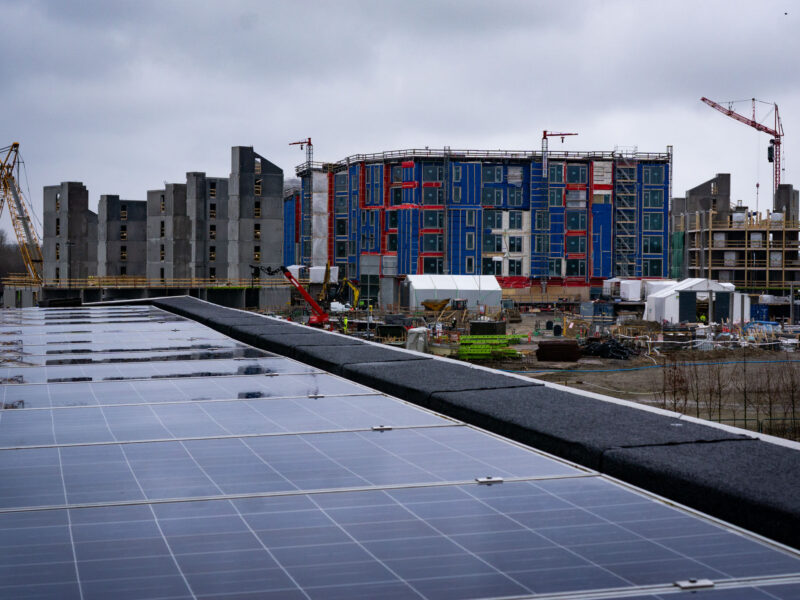
To be sure, Fælledby faces stiff opposition. The nonprofit Friends of Amager Fælled continues to lobby against it. Protest group Extinction Rebellion has repeatedly demonstrated, chaining themselves to trees and otherwise disrupting construction.
Maybe the real lesson of Fælledby is that even with good intentions and a focus on sustainability, development will always come with trade-offs. After all, even green technologies like solar panels require extracting materials to make them.
The term for this is “green on green conflict” — a paradoxical situation where different environmental goals diverge or even clash. One classic example, cited in a University of Oklahoma paper on the subject, are the recurring conflicts between bird lovers and supporters of wind turbines.
Another example might be Fælledby, said Simon Westergaard Lex, an anthropology professor at the University of Copenhagen who has studied the creation of green communities. Here, planners hoping to build sustainable infrastructure and housing have butted heads with defenders of a cherished nature reserve. Tensions can be minimized, Lex said, by taking pains to include all interested parties in longterm planning. Nonetheless, he says projects like Fælledby are a “must have” for Denmark’s green future.
Lex acknowledges the challenges that come with building up green infrastructure.
“It can at times be a romantic dream to build everything from scratch,” he said. “It also makes it more difficult.” If Fælledby succeeds, supporters hope it will be a proof-of-concept, making it easier to build other green communities. And either way, they say the cost of not building them is simply too great, both in terms of climate and of Danish security.
 Follow @LasseSrensen13
Subscribe to our free newsletters
Our weekly newsletter Closing Arguments offers the latest about ongoing trials, major litigation and rulings in courthouses around the U.S. and the world, while the monthly Under the Lights dishes the legal dirt from Hollywood, sports, Big Tech and the arts.