Search Articles


SURABAYA, Indonesia (CN) — As President Donald Trump signed a memorandum of understanding with Iran on Wednesday, ending their conflict and restarting shipping traffic through the Strait of Hormuz, businesspeople in Jakarta must have breathed a collective sigh of relief.
Indonesia, Southeast Asia’s largest economy and the world’s third-largest democracy, could do little but stare as its currency, the rupiah, fell to record lows over the past month. All the while, criticisms grew over President Prabowo Subianto’s economic policies, including an ambitious free meals program.
At the time of writing, one U.S. dollar is worth around 17,800 rupiah following years of steady devaluation. But it’s still an improvement over the past month, as economic and political turmoil in Indonesia and abroad saw the rupiah’s value dip sharply.
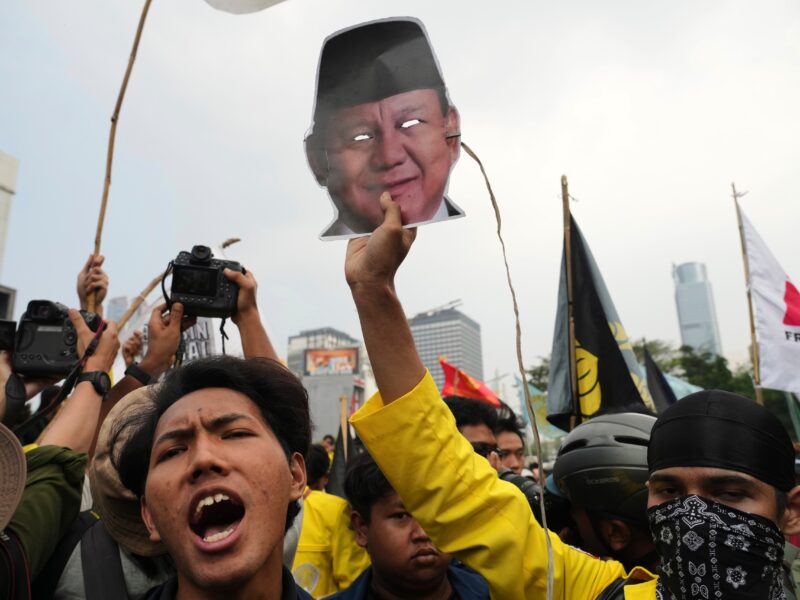
Just a week ago, Indonesians crossed a psychological threshold as one U.S. dollar became worth more than 18,000 rupiah. Coupled with a string of unpopular government decisions, the devaluations resulted in student protests across the island of Java, where political power is centered.
The Indonesian National Bank has raised its interest rate to 5.75%, halting the currency’s slope from around 17,100 per dollar before the Hormuz Strait closure. Economists have praised the move but warn that underlying policy issues could prolong the slump if not properly addressed.
Although Indonesia is an oil-producing nation, its domestic production of around 800,000 barrels a day can’t feed domestic consumption, which is close to double that. Thus, oil imports from the Middle East are crucial for the Asian country’s growth, as well as for the affordability of food and everyday goods.
Economic subsidies have kept fuel and energy prices below market value — but the funds to do that are slipping away. Exhibit A is state-owned company Pertamina, which raised gasoline prices by more than 30% last week.
Indonesians are feeling the squeeze, including Tarisya Ohorella, a consultant in her twenties in Surabaya who supports her family living in a remote village. In recent weeks, she said the money she sends them is no longer fully covering expenses like gas and rice.
“It has not impacted my life personally until now," Ohorella said, “but I know for sure that my family back home has been heavily impacted by the government decision to increase the gas prices.”
Rising food costs, especially at traditional markets, are starting to become topics of casual conversation. Government economic messaging is not lifting spirits, nor is a gloomy news cycle.
“My future here seems bleak," Ohorella said. “It’s getting harder and harder to be optimistic living here.”
To curb the crises and meet ambitious plans to increase the Indonesian economic growth rate to 8% a year by 2029, the Prabowo administration is moving forward with several policy changes. But the former army general has been accused of human rights abuses, and critics can’t help noting that the policy changes are leaning into further state control.
For Indonesians like Ohorella, all of it is doing little to boost confidence in Indonesia’s controversial current government.
“I don’t believe that they have control over the situation," she said. “I don’t think they have the right policies to control the rising prices, because so far, the policies they have created are the ones that are becoming the cause of all of this chaos.”
A presidential wealth fund
Maybe the most remarkable shift undertaken by Prabowo has been the 2025 creation of Danantara.
A new sovereign wealth fund that Prabowo says is worth $1 trillion, the goal of Danantara is to stabilize the Indonesian economy through investments. But the fund — which is controlled directly by the president — relies on multiple state-owned enterprises that were previously overseen by various government ministries.
Not least for that reason, observers warn Danantara may only worsen the country’s economic woes.
“Increasing government control in an economy that is largely driven by the private sector will further damage trust," Andree Surianta, a senior research and policy specialist from the Center for Indonesian Policy Studies, told Courthouse News in an email. “The Indonesian state sector has a poor record of economic efficiency, and there is plenty of evidence to show that.”
Foreign capital in Indonesia is outflowing at a remarkable rate. After hitting a record high, the country’s benchmark stock index has fallen by 36% in just five months, making it the worst performing major equity gauge in the world this year. Experts say a driving factor is low trust in government policies by international investors.
“The government should stop thinking of the economy as a win-lose battleground between the state and the private sector," Surianta said. “The private sector accounts for 60% of economic activity and 90% of employment in Indonesia, so it is an important ally in growing the Indonesian economy. Growing the state sector will create turmoil that may further set the country’s global competitiveness back, resulting in an erosion of market share in the world economy.”
In early June, Jakarta issued a regulation bringing exports of Indonesia’s strategic commodities under governmental control. Indonesia is the world’s largest palm oil exporter and also holds the world’s biggest nickel reserves.
Going forward, export of these commodities will go through a subsidiary of Danantara — though details remain hazy.
Prabowo says the intervention will address issues of revenue leakage around these specific exports. These resources have sold for undervalued prices, he says, costing Indonesia tax revenue.
Even so, “more control without credibility will scare private capital away from the country just when it is needed the most,” Surianta said. He compared it to a disastrous 2022 policy, when a ban on cooking oil exports hurt small farmers and ultimately drove up prices by disrupting Indonesian supply chains.
Social welfare program faces scrutiny
Another hot economic topic in Indonesia is Prabowo’s ambitious free meal program, which has sought to deliver nutritious lunch to children and pregnant women across the archipelago.
Accounting for around 7% of the government budget, the program has faced a range of concerns, including food poisoning, insufficient logistics and heavy military involvement.
There’s also the corruption investigation into the program’s former chief, Sony Sonjaya. He was arrested earlier this month, accused of running a scheme to sell lucrative contracts related to the program.
The program has been “mired in corruption and inefficiency,” Surianto said. As a result, lawmakers are trying to claw back much of its funding. All of this for a free meal program that was one of Prabowo’s main selling points during his 2024 election campaign.
Despite the problems, many observers do see benefits in trying to make sure Indonesians are adequately fed.
“I would not recommend scrapping the food and agricultural plan,” Aluisius Hery Pratono, an economist at the University of Surabaya, said in an email.
“Food security remains a strategic issue for Indonesia," he said. “Food inflation, particularly rice prices, has historically been a major source of economic and political pressure. Instead of abandoning the program, the government should focus on improving productivity through irrigation, agricultural technology, logistics, storage facilities and support for farmers.”
Pratono doesn’t have a problem with state intervention to address Indonesia’s economic challenges. Instead, he sees issues with the quality of that intervention.
“Given Prabowo’s military background, the administration may favor a more centralized and less participatory approach to policymaking," he said. “While this could accelerate policy implementation, it may also reduce stakeholder consultation, weaken policy feedback mechanisms and increase concerns about regulatory predictability.”
 Follow @LasseSrensen13
Subscribe to our free newsletters
Our weekly newsletter Closing Arguments offers the latest about ongoing trials, major litigation and rulings in courthouses around the U.S. and the world, while the monthly Under the Lights dishes the legal dirt from Hollywood, sports, Big Tech and the arts.
Additional Reads
 Nokia prevails over $23M contract suit June 19, 2026