
 Search Articles


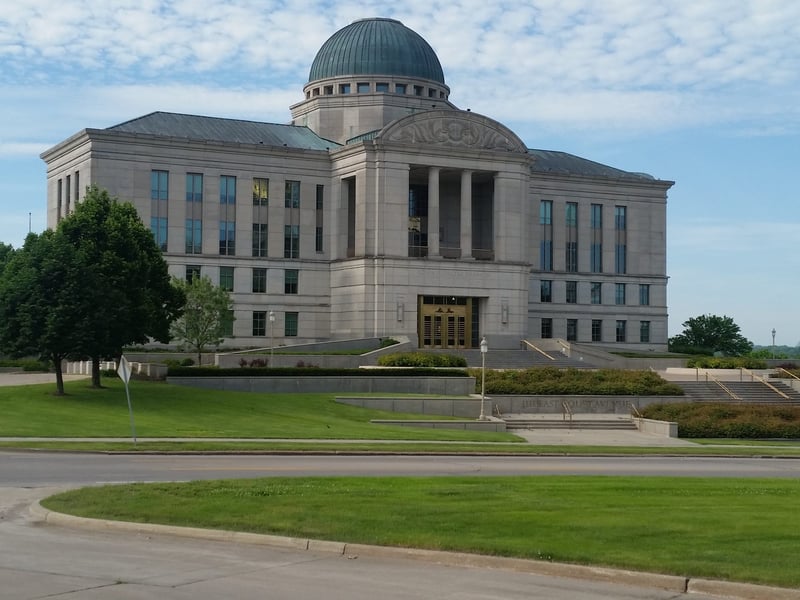
DES MOINES, Iowa (CN) — Less than four years ago, the Iowa Supreme Court ruled that the Iowa Constitution protects the fundamental right of a woman to choose whether to terminate a pregnancy. On Wednesday, the court heard arguments that its decision was wrong and should be overturned.
The case for reversing the 2018 abortion decision came in an appeal of a trial court ruling striking down a state law that requires a physician to obtain informed consent from a pregnant woman at least 24 hours before performing an abortion. The lower court said the 24-hour delay was no different than an earlier version of the law that mandated a 72-hour delay, which the Iowa Supreme Court ruled unconstitutional.
In a brief filed with the justices, the state argued that decision was “demonstrably erroneous” because “nothing in the text, structure, history, or tradition of the Iowa Constitution makes abortion a fundamental right.”
That argument was forcefully made Wednesday by Christopher Schandevel of the Alliance Defending Freedom, which filed an amicus brief in the case on behalf of 60 members of the GOP-controlled Iowa Legislature. Schandevel was granted a share of the state’s allotted time.
For a court to declare a fundamental constitutional right, Schandevel said, “that right has to be a liberty interest that is deeply rooted in the history and tradition of the nation or the state of Iowa. Six months after the Iowa framers adopted the Iowa Constitution, the Iowa Legislature passed a law criminalizing abortion in all cases except for the life of the mother.”
In response, Justice Brent Appel asked: “You mean, the views of the ‘all men’ in the Territorial Legislature, and the views of the ‘all men’ in the 1857 Constitution [Convention], and the views of the ‘all men’ who ratified it – those views control the rights of women in 2022?”
“The words in our Constitution have to be defined by their original public meaning," Schandevel replied. “So it’s not a question of what was in the mind of the male legislators, it’s a question of what the public, including men and women, would have understood that word ‘liberty’ to mean. Since abortion was criminalized at the time of the framing, no member of the public, male or female, would have thought that they had a constitutional right to commit an abortion.”
Rita Bettis Austen, legal counsel for the ACLU of Iowa, which represents plaintiff Planned Parenthood of the Heartland, said the state’s argument is “very simple: It’s just that it disagrees with this court’s prior precedent, and that is not enough under the principles of stare decisis,” under which courts generally adhere to precedents set by earlier decisions.
Justice Matthew McDermott asked, “Isn’t it enough if we found the 2018 ruling to be clearly wrong? Wouldn’t that be enough to change the legal standard” under which the mandatory delay was found unconstitutional?
“Not under the principles of stare decisis," Bettis Austen said. “More is required.”
Chief Justice Susan Christensen questioned whether a 24-hour delay is an unconstitutional burden.
“In my prior life I was an adoption lawyer, and somebody would come to me and want to place their baby for adoption. And there were people who changed their mind after talking to me or chatting with their friends, or whatever," she said. “But even it’s only one person, let’s say it only changes one person’s mind, is 24 hours really that unreasonable?”
In response, Bettis Austen said “the state has not put any evidence in the record” that mandatory delays change women’s minds, “and the unrebutted evidence is that they don’t.” But she said in reality women have even longer even than the mandated 24-hour delay to change their minds under ordinary informed consent practices.
Informed consent, as required by the original state law mandating a 72-hour delay prior to receiving an abortion, required a woman seeking an abortion to undergo an ultrasound, be given the opportunity to view the ultrasound image of the fetus and to hear a heartbeat, and to be given information about abortion alternatives. The statute makes no exceptions for rape or incest victims, or for cases where the fetus has a severe fetal abnormality.
That mandatory delay violated a woman’s constitutional rights to due process and equal protection, the Iowa Supreme Court held, based on the Iowa Constitution, not on U.S. Supreme Court abortion precedents. And the justices held that the challenged law failed under strict scrutiny rather than the less demanding undue burden standard.
The court said the 72-hour delay imposed an unconstitutional burden on Iowa women by requiring two trips to an abortion clinic, a particular burden for low-income women and those in rural areas living far from Planned Parenthood’s two Iowa abortion clinics. The court also found the delay would push some women beyond the 20th week of a pregnancy, after which surgical abortions are prohibited by state law, or beyond 10-week window for a medication abortion.
One issue hanging over this case is what happens if the U.S. Supreme Court overturns Roe v. Wade this term, which could happen if the high court signs off on a Mississippi law that bans abortion after 15 weeks.
Justice Thomas Waterman asked Assistant Iowa General Sam Langholz about that in Wednesday’s hearing.
“The U.S. Supreme Court is going to announce an abortion decision by the end of June. We have a long line of cases where we have held the Iowa due process clause has the same purpose, scope and effect. Should our court wait to see what the U.S. Supreme Court does?” Waterman asked.
“We think its’s not necessary to do that," Langholz replied. But, he said, “it is appropriate to reach the question here, now. The fact that the 2018 decision is manifestly erroneous is enough to reject that decision.”
The Iowa Supreme Court is expected to rule on the case before its current term ends in June.
 Follow @roxalaird16
Subscribe to our free newsletters
Our weekly newsletter Closing Arguments offers the latest about ongoing trials, major litigation and rulings in courthouses around the U.S. and the world, while the monthly Under the Lights dishes the legal dirt from Hollywood, sports, Big Tech and the arts.