
 Search Articles


MANHATTAN (CN) — Last year, the fate of New York City’s congestion pricing pilot program was uncertain.
Though it had been signed into law in 2019 by then-New York Governor Andrew Cuomo, his successor Kathy Hochul unceremoniously iced the toll indefinitely just weeks before its scheduled rollout last summer. Many had speculated that Hochul was concerned about congestion pricing hurting Democratic ballots statewide, as the program was controversial in the city and downright unpopular in surrounding suburbs.
But on Friday, Hochul — who greenlit the program earlier this year — took a trip to the White House to defend congestion pricing against perhaps its biggest critic: President Donald Trump, whose administration moved to kill the toll even as its early results look promising.
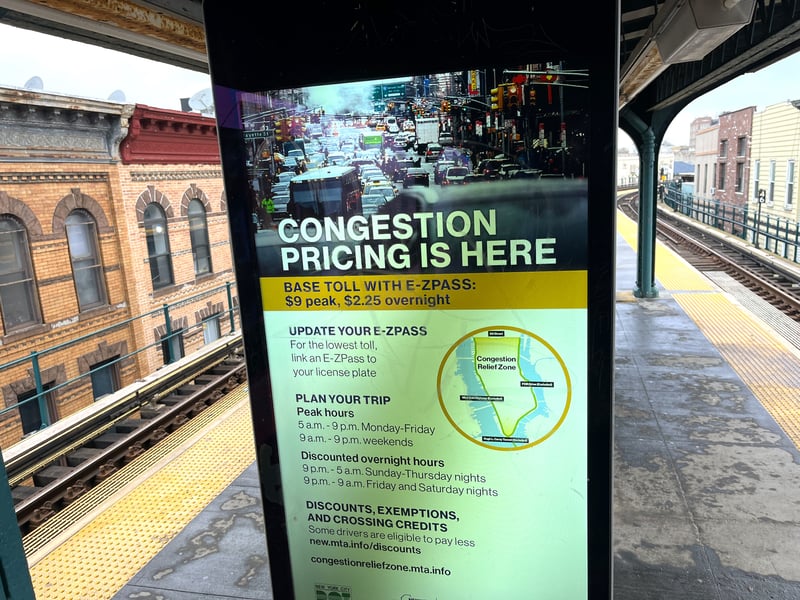
Data shows that traffic is down in Manhattan’s central business district, the area below 60th Street where passenger vehicles are charged a $9 daily toll to enter under the new program. Commute times have plummeted, too, according to polling.
New Yorkers seem to be taking notice. A poll released earlier this week by Siena College showed that many have come around to the idea; 42% of New York City voters said they support the program, compared to 35% who opposed it. It’s a big swing from December when 56% of city voters opposed the toll.
Tom Vieba may not live in New York City, but the Fort Lee, New Jersey, resident told Courthouse News this week that he was firmly in the camp of congestion pricing opposers. Like many Fort Lee residents, he initially feared that the new toll would bring more traffic to his front door as commuters looked for alternative ways to get in and out of Manhattan without passing through the tolling zone.
In reality, he said it’s been “almost transformational” for the better.
“I haven’t just accepted it — I’m willing to pay the toll for the increased quality of life that I get,” Vieba said, claiming that his commute time over the bridge has been slashed when he drives into Manhattan to visit friends and family.
Vieba said the daily traffic from the George Washington Bridge was “paralyzing” Fort Lee residents in recent years, to the point that he barely left his house. After congestion pricing took effect in January, Vieba says he can breathe again.
“I drive to a local store, and it’s been, no hyperbole, almost transformational,” Vieba said.
Matt Matilsky doesn’t drive — he told Courthouse News that he takes the bus from Wayne, New Jersey, to the Port Authority Bus Terminal in Midtown Manhattan for work. But he, too, was skeptical of congestion pricing, fearing that adding another daily fee to commuting workers would be unpopular and regressive.
“I’ve definitely changed my mind,” he said.
Before January, Matilsky said his bus commute could take as long as 80 minutes.
“Now, it’s night and day,” he said. “We can get there in 25 minutes sometimes.”
Despite these anecdotes, congestion pricing still has a long way to go in the eyes of the public. Statewide in New York, it’s still unpopular, with 40% of voters outright against the toll and 33% supporting it. It’s still a positive shift from months past, but the program lacks the plurality support statewide that it currently has in New York City.
And some city residents are still on the fence, like Drew Evans, who lives in the congestion zone in Manhattan’s Financial District. Evans told Courthouse News that he’s peeved that he needs to pay the fee to leave his own neighborhood, and while he supports congestion pricing “in theory,” he’d like to see more exemptions to make the toll less severe for people like him.
“I also have an electric vehicle,” Evans said. “So that should be another clear exemption, to me, if it’s really about the environment.”
In addition to reducing traffic congestion and environmental pollutants in the busiest part of New York City, the congestion pricing toll is slated to raise $1 billion per year to fund the MTA’s aging public transit infrastructure. That funding is in danger of being lost ever since the Trump administration announced plans to ax the state program in February.
“CONGESTION PRICING IS DEAD,” President Trump said in a social media statement after his transportation secretary ordered the MTA to kill the toll. “Manhattan, and all of New York, is SAVED. LONG LIVE THE KING.”
It was perhaps an even more controversial move than congestion pricing, itself.
“I’m against that,” Evans said of Trump’s efforts. “It sort of goes against what the Trump administration has said the whole time, which was that they want to give power back to the states. And now they’re just coming in and trying to tell New York State what to do?”
New York officials have remained committed to leaving the toll on unless a court orders them to turn it off. They sued the Trump administration on Feb. 19, arguing that the federal government has no authority to order the state to ax the program. The case remains pending.
 Follow @Uebey
 Follow @uebey.bsky.social
Subscribe to our free newsletters
Our weekly newsletter Closing Arguments offers the latest about ongoing trials, major litigation and rulings in courthouses around the U.S. and the world, while the monthly Under the Lights dishes the legal dirt from Hollywood, sports, Big Tech and the arts.