
 Search Articles


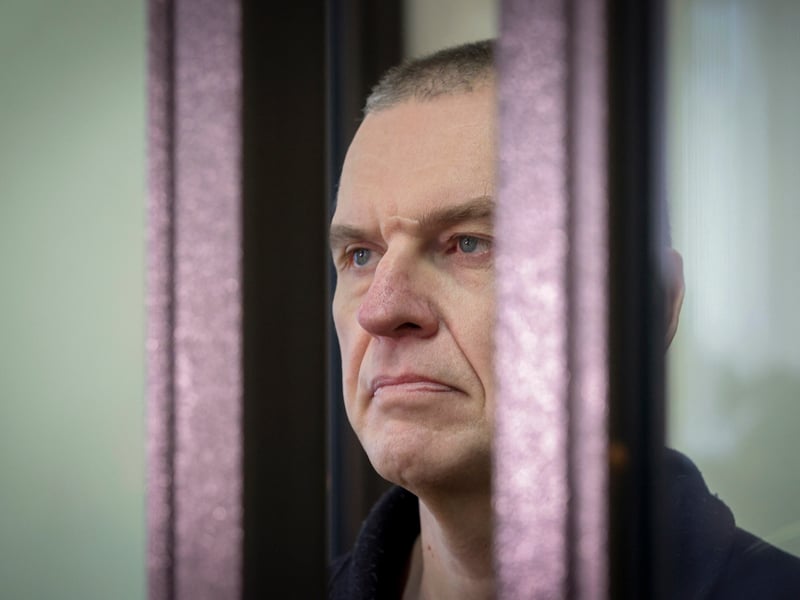
(CN) — Two journalists sitting in prison cells hundreds of miles apart won Europe’s most prestigious human rights award Wednesday, as a colleague who survived five years in solitary confinement watched from the chamber floor.
The European Parliament awarded its Sakharov Prize — often compared to the Nobel Peace Prize for human rights work — to Andrzej Poczobut in Belarus and Mzia Amaglobeli in Georgia, both jailed for their reporting. They will split the 50,000 euro prize — about $58,000.
Neither will be there to accept it. December’s award ceremony in Strasbourg, France, will have two empty chairs where the winners should be sitting.
“Both are journalists currently in prison on trumped-up charges simply for doing their work and for speaking out against injustice,” European Parliament President Roberta Metsola said in announcing the decision. “Their courage has made them symbols of the struggle for freedom and democracy. This house stands with them and with all those who continue to demand freedom.”
Poczobut, a reporter for Poland’s Gazeta Wyborcza newspaper, has been behind bars since March 2021 for criticizing Belarusian President Alexander Lukashenko. He is serving an eight-year sentence in a high-security prison and holds both Polish and Belarusian citizenship.
Amaglobeli founded two independent news sites, Batumelebi and Netgazeti, that have reported on government corruption for 25 years. She was arrested in January during anti-government protests against a “foreign agents” law that critics compare to Russian legislation used to restrict dissent.
She is the first woman journalist imprisoned in Georgia since the country gained independence in 1991. International press freedom groups have called her case politically motivated and expressed alarm over her deteriorating health in custody, including severe vision loss.
Georgia’s government says Amaglobeli was detained for criminal violations during protests. Twenty-four diplomatic missions, including the United States, condemned her two-year sentence as “disproportionate and politically motivated.”
Voices from Belarus
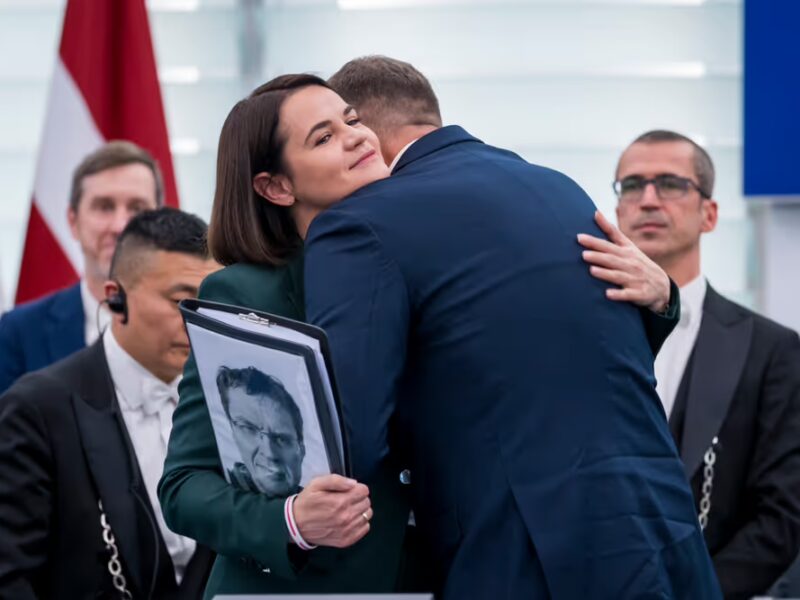
Svetlana Tsikhanouskaya, a 2020 Sakharov Prize winner and Belarus’ opposition leader who has advocated for Poczobut’s release, addressed Parliament shortly after the announcement. She called Poczobut “a symbol of resistance and personal enemy of the dictator.”
“Before hearing his verdict of eight years in high-security prison, he said, ‘I’m going to prison with a clear conscience. I always knew that when times like this come to Belarus, I will end up in prison,’” Tsikhanouskaya said. “Awarding the Sakharov Prize to Andrzej and fearless Mzia Amaglobeli from Georgia sends a strong message to all political prisoners that you are not alone and journalism is not a crime.”
The awards highlight growing tensions over press freedom in former Soviet states. Since July 2024, Belarus has released more than 300 political prisoners in what analysts see as Lukashenko’s attempt to ease Western isolation, but authorities continue arresting critics at a rate of 15 to 20 people per day, according to international monitors.
Lukashenko has served as Belarus’s first and only president since the office’s creation in 1994.
U.S. officials have played a direct role in some releases. In June, U.S. Special Envoy Keith Kellogg visited Minsk — the highest-level American contact with Belarus in years — and secured the release of 14 prisoners, including Tsikhanouski. In September, dozens more were freed following talks with Washington, though all were expelled to Lithuania.
Sergei Tsikhanouski, Svetlana’s husband and a Belarusian opposition leader who was released three months ago after five years in solitary confinement, also addressed Parliament. He told lawmakers his freedom came at a price Americans would recognize: President Donald Trump’s influence.
“The West, due to my wife’s efforts, Lukashenko was trying hard to impress President Trump,” Tsikhanouski said. “That’s why I got out.”
“I managed to survive five years of solitary confinement in the hell of the Belarusian gulag,” Tsikhanouski said. “Some of those I met there were not as lucky. We’ve been losing the best of our people.”
Press freedom has declined sharply across Eastern Europe, with implications that extend beyond the region. Reporters Without Borders ranks Belarus 153rd out of 180 countries for press freedom. Georgia has dropped to 73rd, down from 60th two years ago. Freedom House, the Washington-based democracy watchdog, labeled Belarus an authoritarian state where “elections are openly rigged and civil liberties are severely restricted.”
The Sakharov prize
The other finalists for this year’s prize were journalists and humanitarian aid workers in Palestine and all conflict zones, represented by the Palestinian Journalists Syndicate, the Red Crescent and UNRWA, and Serbian students who led nationwide protests after a railway station collapse in Novi Sad killed 16 people in November 2024. Protests culminated in more than 350,000 people gathering in Belgrade in March.
The Sakharov Prize, established in 1988 and named after Soviet physicist and dissident Andrei Sakharov, honors individuals standing up for human rights and freedom of thought. Past winners include Nelson Mandela and Malala Yousafzai. Last year’s winner, Venezuelan opposition leader Maria Corina Machado, went on to win the Nobel Peace Prize this year — underscoring how the European award can elevate global attention to embattled activists.
Around 1,400 political prisoners remain detained in Belarus, according to Viasna, a Belarusian human rights group. Lukashenko’s government has occasionally released prisoners in response to international pressure while continuing to arrest new critics. Freedom House notes that Belarus has never experienced a democratic transfer of power.
The international attention could provide some protection for the imprisoned journalists, human rights groups say. Some past Sakharov winners have seen their conditions improve or gained release after receiving the honor. Others have remained imprisoned.
Metsola said the Parliament has sent hundreds of postcards to Belarusian political prisoners over the past three years and signed a letter of intent last year on cooperation with Belarus’ democratic forces.
The award ceremony is scheduled for Dec. 16 in Strasbourg. Family members of both journalists will be invited to accept the prize on their behalf. The prize money will be held until both journalists can collect it themselves.
Courthouse News correspondent Yuval Molina is based in Brussels, Belgium.
Subscribe to our free newsletters
Our weekly newsletter Closing Arguments offers the latest about ongoing trials, major litigation and rulings in courthouses around the U.S. and the world, while the monthly Under the Lights dishes the legal dirt from Hollywood, sports, Big Tech and the arts.