
 Search Articles


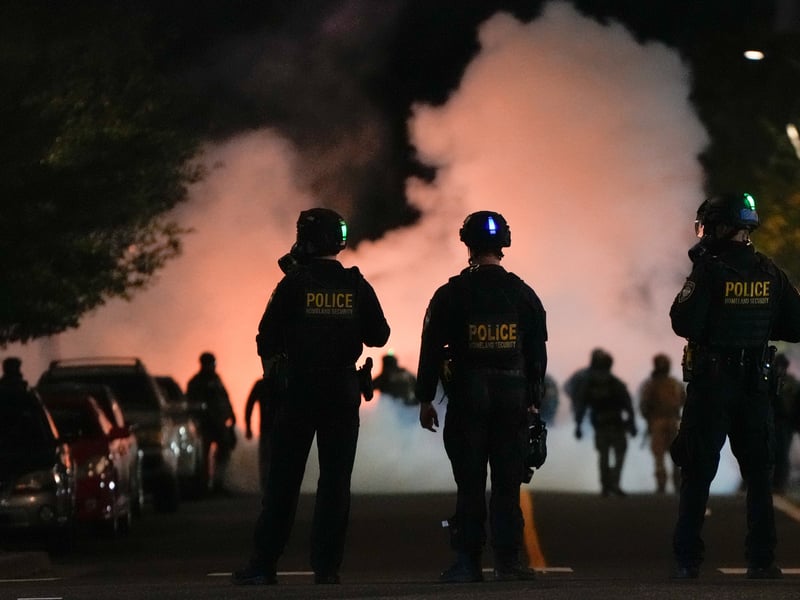
PORTLAND, Ore. (CN) — The Trump administration cannot send any federalized National Guard troops to Oregon for two weeks, a federal judge ruled late Sunday.
U.S. District Judge Karin Immergut’s order capped a weekend of rapid developments over troop deployments to Oregon. After the court blocked President Donald Trump from federalizing Oregon National Guard members on Saturday, Oregon officials announced that troops from both California and Texas were on their way to the state.
“The president cannot keep playing whack-a-mole with different states’ Guard units to get around court orders and the rule of law,” Oregon Attorney General Dan Rayfield said in a statement.
Oregon Governor Tina Kotek likewise accused Trump of abusing states’ National Guard and framed the state’s standoff with the federal government as a fight over the integrity of America’s democracy.
“President Trump’s actions are an effort to occupy and incite cities and states that don’t share his politics, and I believe that we should expect him to continue to push the limits of his authority,” Kotek said in a statement. “The president can expect Oregon to stand up to him at every turn.”
On Saturday night, 101 federalized California National Guard members arrived in Oregon, and an additional 99 were expected to arrive before the end of the weekend, Kotek said. Hours later, she announced she was informed that the Texas National Guard is preparing a deployment to Oregon, Illinois and other areas throughout the country; the number of servicemembers intended to be sent to Oregon is unclear.
The governor said she hasn’t received any direct communication from Trump or Defense Secretary Pete Hegseth about these new deployments.
“This action appears to be intentional to circumvent yesterday’s ruling by a federal judge,” Kotek said.
On Saturday, Immergut blocked the Trump administration from federalizing and deploying Oregon National Guard troops to Portland, citing the county’s longstanding tradition of resisting government overreach.
“This historical tradition boils down to a simple proposition: This is a nation of constitutional law, not martial law,” the Trump-appointed judge wrote in the order. “Defendants have made a range of arguments that, if accepted, risk blurring the line between civil and military federal power — to the detriment of this nation.”
Oregon and Portland sued the Trump administration on Sept. 28, a day after Trump took to social media to announce his intent to “provide all necessary troops to protect war-ravaged Portland” and its Immigration and Customs Enforcement facility. Following the post, the state received a memo announcing the imminent deployment of the Guard.
Shortly after Immergut issued her opinion, the Trump administration appealed the order and asked the Ninth Circuit to stay the effects of the decision.
Immergut’s blocking of Oregon troops didn’t stop the federal government from moving to send forces from California.
California Governor Gavin Newsom cheered the judge’s Sunday decision in a social media post.
“We just won in court — again,” Newsom wrote. “Trump’s abuse of power won’t stand.”
He had announced the deployment of California National Guard members to Portland earlier Sunday.
“This is a breathtaking abuse of the law and power,” Newsom said in a statement. “The Trump administration is unapologetically attacking the rule of law itself and putting into action their dangerous words — ignoring court orders and treating judges, even those appointed by the president himself, as political opponents.”
The case marks the latest legal battle over federal intervention in cities governed by Democratic administrations.
The California troops sent to Oregon had been federalized earlier in the year in response to ongoing protests in Los Angeles, under conditions that Newsom said never necessitated their deployment in the first place. Over the summer, California secured an order blocking the Trump administration’s control of the National Guard in Los Angeles, but the order was paused by the Ninth Circuit.
On Sunday, Oregon and Portland had moved to add California as a plaintiff in their lawsuit against the Trump administration and filed a motion to secure a second temporary restraining order to block the deployment of the federalized California troops, leading Immergut to hold an emergency hearing that night before ultimately blocking Trump from sending any more federal troops into Oregon.
Rayfield said sending in California troops contradicts the president’s own explanation for federalizing the service members in the first place.
“Not only does Portland not need this interference, but the president is abusing his authority over the California National Guard, because he committed to use their capacity to keep California safe,” Rayfield said in a statement. “He can’t be trusted.”
Trump’s deployment of troops centers on concerns for Portland’s ICE facility, which has been the site of protests over the past several months. Documented reports from Portland police leaders that consistently described the protest activity outside the ICE facility as “mild.”
Immergut noted in her order that the protest activity fell short of the threshold required for federal intervention.
“Here, the protests in Portland were not ‘a rebellion’ and did not pose a ‘danger of a rebellion,’ especially in the days leading up to the federalization,” she wrote.
White House Deputy Chief of Staff Stephen Miller blasted the judge’s order.
“A district court judge has no conceivable authority, whatsoever, to restrict the president and commander-in-chief from dispatching members of the U.S. military to defend federal lives and property. Today’s judicial ruling is one of the most egregious and thunderous violations of constitutional order we have ever seen,” he wrote in a social media post.
“Either we have a federal government, a supremacy clause, and a nation, or we don’t,” Miller said in a second post.
The federal government declined to comment.
Subscribe to our free newsletters
Our weekly newsletter Closing Arguments offers the latest about ongoing trials, major litigation and rulings in courthouses around the U.S. and the world, while the monthly Under the Lights dishes the legal dirt from Hollywood, sports, Big Tech and the arts.