
 Search Articles


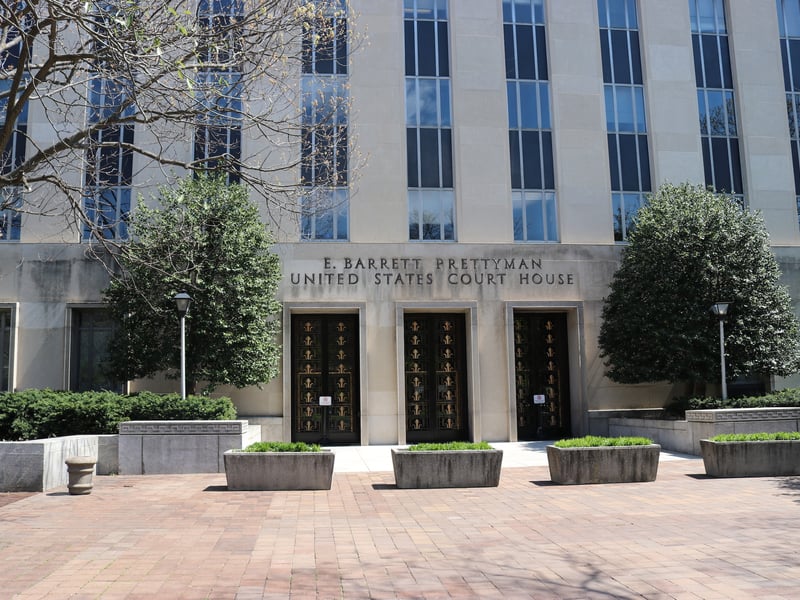
WASHINGTON (CN) — A federal judge on Thursday rejected the Justice Department’s request to delay a final hearing in the antitrust case against Google over its internet search monopoly, citing D.C. Circuit precedent rejecting previous such efforts to freeze proceedings during government shutdowns.
When the federal government shut down Wednesday after the Senate failed to pass a crucial stopgap budget, the Justice Department began filing a slew of motions to freeze high-profile proceedings in federal courts across the country.
Justice Department attorneys have sought stays in Kilmar Ábrego García’s federal case in Maryland, in the District of Columbia attorney general’s challenge against the extended deployment of National Guard troops in the nation’s capital and in the landmark antitrust case against Google over its internet search monopoly, citing the government shutdown in each.
According to the Administrative Office of the U.S. Courts, the federal judiciary can continue paid operations through Oct. 17, relying on court fee balances and other funds not tied to a new appropriations bill. If the shutdown continues beyond that deadline, federal courts will still be able to operate, albeit in a limited capacity, where criminal cases are prioritized over civil proceedings.
In the antitrust case, counsel for Google and the Justice Department’s antitrust team are scheduled to meet Oct. 8 for a hearing centered on either party’s proposed final judgments for the specific remedy necessary to address the tech giant’s monopoly.
“Absent an appropriation, Department of Justice attorneys are prohibited from working, even on a voluntary basis, except in very limited circumstances, including ‘emergencies involving the safety of human life or the protection of property,’” the Justice Department wrote Wednesday, citing the Anti-Deficiency Act.
On Thursday, U.S. District Judge Amit Mehta rejected that request in a minute order, pointing to the Justice Department’s own contingency plan for a shutdown and a D.C. Circuit decision to reject a similar request in early 2019, the last time the federal government shut down.
In that case, Kornitzky Group LLC v. Elwell, a D.C. Circuit panel rejected the Justice Department’s motion to stay oral arguments that fell amid the shutdown, which lasted 35 days between Dec. 22, 2018, and Jan. 25, 2019.
Chief Circuit Judge Sri Srinivasan and Senior Circuit Judge Harry Edwards issued a concurrence, noting that under Section 1342 of the Anti-Deficiency Act, Justice Department employees are still required to comply with court orders, and one rejecting a stay amounts to legal authorization to work.
“Our disposition of this motion is perfectly consistent with this court’s application of Section 1342 in prior cases,” Srinivasan wrote. “For example, when federal appropriations lapsed in 2013, resulting in a ‘shutdown’ from Oct. 1 to Oct. 17, 2013, the court received government motions to stay oral arguments in at least 16 cases. Every one of these motions was denied, and every time, the government then participated in oral argument.”
The Justice Department’s contingency plan for the current shutdown acknowledged as much, noting that attorneys will comply with a court’s order denying a stay request.
While previously scheduled civil hearings are expected to continue in Washington, many other civil proceedings will be significantly impacted.
Chief U.S. District Judge James Boasberg, head of the federal court in Washington, issued a standing order Wednesday that generally waived filing and discovery deadlines in all civil and civil miscellaneous cases.
“This court has a significant volume of civil matters involving the United States, its agencies and its officers and employers, in which the U.S. Attorney’s Office for the District of Columbia and other Department of Justice litigating components represent those party litigants,” the Barack Obama appointee, noting Justice Department employees are generally barred from working in any capacity during a shutdown.
“The court has a need to minimize expenditures of scarce judicial resources on large volumes of case-specific motions to stay or extend pending deadlines,” Boasberg added.
Specifically, his order extends deadlines by 10 days, plus each day the shutdown lasts; if the shutdown ends within seven days, then the deadlines will be extended five days, plus each day of the shutdown. The order does not stay oral arguments.
U.S. District Judge Paula Xinis, the Maryland judge presiding over Ábrego García’s federal case challenging his potential removal to Eswatini, has yet to rule on the Justice Department’s stay request. The parties are scheduled to meet on Oct. 6 for an evidentiary hearing.
U.S. District Judge Jia Cobb, presiding over the District of Columbia’s suit seeking the removal of the National Guard from the city, has also yet to rule.
In an opposition motion, D.C. Attorney General Brian Schwalb urged the Joe Biden appointee to similarly reject the Trump administration’s request, citing the precedent set in 2019 and 2013.
“This case is a poor candidate in which to make an exception from that approach,” Schwalb wrote. “More than 2,300 armed National Guard troops are currently patrolling the District unlawfully. That unprecedented deployment is inflicting irreparable harm to the District’s sovereignty, its economy and public safety. The court should permit this case to continue and allow the District’s motion for a preliminary injunction to be timely resolved.”
 Follow @Ryan_Knappy
Subscribe to our free newsletters
Our weekly newsletter Closing Arguments offers the latest about ongoing trials, major litigation and rulings in courthouses around the U.S. and the world, while the monthly Under the Lights dishes the legal dirt from Hollywood, sports, Big Tech and the arts.