Search Articles


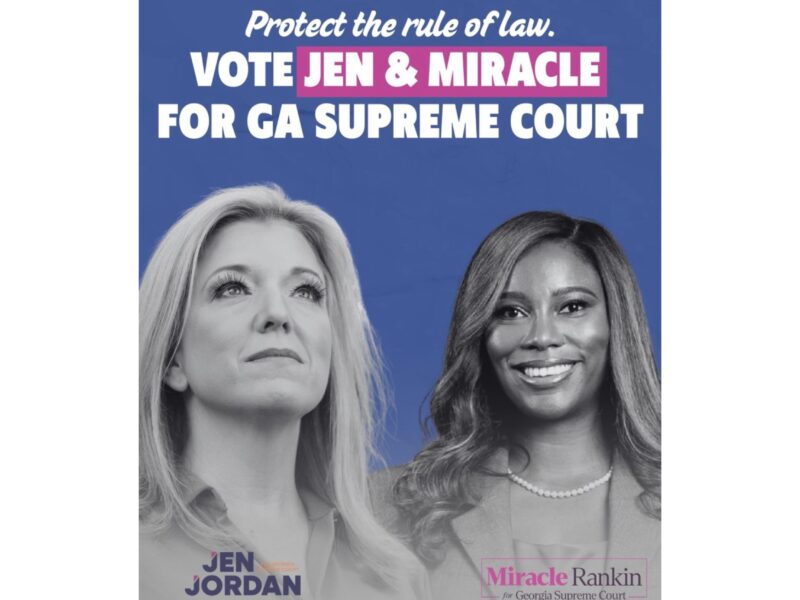
ATLANTA (CN) — On the eve of the election, a federal judge granted a request Monday from two Georgia Supreme Court candidates to block the state’s judicial watchdog from publicly issuing accusations of conduct violations over their abortion rights advocacy.
In the order, U.S District Judge Leslie Gardner blocked Georgia’s Judicial Qualifications Commission — which investigates ethical misconduct in campaigns for judicial office — from issuing a public statement detailing the violations it believes the candidates committed.
Because the commission can issue such public statements before a full investigation is even initiated, the Barack Obama appointee found the candidates faced immediate harm and self-censorship in the final days of a “hotly contested election.”
“Plaintiffs’ fear of prosecution, especially the potential releasing of a damaging public statement days before an election, is objectively reasonable,” Gardner wrote.
The judge determined Jen Jordan and Miracle Rankin’s constitutional challenge showed a likelihood of success.
In their complaint filed on May 1, Jordan and Rankin argue certain parts of the state’s judicial conduct code, as applied to them by the commission, violate free speech rights under the First and 14th Amendments.
Jordan and Rankin said they received letters from the committee on April 27 notifying them of a complaint that had been initiated against them for statements made during their campaigns.
Since receiving the letters, they have not publicly shared the details of the accusations and their complaint remained under seal until Monday’s order.
According to Jordan and Rankin, the commission accused them of violating the code of judicial conduct by appearing together at events related to reproductive freedom, where Jordan conveyed to attendees that she will “restore abortion rights.”
The commission also accuses Rankin of violations for having shared an endorsement by Reproductive Freedom for All, a nonprofit organization that advocates for reproductive rights.
Their joint appearances at commercial events without political affiliation were also identified as a possible violation, but Gardner called the accusations ambiguous. She said such activities are protected by the First Amendment and that candidates for the Supreme Court of Georgia can fundraise together, participate in joint conferences and make public donations to each other’s campaigns.
The judicial code of conduct at issue generally prohibits judicial candidates from making “statements or promises that commit the candidate with respect to issues likely to come before the court that are inconsistent with the impartial performance of the adjudicative duties of judicial office.”
Georgia’s law banning most abortions after six weeks is still being litigated as a Fulton County Superior Court judge was ordered by the state’s justices last year to determine whether pro-choice advocates have standing to sue.
If the special committee determines the accusations warrant speedy intervention, it may refer the matter to a full investigative panel, which can then impose a variety of sanctions, including removal or suspension from office, censure, public reprimand, and “other appropriate disciplinary action.”
Committee members Victoria Darrisaw, James Coursey, Jr. and Warren Selby argue the challenge is “premature” because the letters were simply notices of potential rule violations. They also assert the challenged rules are narrowly tailored to the compelling state interest of “preserving public confidence in the impartiality of the judiciary."
They immediately appealed to the 11th Circuit.
Gardner denied Jordan and Rankin’s request to prohibit the committee from continuing its investigation into potential misconduct.
However, she determined the candidates had identified several ways in which they have been forced to self-censor their freedom of speech out of fear of prosecution by the committee, including refraining from using the phrases “reproductive rights” and “women’s health.”
Jordan stated that since receiving the letter, she has purposefully not used a speech she previously presented on her “personal experience suffering eight miscarriages, and why I feel so strongly that women must have control over decisions affecting their bodies and health.”
Jordan, an attorney and former Democratic state senator, and Rankin, a trial lawyer for the Morgan & Morgan firm, are trying to unseat Republican-appointed Georgia Supreme Court Justices Sarah Hawkins Warren and Charlie Bethel.
Georgia’s justices are elected by popular vote to six-year terms in nonpartisan elections, but governors can appoint replacements if seats become vacant in the middle of a term. Unlike other races in the primary that will head to a general election in November, the court contests will be decided Tuesday.
 Follow @Megwiththenews
Subscribe to our free newsletters
Our weekly newsletter Closing Arguments offers the latest about ongoing trials, major litigation and rulings in courthouses around the U.S. and the world, while the monthly Under the Lights dishes the legal dirt from Hollywood, sports, Big Tech and the arts.