
 Search Articles


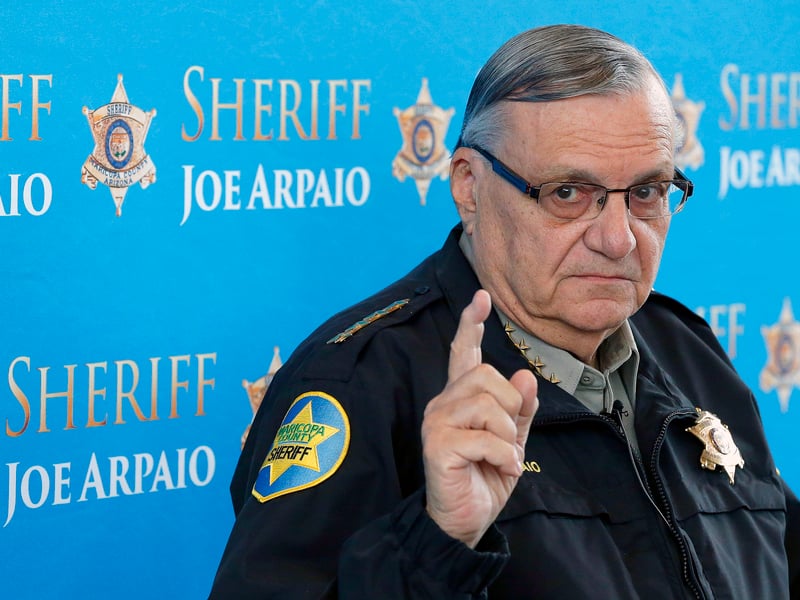
PHOENIX (CN) — The ball is now in the court of the Maricopa County Sheriff’s Office to reply to an audit suggesting it inflated costs related to complying with court orders in a long-standing racial profiling case by $160 million.
The sheriff’s office, under court orders to eliminate racial profiling and a backlog of internal investigations in a class action dating back to the days of “America’s Sheriff” Joe Arpaio, has 180 days to rebut an independent audit that found it overcounted public monies spent on compliance efforts — only if it so desires.
“I’m not gonna command you to do anything,” U.S. District Judge G. Murray Snow told an attorney from the sheriff’s office Tuesday. “The proposal you’ve suggested today sounds like nothing but cost upon cost.”
That proposal suggests the sheriff’s office hire its own experts to review the 97-page audit prepared by a court-appointed team of budget analysts and conduct discovery of all the data the audit team used — data provided directly from the sheriff’s office. That would trigger Snow, a George W. Bush appointee, to hire an attorney for the court-appointed monitor and the American Civil Liberties Union, representing the plaintiff class, to hire its own expert to refute the sheriff’s expert’s findings.
All of that would come out of the sheriff’s pocketbook, driving costs even higher and taking more time and resources away from compliance with preexisting court orders, Snow noted.
“This becomes the exact type of proceeding that I wanted to avoid by talking to you about this weeks ago,” Snow told Joseph Popolizio, a Jones, Skelton & Hochuli attorney representing the sheriff’s office. “That really wasn’t what I had in mind.”
Now more than 10 years and three sheriffs after Snow initially found Joe Arpaio and the Maricopa County Sheriff’s Office to have engaged in a pattern of racial profiling targeting Latino drivers and day laborers in the Phoenix valley, the department still has not complied with court orders by eliminating evidence of racial bias in their traffic stop data or by eliminating its own backlog of internal investigations concerning accusations of civil rights abuses, which only last year dipped below a thousand for the first time.
Recently, Republican officials, including County Attorney Rachel Mitchell and former congresswoman turned County Supervisor Debbie Lesko, have called for the end of the court orders, complaining that the cost of compliance has run the department dry and kept them from doing important police work.
“After 18 years, four different sheriff administrations, $300 million later, MCSO is still under the control of the federal court-appointed monitor thanks to ever-changing and over-extensive guidelines,” she said at a community meeting in July.
Though the sheriff’s office was never required to provide financial statements in its annual compliance reports to the court, it included costs in its 2023 and 2024 reports, prompting Snow to order an independent audit. That Oct. 8 audit found that, of the $226 million the sheriff’s office claims to have spent on complying with the court orders since 2014, $160 million was for regular police activity entirely unrelated to the case.
Some of those costs misattributed to the case included salaries of positions only partially or not at all related to compliance and supervisor positions not required by the court orders. Other expenses included $2.8 million for body-worn camera licenses, $1.5 million in office reservations, $11,000 for a golf cart and $3,000 for car washes.
“It suggests you’re not even close,” Snow said of the suggestion that the department has spent $300 million. “You have not justified your own expenses. They have no support.”
Snow said he tried to get specific expense information out of the department in 2024 the day after it submitted its annual report, including general costs.
“Maricopa County has never been able to provide that, have they?” he asked.
Popolizio said after the hearing that he’s unsure whether the sheriff’s office will move forward with responding to the audit report.
ACLU attorney Jennifer Borchetta argued that reviewing the audit would only waste time and continue to hurt the plaintiff class.
“The longer that this is not resolved, the longer that questions about the budget report can be used to undermine reforms in this case,” she said.
Popolizio said compliance efforts go on.
ACLU attorneys were unavailable for questions immediately after the hearing.
The sheriff’s office and the court-appointed monitor will host a community meeting Wednesday evening at the federal courthouse to update the public on its progress toward compliance. A member of the sheriff’s community advisory board told Courthouse News that it has questions for the sheriff regarding the audit report.
The sheriff’s office hasn’t replied to a request for additional comments.
 Follow @JournalistJoeAZ
Subscribe to our free newsletters
Our weekly newsletter Closing Arguments offers the latest about ongoing trials, major litigation and rulings in courthouses around the U.S. and the world, while the monthly Under the Lights dishes the legal dirt from Hollywood, sports, Big Tech and the arts.