
 Search Articles


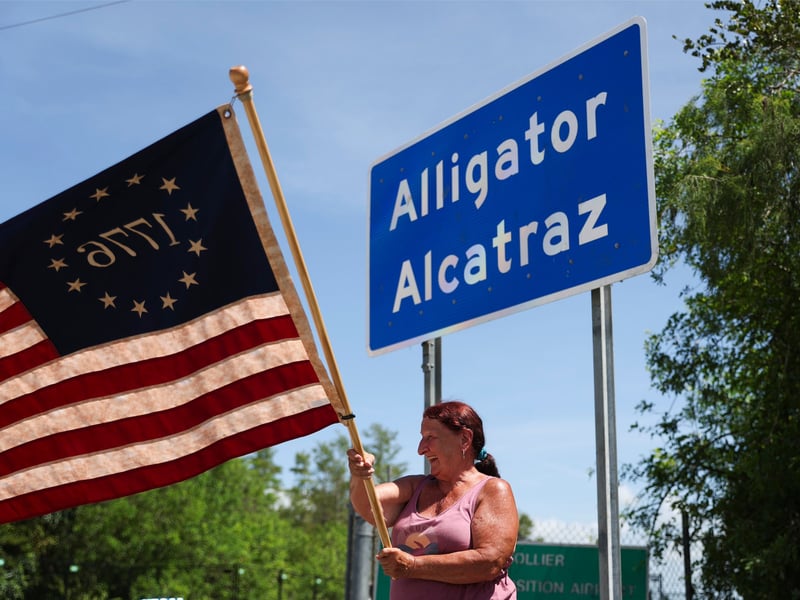
MIAMI (CN) — The Trump administration and Florida Governor Ron DeSantis scored a legal win in the fight over the state’s new migrant detention center dubbed “Alligator Alcatraz” when a federal judge threw out parts of a lawsuit targeting violations of immigrants’ legal rights.
In a 47-page decision, U.S. District Judge Rodolfo Ruiz ruled those detained at the facility now can plead their case to a Miami immigration court, rendering claims from attorneys decrying their clients’ lack of legal access as moot.
Ruiz, a Donald Trump appointee, also agreed with federal and state officials’ contention that the lawsuit was filed in the wrong jurisdiction and moved the federal case from the Southern District of Florida to the Middle District of Florida.
After weeks of federal immigration judges not willing to take cases from the detention center due to questions of jurisdiction, state officials designated the Krone Immigration Processing Center in Miami as the prevailing facility to hear immigrants contesting their detention.
That prompted the judge to dismiss the accusations of undue process in the decision issued late Monday night.
“Several developments have occurred since plaintiffs filed this case, requiring the court to consider whether some or all of Plaintiffs’ claims may be moot,” Ruiz wrote. “First, many of the detained plaintiffs have been transferred out of Alligator Alcatraz. Second, many of the detained plaintiffs (including those who have since been transferred out of Alligator Alcatraz) have received access to counsel, and all the attorney plaintiffs have received access to Alligator Alcatraz detainees.”
The American Civil Liberties Union and immigration advocacy groups brought the lawsuit against the U.S. Department of Homeland Security, U.S. Immigration and Customs Enforcement, DeSantis and other state officials in July, contending that those detained at the facility have not been able to contact their attorneys by phone or email.
Ruiz said that there was nothing more he could do about the plaintiff’s Fifth Amendment due process claims.
The plaintiffs had also claimed the few detainees who can use collect call pay phones only have a maximum of five minutes to speak on the recorded lines, violating attorney-client confidentiality. In addition, they say attorneys who travel to the detention center to meet with clients encountered hours-long wait times at an armed checkpoint, only to be turned away.
In an earlier court filing, and remarks to the judge at a Monday hearing, attorneys for the state acknowledged “initial delays” but said they were resolved.
“More meetings are taking place every day and there have been no complaints," state counsel wrote. “In fact, since the meetings began on July 15, the state defendants have granted every single request for a detainee to meet with legal counsel.”
However, Ruiz determined that the First Amendment claim of lack of confidential attorney-client communications can still continue, though he noted the fluid nature of the case.
“Alligator Alcatraz is a temporary detention facility, a waystation to federal immigration detention centers or to deportation,” Ruiz said. “Moreover, there is ample evidence in the record that certain plaintiffs’ claims have expired during the pendency of this litigation.”
But those claims will move to another judge, in the Middle District of Florida, he said.
“Plaintiffs have consistently maintained that the alleged barriers to counsel and inability to engage in confidential communications have taken place at Alligator Alcatraz, which is not in this district,” Ruiz wrote of the Southern District.
Kevin Guthrie, director of the Florida Division of Emergency Management, who is named in the suit, has maintained that the detention facility lies in Collier County, which falls under the Middle District.
“Within the site, only a tiny sliver of unpaved runway is situated in Miami-Dade County,” he said in a recent court filing. “No portion of the detention facility lies on that sliver of extended runway.”
In a statement, ACLU attorney Eunice Cho said “It should not take a lawsuit to force the government to abide by the law and the Constitution. We look forward to continuing the fight.”
Two months ago, in response to President Donald Trump’s immigration crackdown, DeSantis and Florida Attorney General James Uthmeier proposed the idea of a detention center in the Everglades and used emergency powers to acquire the Dade-Collier Training and Transition Airport, a small runway surrounded by the Big Cypress National Preserve and Everglades National Park.
Within days, trucks carrying prefabricated housing, generators, security lighting and fill dirt entered the area and workers hastily set up tents and trailers to house those arrested by immigration authorities and state law enforcement.
Trump visited the facility on July 1 — the day before the first detainees arrived — and told reporters, “We’re going to teach them how to run away from an alligator if they escape prison.”
Since then, environmental activists, indigenous tribes, Democratic state lawmakers and members of Congress have decried the detention center as inhumane and detrimental to the ecosystem, pointing to reports of flooding, pest infestations, sewage backups and light pollution.
The detention center faces another lawsuit accusing the government of violating federal environmental law. Another Miami federal judge granted a request to halt construction on the grounds last week. But U.S. District Judge Kathleen Williams has yet to rule on a venue change for that lawsuit.
 Follow @alexbpickett
Subscribe to our free newsletters
Our weekly newsletter Closing Arguments offers the latest about ongoing trials, major litigation and rulings in courthouses around the U.S. and the world, while the monthly Under the Lights dishes the legal dirt from Hollywood, sports, Big Tech and the arts.