
 Search Articles


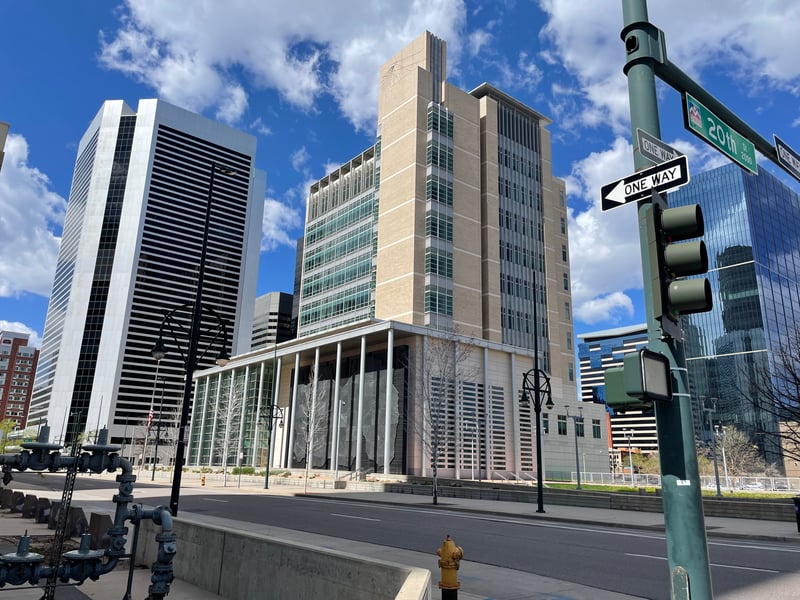
DENVER (CN) — A federal judge on Friday sentenced a Gambian Jungler to nearly 68 years in prison after a U.S. jury found him guilty of six charges related to torturing people under orders from his country’s president during a 2006 coup attempt.
“Justice in this case is not only about a sentence, but restoring faith in the rule of law,” said Senior U.S. District Judge Christine Arguello.
Tried before a Denver jury in April, Michael Sang Correa, 46, was found guilty on five counts of torture and one count of conspiracy for acts committed in The Gambia following a failed coup under the country’s former president, Yahya Jammeh. Jammeh ordered Correa and other members of his special forces unit, the Junglers, to arrest and torture those believed to have organized the attempted takeover.
“Joining the Junglers set you on the wrong path,” said Arguello, a George W. Bush appointee. “You continued down that path and chose to torture your fellow citizens which you knew was immoral and criminal.”
Correa’s defense had requested a sentence of seven years, while federal prosecutors argued for 20 years per count to run consecutively, adding up to 120 years in prison. Arguello ultimately adopted an aggregated assault template for calculating the sentence of 135 months per count, and criticized the government for picking a number that had no real-world relevance.
U.S. Attorney Melissa Hindman defended her calculation but said she was satisfied with anything that represented a life sentence for Correa.
Home to 2.4 million people, The Gambia follows its eponymous river through West Africa, where it borders Senegal and the Atlantic Ocean. The former British colony gained independence in 1965.
The Junglers were also called the Black Blacks, for the color of their uniform and the way they instilled fear. To obtain confessions, Correa and other Junglers strung their victims from trees in bags and beat them. Correa electrocuted the victims, stabbed them with a bayonet, burned cigarettes on their skin, poured molten plastic on their legs and rubbed sand in their eyes.
Several surviving victims of Correa’s torture — Yaya Darboe, Pharing Sanyang, Demba Dem and Tamsir Jasseh — traveled to testify and address the court ahead of sentencing.
“This is not a distant memory, I still relive it,” said Jasseh, a veteran of the U.S. Navy who returned to his native country in hopes of building up the Gambian police force. “It was not President Jammeh we feared, it was the Junglers.”
Jasseh said he wasn’t involved in the plotting of the 2006 coup but drove the movement’s architect, Colonel Ndure Cham, to the Senegal border to escape.
After enduring the Jungler’s torture, Jasseh was convicted of treason by the Gambian court and sentenced to 20 years of hard labor. At the urging of American activist Reverend Jesse Jackson, however, Jammeh released Jasseh in 2012, allowing him to return to the U.S.
“Now the time of fear is over,” Jasseh said. “This is the era of accountability.”
Jammeh held power from 1994, after leading a coup against former President Dawda Jawara, until he lost reelection in 2016 and fled the country the following year. Throughout his tenure, U.S. prosecutors say Jammeh ruled over the country as a dictator, arresting and torturing those who opposed him while suppressing the media and other critics.
Correa initially entered the U.S. while accompanying his country’s vice president. When Jammeh fell from power after losing the 2016 election, Correa tried to remain in the U.S.
After U.S. Customs and Immigration Enforcement detained Correa in 2019, the Gambian government and several American senators petitioned the U.S. Department of Justice to file criminal charges against him under the legal doctrine of universal jurisdiction.
Wearing a brown jumpsuit, a belly chain and handcuffs, Correa apologized to his victims and asked for forgiveness to bring them peace.
Correa choked on his words as he addressed the widow of Pierre Mendy, who had traveled to the U.S. to speak on his behalf.
Correa tortured Mendy, who had been President Jammeh’s bodyguard and passed away in 2021. His wife Elizabeth recalled that when she paid the prison guards to give him better food, Mendy gave it all away, and asked her to bring more.
“Pierre was in my unit,” Correa said. “I have love for that man, he is still in my heart and I am going to die with that.”
Ultimately, Correa said did not deny the torture he inflicted on the victims, adding only that “it was a question of life or death.”
He asked the judge to allow him a chance to return to his family — a request she denied, noting he is unlikely to live to 113.
Federal public defender Matthew Belcher said he would appeal, calling the sentence “procedurally and substantially unreasonable.”
According to the Center for Justice and Accountability, other Junglers have faced prosecution abroad, including Bai Lowe, who was sentenced to life in prison after being convicted by a German court in 2023. Following a Swiss trial last year, former Interior Minister Ousman Sonko was convicted and sentenced to 20 years in prison.
 Follow @bright_lamp
Subscribe to our free newsletters
Our weekly newsletter Closing Arguments offers the latest about ongoing trials, major litigation and rulings in courthouses around the U.S. and the world, while the monthly Under the Lights dishes the legal dirt from Hollywood, sports, Big Tech and the arts.