Search Articles


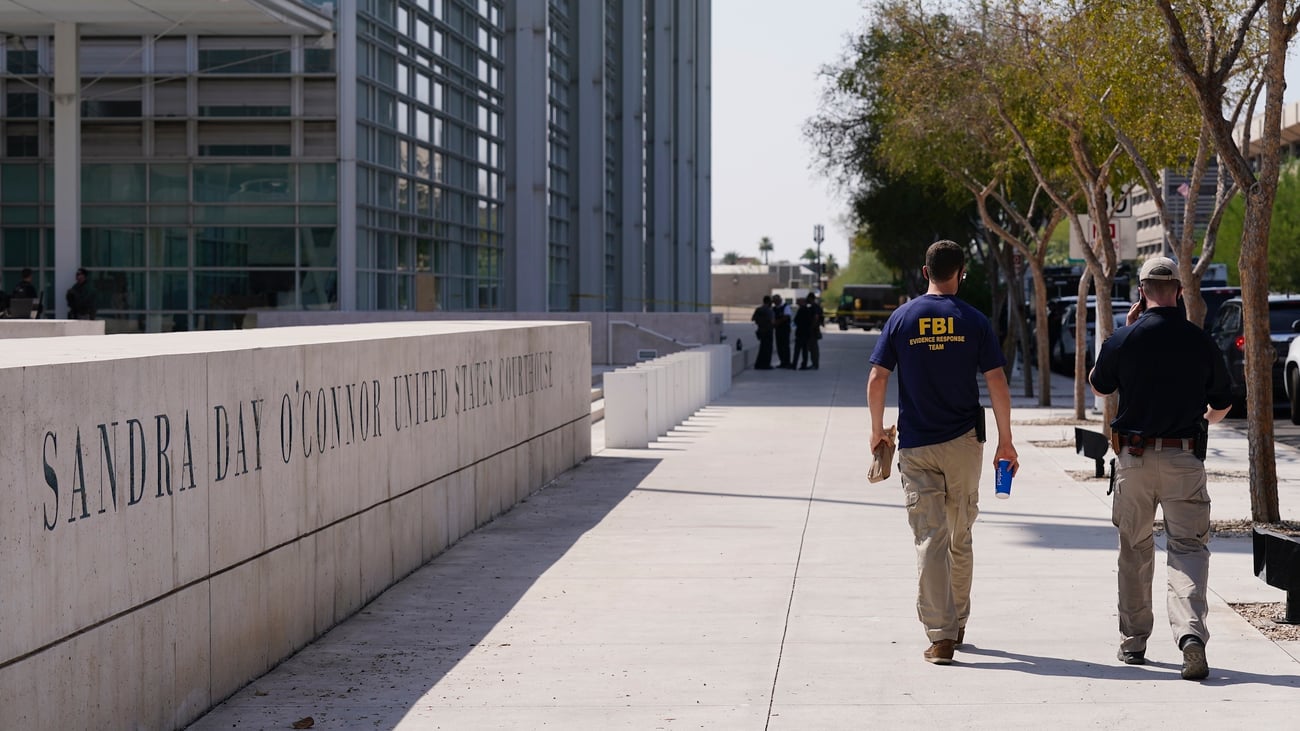
PHOENIX (CN) — Whether a Phoenix police officer lied about Jamaar Williams assaulting him and resisting arrest is now for six jurors in Phoenix federal court to determine.
In closing statements on the fifth day of Williams’ malicious prosecution trial against the city of Phoenix, his attorney Christopher Madeksho said there’s no evidence his client did either.
Williams, a local attorney and activist, called three police officers present at the July 12, 2019, protest at which he was arrested to corroborate the story of officer Darrell Magee, who said Williams shoved him in the chest and pulled away when Magee grabbed his arm.
Lt. Benjamin Moore, who commanded the tactical response unit deployed to manage the protest, said he didn’t see the altercation and “couldn’t tell you either way.”
Joseph Gage, who stood behind Magee on the skirmish line pushing Williams and other protesters on the sidewalk on Central Avenue that night, said he saw a struggle in the corner of his eye but couldn’t tell what was going on.
Francisco Barrios, who wrote the initial probable cause affidavit as orated to him by Magee after Williams was later arrested by another officer, said he never saw what Magee described to him, and never made an attempt to verify the truth.
“Well, if he lied then there should be punishment,” he said on the witness stand this week.
He also acknowledged if an officer didn’t want to testify at a preliminary hearing, that officer would ask another to write the report for them.
Williams sued in 2020, claiming Magee made intentionally false statements to support Williams’ prosecution.
“If he was telling the truth, he would have written the statement himself and would have testified at the preliminary hearing himself,” Madeksho told the jury Friday morning.
A state judge dismissed the charges at that preliminary hearing after learning that Barrios had not witnessed the events himself and that Barrios saw video of a “caucasian male” engaged in the exact behavior Magee had attributed to Williams, who is Black.
“He presented false information that ended up in the hands of Deputy County Attorney Jeremy Miller,” Madeksho said. “Officer Magee misled Deputy County Attorney Jeremy Miller. Because of that, there was a finding of no probable cause, thankfully.”
Lori Berke, defending Magee, blamed the county attorney for not subpoenaing Magee.
“So the judge dismissed the charge without prejudice so the prosecutor could refile the charges and bring Mr. Magee in to testify,” she said.
She argued Magee couldn’t have acted with malice because he never recommended that Williams be charged with resisting arrest, only aggravated assault, which was dropped before the hearing. Miller chose to pursue resisting arrest charges on his own.
Berke asked the jury what Magee would have to gain by lying about one of many people protesting that night.
On rebuttal, plaintiff attorney Mart Harris answered “his safety.”
After Williams’ wife, Heather Hamel, is pushed to the ground, video shows Williams asking Magee if he had ever been sued before.
“He knew Mr. Williams is a lawyer,” Harris told the jury. “He said he found that out later that night.”
Harris said Williams knew better than to throw away his legal career by pushing an officer surrounded by dozens more.
After Magee pushed Williams back toward the sidewalk, seen on grainy police surveillance video difficult to discern, Madeksho said Magee told him to “get back.”
“Not ‘hands in the air,’” Madeksho said. Not ‘you’re under arrest.’ Not ‘stop resisting’. There was no attempt to arrest Jamaar Williams.”
Madeksho said Magee changed his story too many times between the incident and the last day of trial to be considered trustworthy.
Magee said in his supplemental report that he pushed Jamaar Willaims to effectuate an arrest. But when asked directly by a juror why he pushed Williams, he said officers were given instructions to move protesters back onto the sidewalk.
“It’s a different answer than any reasons he’s given before for seven years,” Madeksho said.
Harris added Magee said in his deposition that the surveillance video was too blurry to see, but said on the witness stand that he could clearly see Williams shove him in that same video.
“Memories fade,” Harris said. “Over a few days, his memory got better? Over seven years, his memory and apparently his vision got better?”
Williams asked the jury for $7 million in compensatory damages and $21 million in punitive damages.
“A small punitive damages award teaches nothing,” Madeksho said. “Give them a reason. Make it known that if an officer makes false statements there will be consequences.”
The jury took the case Friday afternoon.
 Follow @JournalistJoeAZ
Subscribe to our free newsletters
Our weekly newsletter Closing Arguments offers the latest about ongoing trials, major litigation and rulings in courthouses around the U.S. and the world, while the monthly Under the Lights dishes the legal dirt from Hollywood, sports, Big Tech and the arts.