
 Search Articles


WASHINGTON (CN) — Concerned about chaotic post-election litigation, the Supreme Court seemed open Wednesday to making it easier for political candidates to challenge election rules.
“What you’re sketching out for us is a potential disaster,” Chief Justice John Roberts told Illinois’ solicitor general.
Illinois said candidates must prove an election rule was harmful to bring a court challenge, but most of the justices were concerned the requirement would limit election litigation to high-profile, close cases that pressure courts to intervene in the days and weeks around Election Day.
“You’re saying, if the candidate is going to win by 65%, no standing, but if the candidate hopes to win by a dozen votes … then he has standing,” Roberts, a George W. Bush appointee, told Illinois’ solicitor general. “But we’re not going to know that until we get very close to the election, so it’s going to be the most fraught time for the court to get involved in electoral politics.”
U.S. Representative Michael Bost, a Republican from Illinois, said the court could avoid that result by loosening the requirements for candidates to bring lawsuits.
“There is a better way, and it simply requires acknowledging that candidates have a unique, concrete and particularized interest in the rules of the electoral road, especially those that address which ballots are going to be counted and when,” said Paul Clement, an attorney with Clement & Murphy representing Bost.
Bost tried to challenge Illinois’ mail-in ballot deadline in 2022, but the lower courts ruled that he didn’t have standing — a legal term for the injury requirement needed to bring a lawsuit. Bost urged the justices to grant all candidates standing to challenge election rules, arguing they should always have standing to sue over election rules.
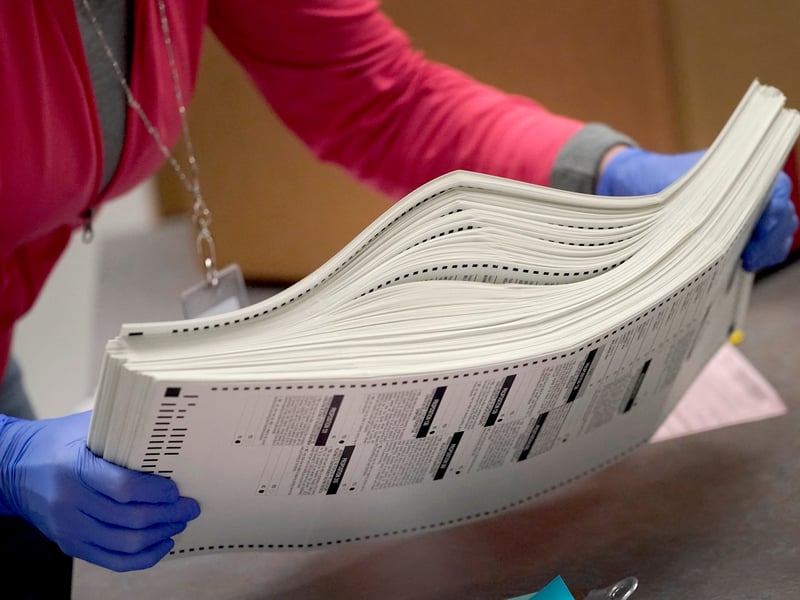
Illinois accepts and counts mail-in ballots up to 14 days after an election if the ballots are postmarked by Election Day. Bost claims the rule violates federal statutes setting the time, place and manner of federal elections.
The only question before the Supreme Court was whether Bost had standing to challenge the mail-in ballot rule — not whether the rule itself was lawful. Illinois argued that Bost needed to show that the ballot deadline hurt his electoral chances.
But the justices appeared more receptive to Bost’s arguments, worrying that parsing the degree to which a rule impacted a candidate’s success in a race was too political.
“Is there something unseemly about federal courts making prognostications about a candidate’s chance of success immediately before an election that itself might influence the election?” Justice Neil Gorsuch, a Donald Trump appointee, asked.
Justices Sonia Sotomayor and Ketanji Brown Jackson broke with their conservative colleagues. Sotomayor, a Barack Obama appointee, said lowering standing requirements for candidates could unnecessarily open election rules up to litigation.
“[Bost’s] rule would say that that candidate who has not just an insubstantial but a statistically almost impossible chance of winning, that that candidate can come in and seek a change of that rule,” Sotomayor said.
Bost argued that candidates always have standing because they are regulated by election rules. Jackson disagreed, stating voters were the regulated party.
“When you’re talking about an election, it’s not the candidates who are the object; it is the voters,” Jackson said. “What an election is is the opportunity for the people to decide who are going to govern them. And so, in that context, one could argue that the voters would be able to make the same kind of grievance that you say is particular to the candidate here.”
Justice Elena Kagan, an Obama appointee, seemed to take a middle ground, expressing concern about post-election litigation timelines while also finding issue with Bost’s complaint specifically.
“I think [Bost] could show standing — whether he did show standing is another thing entirely,” Kagan said. “This is a complaint that sort of seems a little bit to be created in order to test ‘I don’t have to show injury at all’ theory.”
Kagan said creating a candidate-only carve out in the court’s standing doctrine was inconsistent with precedent. Justice Amy Coney Barrett seemed concerned about the broader impact of lowering standing requirements.
“We don’t fashion bespoke rules for standing in particular contexts,” Barrett, a Trump appointee, said, questioning how ruling in Bost’s favor would spill over into other litigation.
Bost suggested the court could avoid muddying the waters over standing in other contexts, but it was unclear how the court might do so.
 Follow @KelseyReichmann
 Follow @kelseyreichmann.bsky.social
Subscribe to our free newsletters
Our weekly newsletter Closing Arguments offers the latest about ongoing trials, major litigation and rulings in courthouses around the U.S. and the world, while the monthly Under the Lights dishes the legal dirt from Hollywood, sports, Big Tech and the arts.